
As onchain systems grow up, the way privacy is discussed is changing. It’s no longer mostly about ideology or personal preference. It’s becoming a practical issue. Financial systems simply don’t work when every position, relationship, and strategy is exposed by default. Dusk is built with that reality in mind. It doesn’t treat privacy as a way to avoid oversight. It treats privacy as the condition that makes oversight possible without breaking participation.
Early blockchains assumed that transparency would automatically produce trust. If everything was visible, bad behavior would be obvious. That idea held when systems were small and experimental. As more value moved onchain, the cracks showed. Public exposure of balances, counterparties, and strategies is something traditional finance would never accept. Dusk starts from that uncomfortable truth instead of working around it.
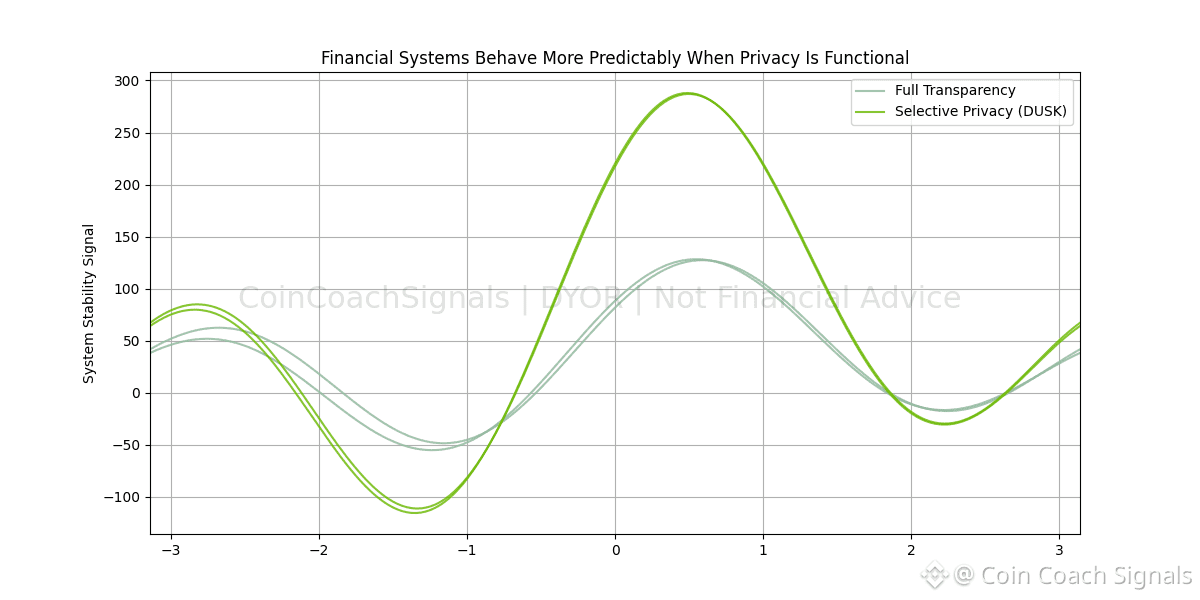
The important shift is how Dusk separates visibility from verification. Financial systems don’t need everyone watching everything all the time. They need to be able to prove that rules are being followed. On Dusk, transactions and asset states can stay private by default, while still being provable when verification is required. That’s how audits actually work in practice. The difference is that Dusk replaces human discretion with cryptographic proof.
This changes how accountability shows up onchain. On transparent networks, accountability usually comes after the fact. Something goes wrong, and everyone can see it. Dusk moves accountability earlier. Rules are enforced during execution. Contracts operate on confidential data but behave predictably. If something violates the rules, it simply doesn’t execute. The system prevents problems instead of just exposing them.
For developers, this creates a very different environment. Applications aren’t built for maximum openness or fast composability. They’re built to behave correctly under constraints. Permissions, eligibility, and disclosure rules can be enforced directly by the protocol. That makes it possible to design systems that expect regulatory interaction without relying on offchain processes or trusted gatekeepers.
Tokenized assets make this especially clear. Real-world assets aren’t static tokens. They come with ongoing obligations. Ownership may need to stay private. Transfers may need conditions. Disclosures may only apply in certain situations. Dusk supports this natively. Assets don’t just exist. They follow rules over time, not just at issuance.
The ecosystem forming around Dusk reflects that mindset. Teams aren’t chasing attention or quick experiments. They’re building issuance frameworks, regulated DeFi structures, and settlement layers that assume scrutiny from the start. These builders expect audits. They expect rules to change. Their systems are designed to keep working as oversight increases, not fall apart under it.
Dusk also takes a different view of decentralization. Decentralization isn’t the absence of structure. Financial systems need structure. The real question is who enforces it. On Dusk, enforcement is handled by code, not discretion. Rules apply the same way to everyone. That reduces reliance on intermediaries without pretending boundaries don’t exist.
This makes institutional participation more realistic. Many organizations are open to onchain systems, but not if participation means full public exposure. Dusk lowers that barrier. Confidentiality doesn’t disappear, and oversight doesn’t disappear either. Verification happens when needed, not constantly.
Because of this, growth looks different. Dusk isn’t built to attract speculative capital with incentives or narratives. It appeals more to participants who care about predictability, privacy, and legal clarity. That kind of adoption is slower, but it tends to stick. It grows through integration, not hype.
Technically, Dusk uses zero-knowledge proofs carefully. The goal isn’t to show off complexity. It’s to remove ambiguity where it matters. Proofs are used where they reduce risk, not everywhere they can be used. That discipline matters, because financial systems punish both shortcuts and overengineering.
As the crypto space matures, the limits of transparency-first design become harder to ignore. Enterprises testing onchain settlement hit confidentiality issues almost immediately. Regulated markets require selective disclosure by default. Dusk doesn’t retrofit these ideas later. They’re part of the starting assumptions.
What stands out most is consistency. Dusk doesn’t chase narratives. It doesn’t pivot into unrelated problem spaces. Privacy stays selective. Compliance stays native. Enforcement stays automatic. Over time, that consistency builds credibility, especially with participants who care more about longevity than speed.
Dusk isn’t trying to make onchain finance louder or more visible. It’s trying to make it usable under real conditions. That takes patience, and it means accepting that some problems don’t have fast solutions. As decentralized systems move closer to real financial responsibility, that approach stops being optional.
Dusk is building for integration, not escape. Quietly, deliberately, and with the understanding that privacy isn’t a loophole. It’s a requirement if serious financial systems are going to work at all.
For educational purposes only. Not financial advice. Do your own research.
@Dusk $DUSK #Dusk #dusk
