
The majority of cryptocurrency investors discover the same thing the hard way: while blockchains excel at transferring value, they are appalling at preserving actual content. A fundamental issue arises when you get beyond straightforward transactions, such as NFT art files, gaming assets, AI datasets, social media media, legal records, and research archives: where does the actual data reside, and will it still be there in years? Walrus is specifically attempting to close that gap. Compared to conventional Web3 storage solutions, Walrus is a decentralized "blob" storage network built for long-term, large-file storage.Walrus views storage as essential infrastructure that apps can rely on rather than something users have to worry about all the time, as opposed to a disorganized afterthought. The team behind Sui, Mysten Labs, first presented it as a storage and data availability protocol. A developer preview was released in June 2024, and on March 27, 2025, the public mainnet was launched. This date was significant because it signaled the transition from experimental rollout to actual production usage with mainnet economics.
It is helpful to consider Walrus from the perspectives of both an investor and an app developer in order to comprehend its significance. Narratives are important to investors, while friction is important to builders. Even though the "storage narrative" has been around for a while, many solutions still seem difficult to implement: upload data, obtain a content identification, and hope that enough nodes will sustain it.and frequently depend on third parties or paid pinning to ensure permanence. Walrus aims to create a more application-friendly approach by storing vast amounts of unstructured content, including photos, videos, PDFs, and datasets, and making them programmable, verifiable, and retrievable without requiring reliance on a single hosting provider. According to Walrus literature, the protocol uses advanced erasure coding instead of full replication in order to keep costs down. To put it simply, some nodes become unavailable. In this method, Walrus estimates the storage cost to be about ~5× the blob size, which is still redundant but significantly less expensive than naive complete replication over numerous participants. This is important since storage is not a one-time expense; "permanent storage" only functions when the economics are long-term viable.
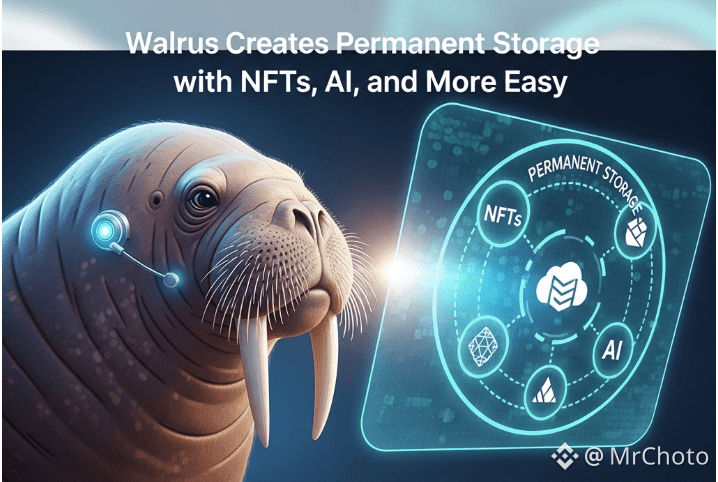
The combination of NFTs, AI, and "data markets" is where Walrus becomes most intriguing—beyond the typical Web3 storage sell. Minting an NFT without durable data is like purchasing a framed art label when the picture is in a room you don't control. This is the clearest illustration of the storage issue.In the past, many NFT programs depended on centralized hosting or kept metadata off chain; when links fail, the NFT becomes a broken promise. By facilitating decentralized media and information storage that can be accessed long after the original buzz cycle passes, Walrus directly addresses that suffering. The transition from "collectible that points somewhere" to "collectible whose content can realistically survive" is a significant change for NFT architecture. As AI apps become more on-chain adjacent (for provenance, payments, and coordination), the storage issue becomes even more significant. Models require data, and agents require memory. To put it another way, Walrus is saying "store files in a way apps can build business logic around," not just "store files."
Walrus's long-term engagement story appears more compelling from a technical investment perspective than rapid launch projects since it is supported by formal design and thorough study. Reducing the cost of maintaining data while maintaining good security assurances even under real-world conditions like node churn and network latency is a goal described in the Walrus whitepaper work that is easy to understand even for cryptography experts. Because "proof of storage" is meaningless if cheaters can fabricate availability, the protocol's main research proposes a two-dimensional erasure coding technique (commonly referred to as "RedStuff") and designs around challenge detail. These phrases may not be important to traders on a daily basis, but investors should: infrastructure networks fail because the incentives and verification aren't strong enough under pressure, not because of marketing.What does the phrase "Walrus makes permanent storage simple" actually mean? It indicates that the goal of the product is to lessen the mental strain on both the builder and the consumer. If you're an NFT artist, permanence means you won't have to worry about your work vanishing. When developing an AI application, permanence ensures that the dataset of your agent does not disappear due to a service outage. Permanence in gaming refers to the availability of assets over seasons and communities, rather than being lost as a result of a single hosting provider's conditions changing. The more you examine it, the more storage turns into a covert requirement for practically every cryptocurrency industry: RWAs require paper trails, DePIN requires telemetry archives,AI requires data, and social dApps require media. These systems inherit centralized fragility when they depend on centralized storage. According to Walrus's prediction, permanent and verifiable storage will become standard infrastructure as Web3 develops, just like exchanges did following the initial wave of tokens or stablecoins did following the initial wave of DeFi.
The true lesson for traders is not that "storage is exciting." Seldom is storage exciting. The lesson is that markets frequently misprice uninteresting infrastructure at first, then overpay once demand is clear. In terms of how long "data-heavy crypto" themes like NFTs and AI can last, Walrus is still early in the adoption curve, having debuted its public mainnet in March 2025. Durable data storage becomes less of a specialty market and more like necessary plumbing if the next cycle is even more media and AI-driven, as present trends indicate. program, but hoping to establish itself as a default storage layer on which several applications rely covertly. The loudest projects in cryptocurrency receive the most attention, but the deepest value frequently builds up in the rails that are eventually needed by everything else. @Walrus 🦭/acc #walrus $WAL

