Walrus began as an attempt to solve a simple but stubborn problem: how to store very large, unstructured files videos, datasets, models, game assets in a way that is censorship resistant, affordable, and practical for real-world applications. Rather than trying to make every blockchain node hold a complete copy of every file, Walrus splits each file into encoded pieces and places those pieces across a network of independent storage nodes, while relying on the Sui blockchain as a lightweight control plane that manages discoverability, payments, node lifecycles and proofs of availability. This separation blobs for the heavy data and the blockchain for coordination is central to Walrus’s design and is what lets the system aim for both efficiency and strong fault tolerance.
Walrus 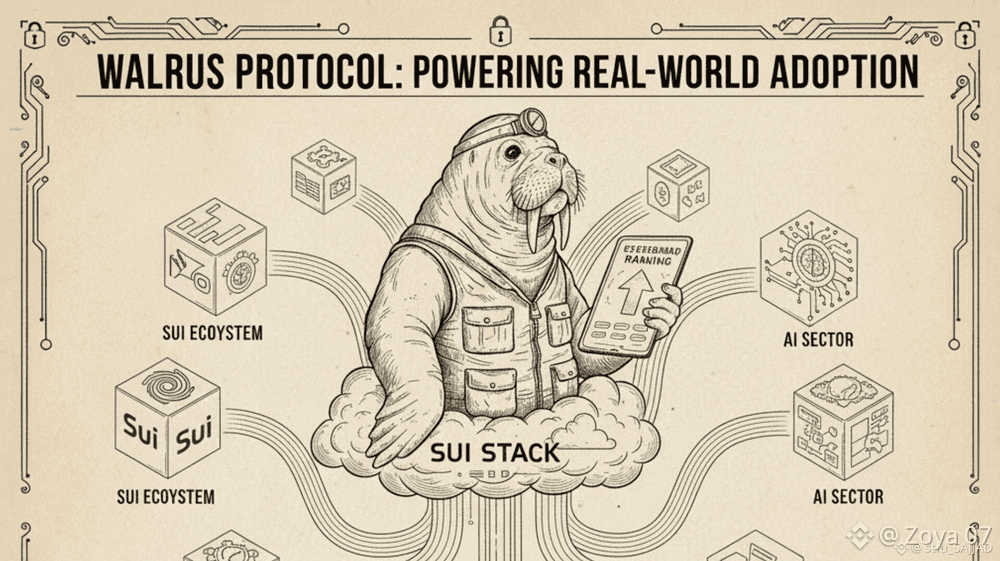
Under the hood Walrus uses erasure coding in an especially practical form. Instead of full replication, files are converted into many small encoded shards using a twodimensional erasure scheme the project calls “Red Stuff.” The idea is to get the reliability of replication while paying far less in storage overhead and to permit very fast recovery even when many nodes are missing or malicious. Red Stuff and the overall blob architecture let Walrus scale to hundreds of storage nodes per blob, which improves resilience against node failures and reduces the per-byte cost of keeping data available. The Walrus whitepapers and technical notes explain that this approach was chosen because it balances recovery speed, storage efficiency, and simplicity for builders who must integrate large files into onchain workflows.
Alberto Sonnino +1
Sui is not an accidental choice for Walrus. The protocol treats Sui as the system of record for metadata and economic state while avoiding forcing Sui validators to carry the heavy blob payloads themselves. Operations that create, update, or delete blobs are represented on Sui so that indexing, discovery and payments are auditable, composable and permissionless; the heavy lifting storing and serving the encoded parts happens off-chain on storage nodes that speak the Walrus protocol. This architecture makes it straightforward for dApp developers to reference large off-chain assets in onchain workflows without bloating the blockchain itself, and it allows Walrus to leverage Sui’s cheap, fast transactions for lifecycle management. For builders this means uploads, proofs of availability, and accounting can be integrated with smart contracts and agent systems while keeping bandwidth and storage costs manageable.
Alberto Sonnino 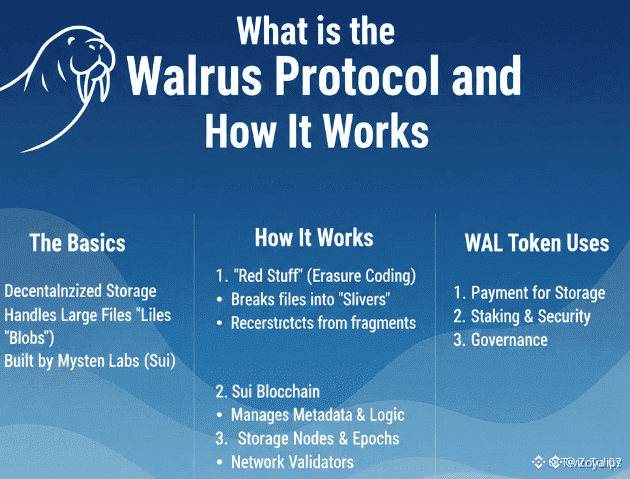
The WAL token is the economic lubricant that the Walrus system uses to make storage payments predictable and to align incentives between users, storage node operators and stakers. When users pay for storage they do so in WAL, typically prepaying for a fixed time window; those payments are then distributed over time to the nodes that serve the encoded parts as compensation. The protocol design includes mechanisms to smooth out fiat-denominated cost targets so that a user buying storage today does not get exposed to the full short-term volatility of the token. In addition to payments, WAL is used for staking and governance primitives in the Walrus roadmap, creating a natural incentive for operators to stay honest and for token holders to participate in network decisions. These token economics are documented in Walrus’s token page and developer materials.
Walrus +1
The project also pursued rapid ecosystem integration and developer feedback early on. A developer preview and testnet tools were released to let Sui builders experiment with storing large assets and to gather operational telemetry. Partnerships and integrations followed the preview phase, with teams building on Walrus for onchain AI agents, decentralized websites, and tooling like provenance builders and GitHub Actions that simplify deploying Walrus-backed sites. The fundraising story and investor interest including a sizable private sale reported in mainstream crypto press ahead of wider launches reflect that institutional players see decentralized blob storage as a necessary layer for emerging onchain use cases like agent-driven automation and AI data markets.
Mysten Labs +2
For developers there are several concrete projects and repos to explore: the Walrus core and node software, documentation repositories, and curated lists of Walrus related tools such as site builders and automation bots. These resources make it possible to run a storage node, experiment with encoding and retrieval, and deploy “Walrus Sites” that serve static content directly from the decentralized layer. The availability of example tooling shortens the path from concept to production and encourages experimentation for example, composing storage with onchain agents or building marketplaces that sell access to large data assets.
GitHub +2
From a market point of view WAL is traded on multiple centralized exchanges and listed on market aggregators, so price discovery and liquidity exist for traders and integrators who need to buy or hedge storage costs. Market listings also make it easier for projects to obtain tokens for incentive programs, developer bounties, or storage rebates. That said, token markets are volatile and any operational budgeting that depends on WAL should consider hedging and cost smoothing approaches that the protocol itself recommends.
CoinGecko +1
Walrus’s real promise comes into focus when you picture concrete applications: an AI startup that needs to store terabytes of training data and make parts of it cheaply retrievable for onchain agents, a censorship resistant publishing platform that serves downloadable media from a decentralized edge, or gaming studios that host large asset packs referenced directly from smart contracts. Those scenarios highlight Walrus’s main engineering trade-offs: you get much lower replication overhead and faster recovery compared with naive replication schemes, you keep onchain state small and auditable, and you inherit composability with Sui’s smart contracts. At the same time, the system inherits real-world challenges: node availability and geographic distribution matter for latency, economic mechanisms must be carefully stress-tested to avoid long term inflationary or monopolistic dynamics, and developer ergonomics (APIs, SDKs, and integrations) determine how fast the broader ecosystem adopts the layer. The project documentation and whitepapers are candid about these trade-offs and describe the experiments and benchmarks the team ran to validate the design choices.
Walrus Docs +1
Looking ahead, growth for Walrus will be driven by adoption across projects that need an offchain data layer tightly integrated with smart contracts and agents. That growth depends not only on the robustness of Red Stuff and the node network but also on easy onboarding for storage node operators, clear economic primitives for long-term storage payments, and an active community building real use cases. If those elements come together, Walrus could become a common backend for many classes of dApps that today either use expensive centralized clouds or accept the limitations of light weight decentralized storage. The team’s published roadmap, blogs, and technical repos remain the best places to track progress, and the project’s public materials and press coverage give a reasonably detailed view into both the architecture and the business plan.