
Dusk Foundation tightens when delivery settles and payment is forced to wait behind it.
I’ve watched this one land badly in a real flow. Delivery final, confirmations green, everyone already speaking in past tense—then the payment leg just sits there, untouched, because the execution window it needs isn’t the one that just closed.
Nothing is broken. That’s what makes it uncomfortable.
On Dusk, Delivery-versus-Payment isn’t something humans reconcile after the fact. The delivery leg clears under a specific execution context. Ownership flips. Dusk's Deterministic finality lands. The payment leg doesn’t get to ride that momentum. It evaluates its own conditions at execution time, not intent time, not preparation time.
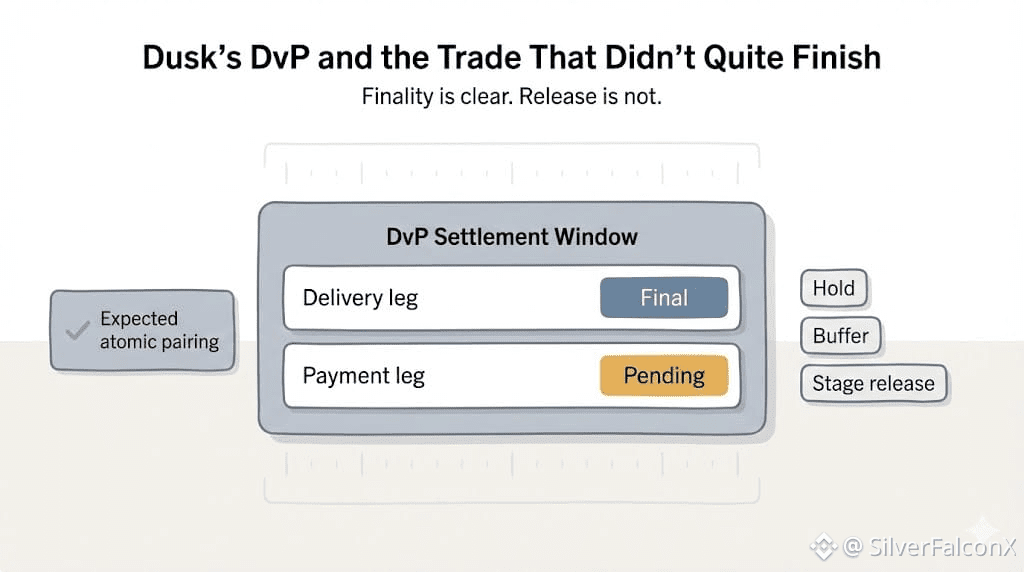
Sometimes those windows don’t overlap.
That’s when the system stops being polite.
The delivery is done. The payment is eligible in every way except one that matters now. On other infrastructure, this is where someone releases funds early and tells themselves the system will catch up. If it does, the shortcut disappears from memory. If it doesn’t, the blame gets distributed across time.
Dusk doesn’t distribute it.
The payment leg doesn’t inherit certainty just because the delivery looks clean. It waits because its own rule set hasn’t cleared. No courtesy transfer. No partial atomicity. Just a stalled second half that refuses to pretend the first half solved everything.
Privacy makes the wait louder.
There’s no public queue to point at, no visible crawl toward completion. From the outside, it looks like nothing happened. Inside, capital is split across two states that operators don’t like holding apart—one final, one pending, neither reversible without consequence.
That gap eats time in a way dashboards can’t explain.
Payment windows get missed. Counterparties ask which side “counts” for reporting. Ops ends up explaining why finality didn’t unlock funds when finality is supposed to mean closure. There’s no incident response because nothing violated the rules. The rules are the problem.
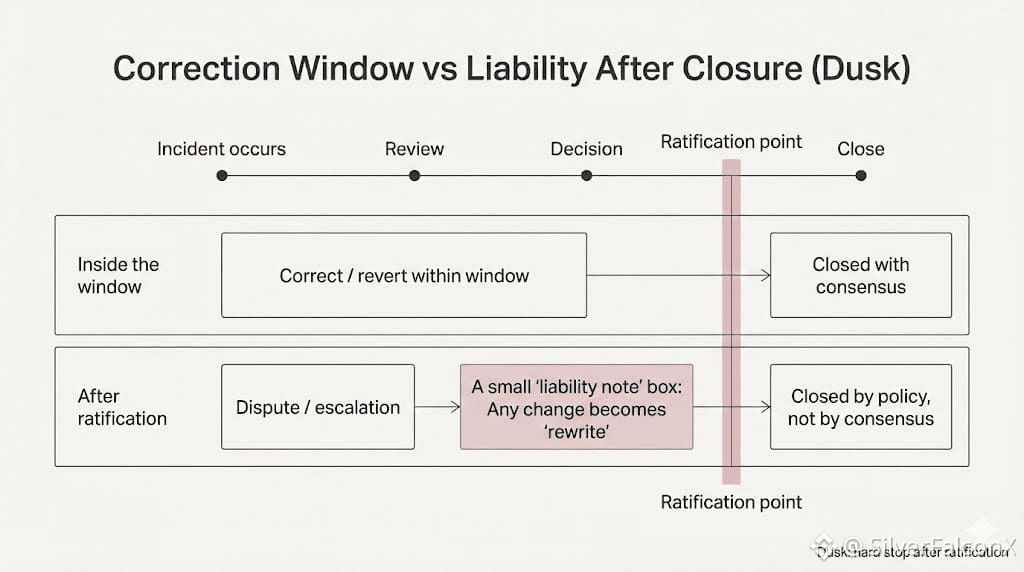
DvP here isn’t forgiving. It’s synchronized or it doesn’t happen.
Flows built on “we’ll settle the other side in a minute” start failing quietly. Schedules tighten. Buffers get real. Anything that depended on human smoothing between legs gets exposed the first time timing slips.
Dusk doesn’t rush to resolve that tension.
It leaves delivery where it landed and payment where it stopped, waiting for the next execution window to decide whether the two can meet again—or whether everyone has to unwind and try differently. #Dusk
