

Blockchain networks, particularly Ethereum, face persistent challenges around scalability. High network congestion, slow transaction processing, and elevated gas fees can hinder both user experience and adoption. Plasma, a Layer-2 scaling solution, addresses these challenges by offloading transactions from the main chain while maintaining security and decentralization.
Transaction Volume Capabilities
Plasma operates as a high-speed, low-fee layer-2 framework, designed to increase Ethereum’s transaction throughput significantly. By processing transactions on child chains—secondary chains anchored to the main blockchain—Plasma enables multiple independent transaction streams, reducing pressure on the root chain. This architecture can boost Ethereum’s transaction capacity to 1,500 transfers per second or higher, making it viable for applications that require speed and reliability.
A key advantage of Plasma is its tree-like structure, allowing for multiple nested child chains. Each chain can function autonomously, processing transactions without congesting the main network. This structure is highly beneficial for decentralized finance (DeFi) platforms, NFT marketplaces, and gaming ecosystems, where rapid and low-cost transactions are essential. By distributing computation and storage across multiple chains, Plasma also reduces network congestion, enhancing overall throughput and user experience.
Security and Verification
Despite operating off-chain, Plasma preserves Ethereum’s core security guarantees. Child chains periodically commit their state to the root chain, allowing for verification and dispute resolution. Fraud proofs and exit mechanisms ensure that even if a child chain operator misbehaves, users retain the ability to recover funds. This design strikes a balance between scalability and trustlessness, ensuring that Layer-2 efficiency does not compromise fundamental blockchain security.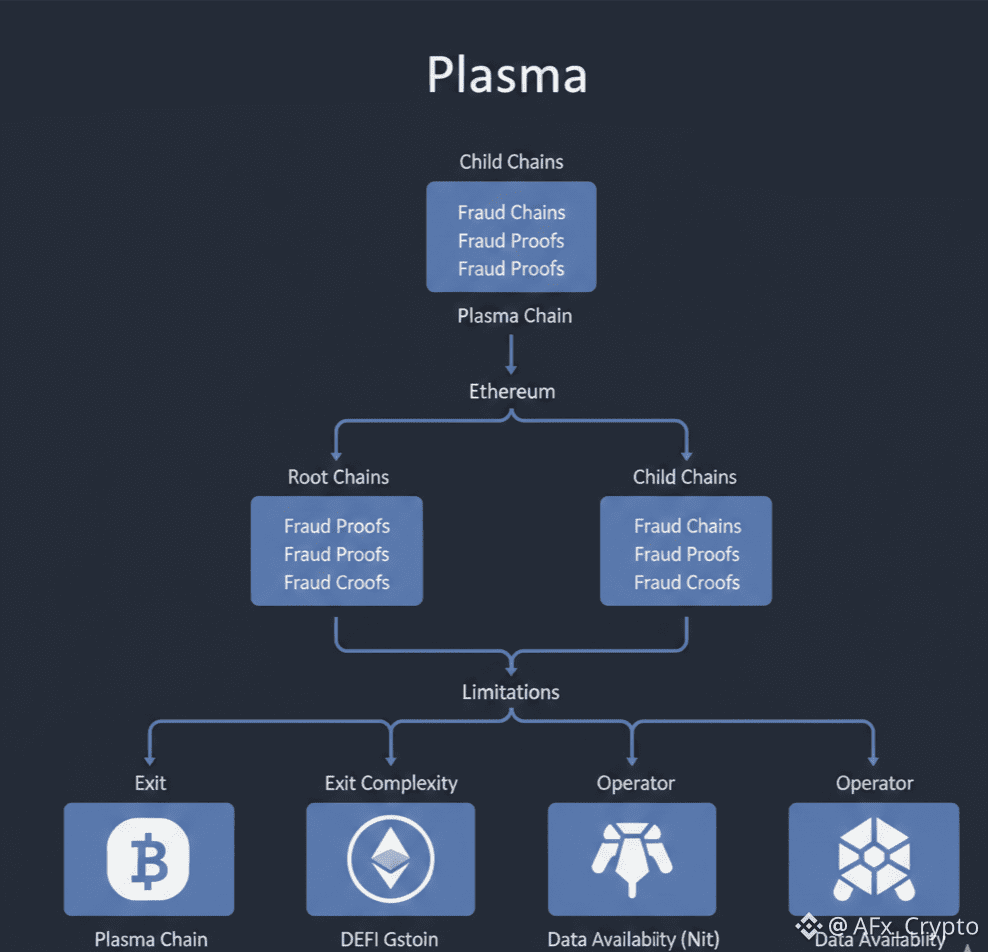
Limitations and Challenges
While Plasma significantly improves performance, it introduces complexities and limitations:
Exit Process Complexity: Leaving a Plasma chain requires multiple steps and time delays, which can frustrate users and complicate liquidity management.
Data Availability Risks: Because not all transaction data resides on the root chain, users rely on operators to provide sufficient data. Failure to do so can hinder balance verification and dispute resolution.
Limited Smart Contract Flexibility: Plasma is not ideal for general-purpose smart contracts, as its design focuses primarily on high-throughput transaction processing rather than complex logic execution.
Operator Dependence: Child chains rely on honest operators for proper functioning. Although fraud proofs exist, the system still assumes operator cooperation for optimal efficiency.
Throughput vs Centralized Systems: Even with Layer-2 scaling, Plasma cannot yet match the transaction volumes of centralized networks like Visa or Mastercard, which can handle roughly 24,000 TPS. Layer-2 solutions remain a compromise between decentralization and raw throughput.
Practical Applications
Despite its limitations, Plasma’s scalability model is well-suited for financial and gaming applications, where transaction speed and low fees are critical. NFT marketplaces benefit from faster minting and transfers, while DeFi platforms can execute trades and settlements with reduced latency and cost. Plasma’s structure also supports modular growth, allowing blockchain networks to scale incrementally as demand increases.
Conclusion
Plasma exemplifies how Layer-2 scaling can reconcile security, decentralization, and throughput in blockchain networks. By offloading computation to child chains, implementing fraud proofs, and preserving root-chain verification, it addresses Ethereum’s most pressing performance bottlenecks. While challenges around exits, data availability, and operator reliance remain, Plasma demonstrates that thoughtful Layer-2 design is essential for achieving practical scalability in decentralized systems.

