

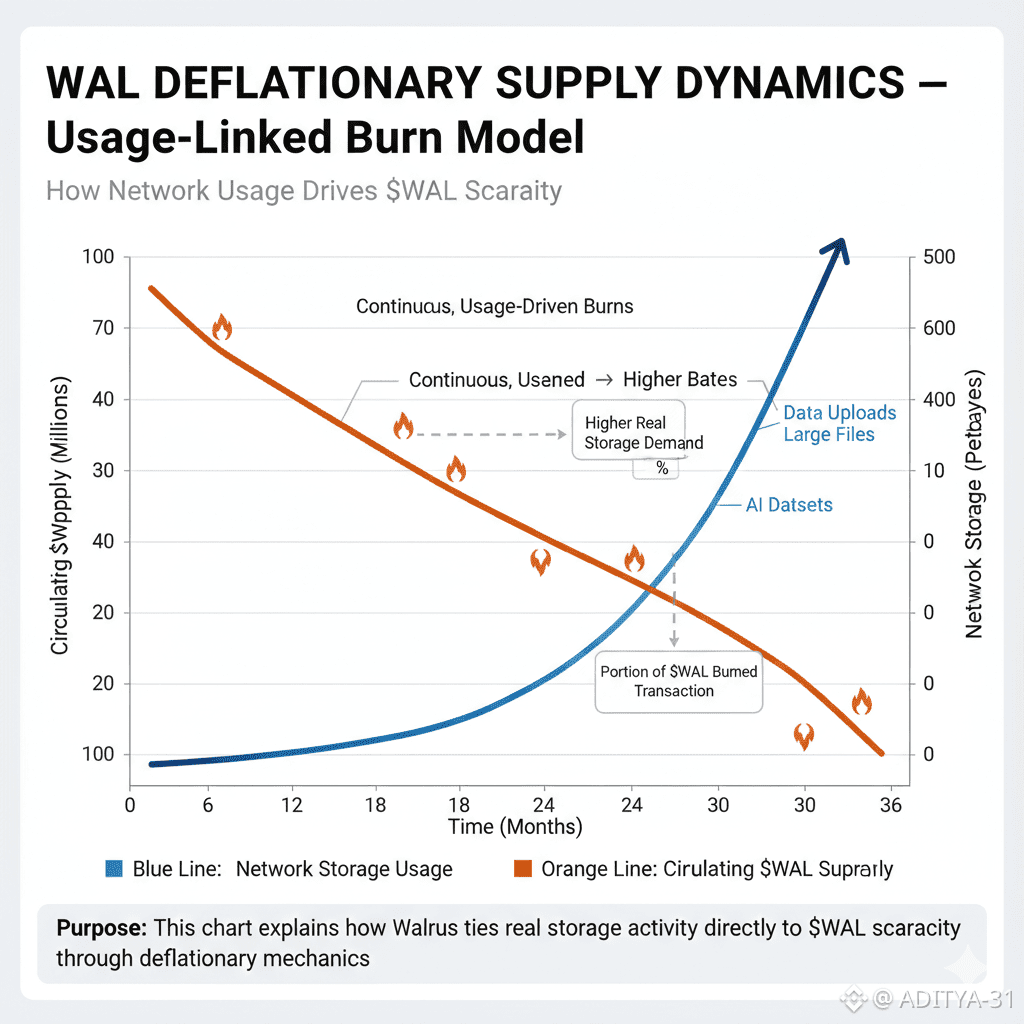
Walrus Protocol ko decentralized storage ka simple alternative nahi banaya gaya — balki Web3 me large data, media, aur AI datasets ke demand ko address karne ke liye ek economic engine ke roop me design kiya gaya hai. Is ecosystem ki economics native token Wal ke around center hoti hai, jiska role sirf storage payments aur staking tak limited nahi balki network sustainability aur real usage par scarcity pressure create karna hai.
Token Burning: Usage-Linked Scarcity
Walrus Protocol jaldi hi transactions ke saath Wal token ko burn (permanently remove from circulation) karne wale mechanics introduce kar raha hai. Jab bhi kisi user ne network par data upload ya storage services ke liye WAL me payment kiya, us transaction ka ek portion token supply se permanently burn ho jayega. Is ka direct effect yeh hota hai ki system usage ke sath scarcity create karta hai, jisse circulating supply gradually compress hoti hai.
Ye approach typical “one-time burn events” se bilkul alag hai. Instead of making token scarcity a marketing gimmick, Walrus tokenomics usage-driven deflationary logic par base hoti hai — jahan real storage activity, large file uploads, aur ecosystem adoption directly token supply dynamics ko influence karte hain.
Transparent Costs aur Pricing Predictability
Deflationary mechanics ka ek aur important dimension pricing predictability hai. Walrus Protocol future plans me yeh bhi support karega ki users top-level storage pricing ko USD terms me pay kar saken, taaki long-term cost planning aur pricing volatility avoid ki ja sake. Even with $WAL burning in the background, user experience aur cost expectations stable aur transparent rehte hain — especially important jab decentralized storage enterprise use cases, media platforms, aur AI datasets jaise heavy workloads handle karta hai.
Security, Incentives, aur Network Health
$WAL token economics ka role sirf scarcity aur pricing tak hi limited nahi hai; yeh network security aur behavior incentives me bhi integral part play karta hai. Protocol design me deflationary pressure ek dual purpose serve karta hai:
1. Storage Payments ka Economic Link: Large file uploads, media storage, aur programmable storage usage Wal token payments se incentivized hote hain, jisse network participants aur storage providers real economic signals receive karte hain.
2. Behavior Discipline through Penalties: Agar storage nodes or actors malicious behavior dikhate hain, protocol me penalties ya slashing ke mechanisms apply ho sakte hain — jisse Wal burn hota hai aur network health maintained rehti hai.
In mechanisms ka combined effect yeh hota hai ki network efficient, resilient aur sustainable rehta hai, na ki sirf speculative incentivization par dependent.
$WAL: Utility Beyond Payments
Wal token ka utility diversified hai:
Payments for Storage Services: Users decentralized storage capacity ke liye WAL me prepay karte hain aur data store karte hain.
Staking and Network Security: Storage nodes aur holders staking karke network operations secure karte hain aur rewards earn karte hain, jisse decentralized participation incentivized hoti hai.
Governance: WAL holders protocol parameters aur ecosystem decisions me participate kar sakte hain, jisse parameter adjustments aur long-term evolution par influence milta hai.
Ye multi-layered utility Wal ko ek broader infrastructure token ke roop me position karta hai, jahan value capture sirf tradable asset se zyada isse related network activity aur economic participation par depend karta hai.
Long-Term Economic Alignment
Walrus jahan itself a decentralized storage protocol hai, wahin Wal ka deflationary model is ecosystem ko economic alignment aur usage traction ke sath tie karta hai. Jaise jaise Web3 applications, NFT media storage, machine-learning datasets aur programmable data needs grow karte hain, yeh deflationary pressure WAL ki scarcity aur real usage ko connect karta hai — bina artificial hype ya forced token burns ke.
In sab economic mechanisms ke through Walrus Protocol Wal token ko ek sustainable, usage-integrated economic primitive bana leta hai, jahan network health, user costs, aur token scarcity aligned rehte hain with real storage demand instead of short-lived speculative cycles — ek model jo long-term infrastructure adoption ko support karta hai.

