

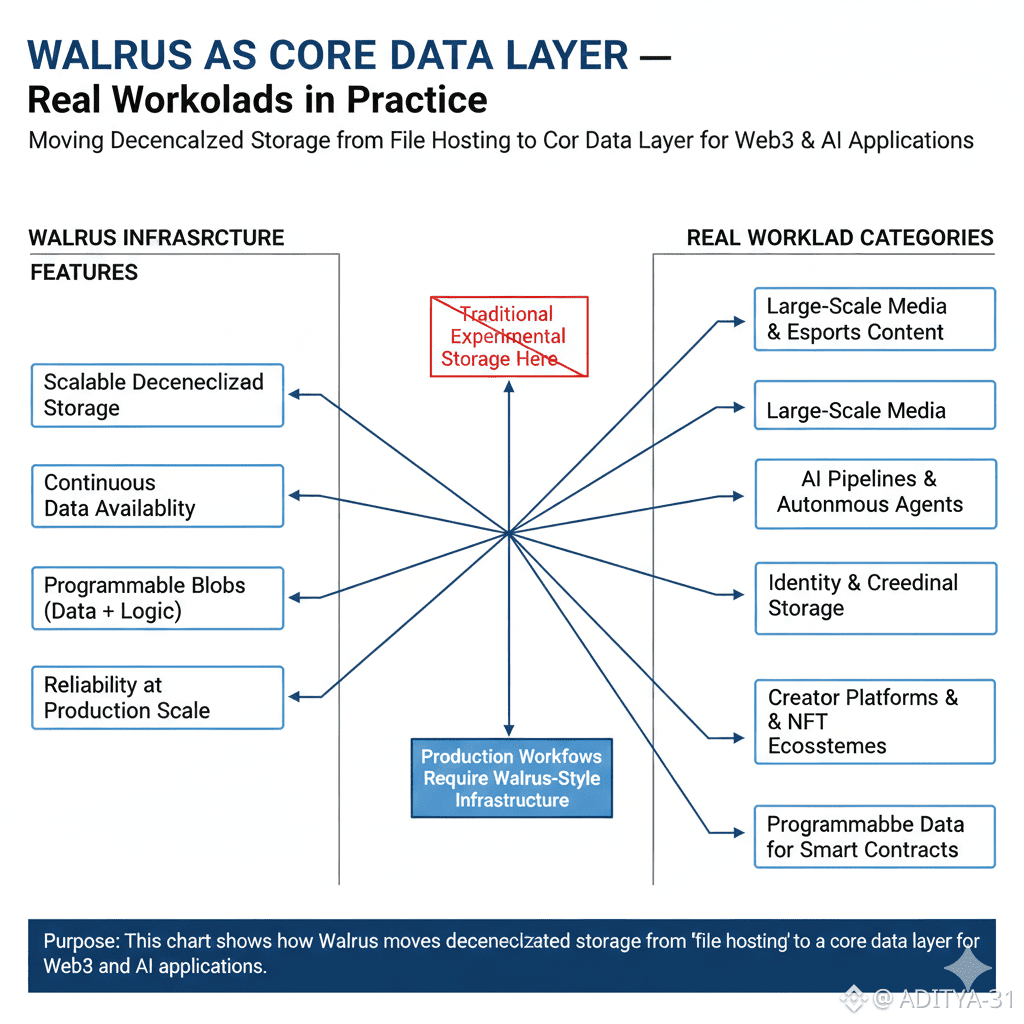
Walrus Protocol ka official blog ek simple update feed nahi lagta. Usse padhkar clear ho jata hai ki project sirf architecture explain karne ya future promises dikhane me interested nahi hai — focus actual usage, builder activity aur real data workloads par hai. Blog posts me ek consistent pattern dikhta hai: decentralized storage ko theory se nikal kar practical infrastructure banane ki direction.
Jab Decentralized Storage Enterprise-Scale Use Me Aata Hai
Recent blog updates me sabse striking example large-scale media usage ka hai. Jab ek global esports brand apna hundreds of terabytes ka content decentralized storage par move karta hai, to ye sirf partnership announcement nahi hoti — ye signal hota hai ki infrastructure production-ready ho chuka hai. Walrus ke case me, aise examples dikhate hain ki Web3 storage ab sirf small files ya experimental apps tak limited nahi raha.
Iska ek aur important angle AI-driven workflows ka hai. Blog posts me repeatedly mention hota hai ki future applications static data par nahi chalenge — unhe continuously accessible, reliable aur programmable data chahiye. Autonomous agents, AI pipelines aur data-heavy systems ke liye storage ka dependable hona optional nahi hota. Walrus apne blog me isi practical problem ko directly address karta dikhta hai.
Ecosystem Growth Sirf Numbers Me Nahi, Activity Me Dikhti Hai
Walrus ke blog ka ek strong point ye hai ki wo sirf protocol metrics ya TPS type stats par focus nahi karta. Hackathons, builder experiments aur community-led projects ko regularly highlight kiya jata hai. Ye approach ek cheez clear karta hai: ecosystem growth ka matlab sirf network ka chalna nahi, balki us par logon ka actively build karna.
“Year in Review” type posts se ye bhi samajh aata hai ki development isolated events ke form me nahi ho raha. Milestones, tooling updates aur partnerships ek continuous timeline ka part lagte hain. Isse readers ko ek broader picture milti hai ki project ka direction short-term hype driven nahi hai.
Partnerships Jo Sirf Branding Tak Limited Nahi
Blog me featured partnerships ka tone bhi alag hai. Identity platforms, data access control layers aur bandwidth-focused networks ke sath integration ka matlab sirf logo placement nahi hota. Jab millions of credentials decentralized storage par migrate hote hain, to wo trust aur scalability dono ka test hota hai.
Aise collaborations ye indicate karte hain ki Walrus apne aap ko sirf ek storage provider ke roop me nahi dekh raha, balki ek core data layer ke roop me position kar raha hai — jahan identity, content aur application state long-term ke liye survive kar sake.
Storage Jo Sirf Files Nahi, Logic Bhi Handle Kare
Walrus ke blog ka technical content bhi interesting hai, lekin overly academic nahi. Programmable blob storage ka concept simple words me samjhaya jata hai: data ko sirf store nahi karna, balki uske sath logic attach karna. Jab storage objects smart contracts ke behavior ka hissa ban jaate hain, to applications ka design fundamentally change ho jata hai.
Under the hood concepts jaise erasure coding aur availability proofs ko is context me present kiya jata hai ki “ye kyun matter karta hai”, na ki sirf “ye kaise kaam karta hai”. Ye approach builders ke liye zyada practical hoti hai.
Community-Driven Use Cases Jo Theory Ko Break Karte Hain
Blog me jo real stories aati hain — jaise creator platforms, NFT brands aur storage interfaces — wo ye prove karti hain ki decentralized storage consumer-facing products me bhi work kar sakta hai. Ye sirf backend infra nahi reh jata, balki user experience ka part ban jata hai.
Iska matlab ye hai ki Walrus ka storage layer sirf Web3 developers ke liye nahi, balki brands aur content-heavy platforms ke liye bhi relevant ho raha hai. Ye shift decentralized infrastructure ke adoption ke liye kaafi important hota hai.
Final Take
Walrus Protocol ka blog ek cheez consistently communicate karta hai: decentralized storage ka next phase sirf “exist karna” nahi hai, balki daily workflows ka part banna hai. Real data, real users aur real scale par kaam karna hi infrastructure ka asli test hota hai.
Blog ke content se ye impression milta hai ki Walrus us phase me enter kar raha hai jahan decentralized storage optional feature nahi, balki Web3 stack ka core layer banne lagta hai.

