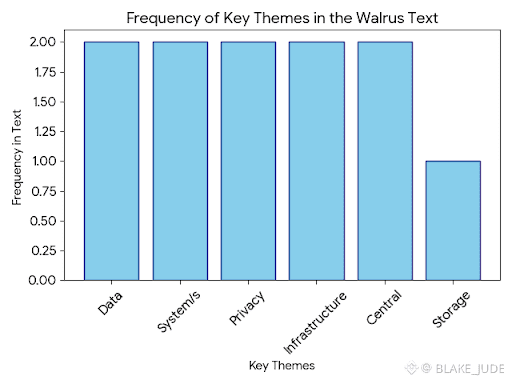
Data has gravity. Once it settles somewhere everything else starts orbiting around it applications users permissions power. For decades that gravity has pulled relentlessly toward centralized servers. Not because people loved the idea but because there were no serious alternatives. Decentralization promised freedom yet quietly failed the moment files got large private or operationally important. Walrus begins from that failure not from hype and that is what makes it interesting.
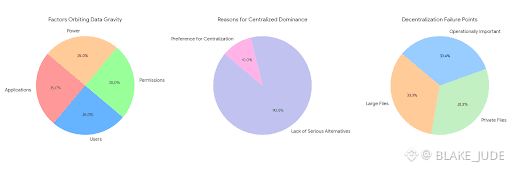
Instead of treating decentralized storage as an afterthought bolted onto a blockchain Walrus treats it as a first class problem. The protocol does not pretend that blockchains should store massive files directly. That fantasy has already collapsed under fees and inefficiency. Walrus takes a more grounded approach data lives off chain split encoded and scattered across a network that has no single owner and no single point of failure. What remains on chain is not the data itself but the logic that governs access integrity and incentives.
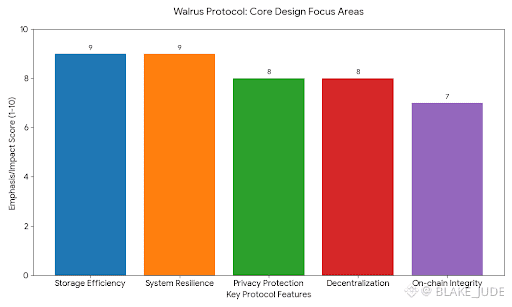
This distinction changes the entire conversation. Suddenly decentralized storage is not about ideological purity it is about engineering trade offs. Walrus uses erasure coding to break files into fragments that can survive partial loss without becoming unreadable. A file no longer needs to exist everywhere to be safe. It only needs to exist enough. That subtle shift dramatically reduces storage overhead while increasing resilience and it is the kind of design decision that suggests the builders have spent time thinking about how systems actually fail in the real world.
Privacy threads through everything Walrus does but not in a loud absolutist way. There is no pretense that privacy means invisibility or chaos. Instead the protocol focuses on minimizing unnecessary exposure. Transactions can be structured so that only essential information is revealed while sensitive details remain shielded. File contents are never broadcast to the world they are accessed through encrypted references tied to permissions and cryptographic proofs. The result is a system where verification does not require voyeurism.
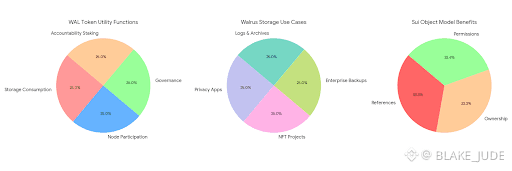
The WAL token fits naturally into this architecture. It is not a decorative asset meant to spark speculation before utility arrives later. WAL is consumed when storage is used locked when nodes want to participate and wielded when governance decisions need to be made. Storage providers stake it to prove commitment and that stake becomes leverage for accountability. Misbehavior is not punished socially it is punished economically. That alignment of incentives is what allows a decentralized system to behave predictably without a central operator watching over it.
Running on the Sui blockchain gives Walrus a structural advantage that is easy to overlook. Suis object based model handles references ownership and permissions with a clarity that fits storage systems far better than account only chains. A file is not just data it is an object with rules attached. Who can access it who can update it and under what conditions all of that can be expressed cleanly without duct tape logic. For developers this matters more than marketing ever could. It means fewer abstractions fewer hacks and fewer surprises.
What emerges from this design is not a single killer application but a foundation flexible enough to support many. A privacy focused application can store sensitive records without leaking metadata. An NFT project can host large assets without trusting centralized gateways that may disappear. An enterprise can distribute backups across jurisdictions without surrendering control to one vendor. Even mundane use cases logs archives internal documents start to look different when availability and ownership are not mutually exclusive.
None of this is free of tension. Distributed systems are slower than centralized ones in certain scenarios. Economic models can drift if incentives are not tuned carefully. Privacy attracts attention and not always the kind builders hope for. Walrus does not magically solve these issues but it does something more honest it acknowledges them and builds within those constraints instead of ignoring them.
What stands out most is the absence of spectacle. Walrus does not frame itself as a revolution that will replace everything overnight. It behaves more like infrastructure that expects to be tested stressed and quietly depended on. That mindset is rare in a space addicted to bold claims. It suggests a long game one where success is not measured by headlines but by whether people stop thinking about where their data lives because it simply works.
WAL in that sense represents more than network fees or governance votes. It represents participation in a system where data does not automatically drift toward central power. Where storage is not an act of surrender. Where privacy is not treated as suspicious by default. That may not sound dramatic but it is precisely why it matters. The most meaningful shifts in infrastructure rarely announce themselves. They just change what feels normal one design choice at a time.