
When you’re building anything in the realm of smart technology—whether it’s intelligent agents, advanced automation, robust on-chain identity solutions, or just aiming for more adaptive, interactive user experiences—you’re no longer just piecing together simple applications. You’re architecting systems that are deeply aware of, and responsive to, ever-shifting context. This level of complexity demands a new way of thinking about both how data is structured and how it moves through your stack.
That’s why the concept of “Seeds” keeps resurfacing as such a powerful idea for me. The traditional approach to data—treating it as a monolithic blob sitting inertly on some distant server—simply doesn’t cut it anymore, especially when context and verifiability matter. Neutron fundamentally reimagines this paradigm. It takes raw, unwieldy information and compresses it into modular, actionable pieces—these “Seeds”—which are not only easier to reference and verify, but also portable and composable across different environments. If you’ve ever been responsible for shipping a product where data integrity, provenance, and persistent availability are non-negotiable, you’ll immediately grasp why this shift is so transformative. It’s not just about efficiency; it’s about fundamentally elevating trust and flexibility within your system.
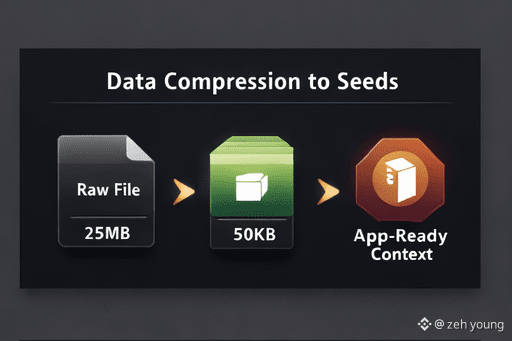
When you visualize this—imagine a “Compression Concept Chart”—you see how much more streamlined information flow can become. The practical upshot is that, once your data layer is both resilient and portable, you’re no longer forced to fall back on centralized workarounds. This unlocks true ecosystem growth, enabling networks and communities to flourish organically, rather than inevitably reverting to the centralization patterns that have plagued Web2. A solid data foundation means innovation can happen at the edges, not just the center.
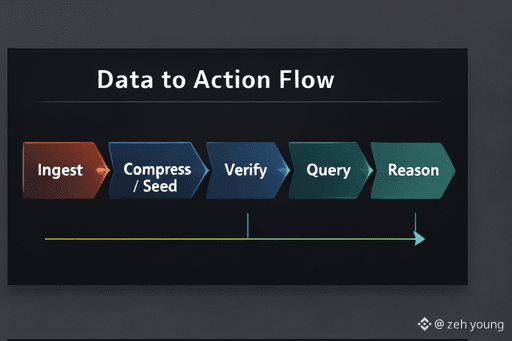
If you map this out in a “Data Lifecycle Flowchart,” it becomes clear that the movement, verification, and utilization of data is far more dynamic, secure, and transparent. Every actor in the system has the ability to access, validate, and build upon data without depending on a single point of failure. This kind of architecture is what makes entirely new classes of decentralized applications possible—ones where composability and trust are built in from the ground up.
Enter $VANRY. Its role is pivotal: it acts as the network’s native meter and alignment mechanism, tracking real usage and ensuring that incentives remain properly calibrated as the ecosystem scales. When people ask about the necessity of the token, the question is often framed too narrowly. Instead, consider the broader implication: if this stack becomes the default workflow for developers and creators—if “Seeds” become the standard for data structure and movement—then $VANRY isn’t just another token. It becomes the heartbeat of the system, governing access, prioritization, and even governance as adoption grows. That’s when you start to see the true network effects kick in, driving innovation, sustainability, and value creation at a whole new level.
@Vanarchain #vanar $VANRY #seeds
