
Contemporary applications are living entities that rely on memory, context, and continuity, they’re much more than simple processing systems. They may be financial applications tracking compliance records, gaming applications maintaining player histories, or AI applications utilizing the power of continuous interaction to learn. As such, data persistence has become an essential element of digital infrastructure. With blockchain based systems, the complexity of maintaining persistence increases, as you need to ensure that data is not only accessible and verifiable but also durable without the added costs and latency associated with it.
Walrus provides a new way of thinking about application-level data persistence. Simply put, data persistence refers to the ability for data to remain available over a period of time, regardless of how systems grow, change, or fail. Traditional blockchains replicate all of the same data to every node in the network which increases trust among users, however, this also creates greater amounts of storage burden on the network increasing overall costs associated with on chain storage and infrastructure expenses. The trend over the past two years shows that on chain storage fees are rising, just as applications require larger sets of on chain data. As many developers struggle to find a balance between decentralization and operational costs, they experience tension that ultimately leads to poor design decisions.
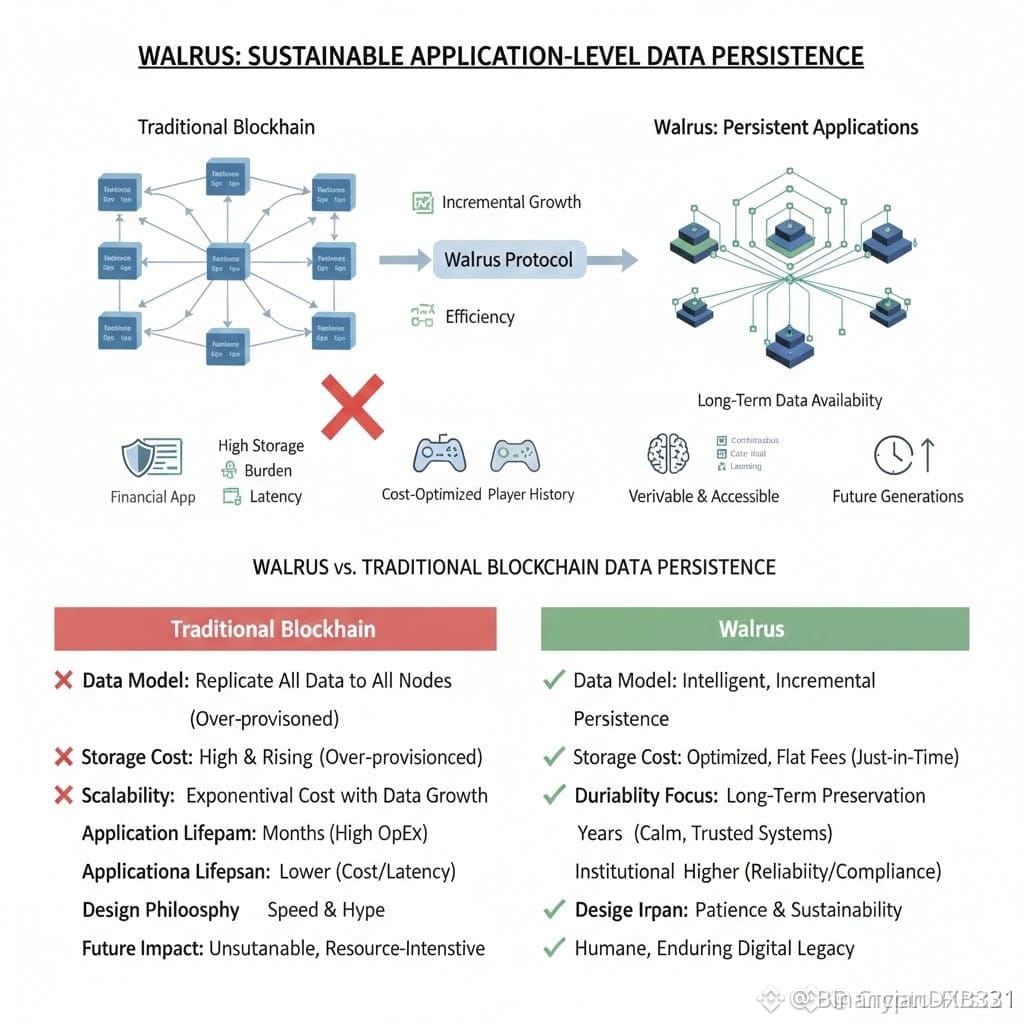
An emerging trend is the impact of Blockchain technology which is gradually moving into the mainstream. As companies begin using blockchain systems in production, they begin to care less about whether they work fast enough today, but rather how long the information they have stored on them will last. Developers are now developing applications to last for many years; an application developer's design will be viewed differently than an engineers as opposed to an engineer's design which will only be used for a couple of months.
On a personal level, this indicates to me that the development community is starting to pay attention to how its design decisions will impact future generations of users. When the developers treat data appropriately and responsibly, it leads to much calmer systems that can be trusted and used in a more humane manner. In this way, Walrus demonstrates an understanding of the importance of sustainable digital infrastructure.
In the digital world today, preserving data over the long term requires thought, not just for technical reasons, but also so that we as a society can think about and build systems for our children and grandchildren. Walrus allows for data preservation while supporting continued usability after the initial period of time when interest in a specific application may have faded.
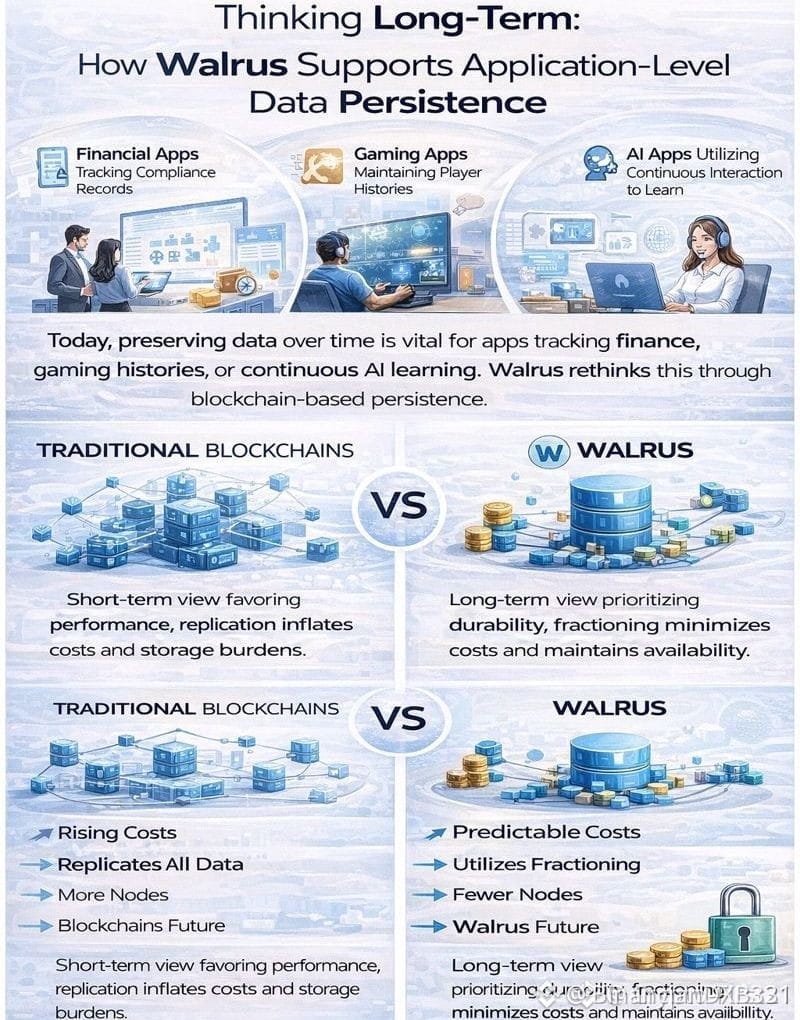
There’s also an overall trend across the industry. As blockchain technology moves out of the experimental phase and into full production, the focus on data storage and retrieval has shifted from performance based to durability based as part of the design process. Therefore, applications that utilize blockchain will be designed with their intended lifespan in mind. Walrus provides support for long term data storage without requiring the underlying infrastructure to be over provisioned. Walrus promotes an incremental approach to system growth rather than an exponential approach by valuing stability over spectacle.
On a personal level, I find this trend to be very encouraging. It seems like the industry is finally taking an interest in the impact of its design decisions over the long term. As a result, when you approach data with intentionality and restraint, you create a calmer environment for digital systems where users can trust the technology they use and ultimately find them to be more human in nature. In this regard, Walrus represents a greater appreciation for what sustainable digital infrastructure should be like.
In conclusion, application-level data persistence is not just a technical issue, it is a question of what type of digital systems we want to last into the future. Walrus represents a vision for a future where data has the ability to persist into the future and support applications that provide continued reliability, transparency, and usability long after the novelty has worn off.