
Decentralized storage has long promised a world where your data is safe, distributed, and independent of any single authority. The idea is elegant: files are broken into fragments, stored across multiple nodes, and verified regularly to ensure integrity. On paper, it sounds perfect. But in reality, most decentralized systems face a harsh truth networks are messy, unpredictable, and prone to delays. Nodes go offline, connections drop, and traffic spikes can slow entire regions. Traditional storage networks, relying on strict timing rules, often fail under these real-world conditions. Walrus has recognized this problem and introduced a radical solution.
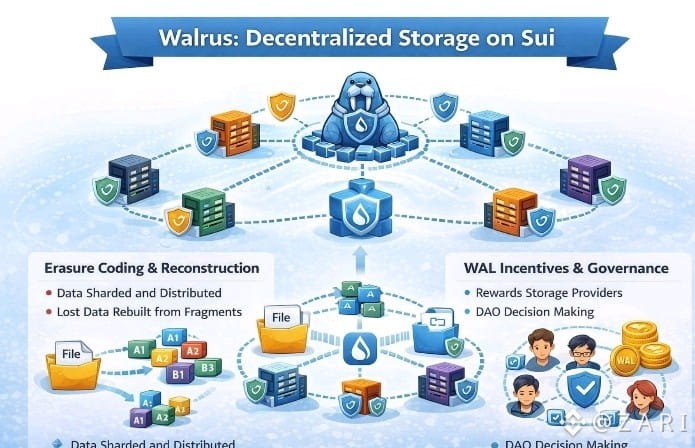
The Walrus Protocol redefines decentralized storage with its Asynchronous Challenge Protocol (ACP). This isn’t just an incremental improvement it’s a paradigm shift. Instead of punishing nodes for late responses, Walrus focuses on whether enough correct data fragments exist across the network to maintain integrity. Speed no longer equals security. Structure and correctness do.
The Core Problem of Traditional Storage
Most existing decentralized storage systems use synchronous challenge mechanisms. In simple terms, nodes are asked to prove they have specific data within a strict time window. Late responses are treated as failures, even if the node is honest and fully storing the data. This approach assumes a perfect network, which rarely exists outside of theoretical models. Congestion, hardware limitations, or regional disruptions can all cause delays, unfairly penalizing reliable nodes and reducing overall network resilience.
Walrus’ Structural Shift
Walrus replaces timing with structure. Instead of relying on speed, it cares about whether the network collectively holds enough valid fragments to reconstruct data. Late responses are accepted, and faster responses do not provide any advantage. This approach eliminates the flaws of time-based verification and ensures that security depends on correctness rather than punctuality.
How the Asynchronous Challenge Protocol Works
In ACP, challenges are issued to storage nodes, but responses can arrive independently and at their own pace. The network only requires a sufficient collection of valid proofs to confirm that data is secure and accessible. There are no penalties for late but correct responses and no rewards for early responses. This simple yet powerful mechanism ensures that the system remains secure even under unpredictable conditions.
Why Asynchrony Matters
Real world networks are never perfect. Messages arrive out of order. Connections drop unexpectedly. Traffic surges slow down entire regions. These are not edge cases they are the reality of global networks. By embracing asynchrony, Walrus designs a storage system that functions securely despite delays, dropped packets, or partial failures. The protocol does not demand full participation at any given moment, making the network more resilient and stable.

Reducing Overhead Without Sacrificing Security
Traditional decentralized storage often compensates for unreliable verification through heavy replication or continuous validation. This consumes storage, bandwidth, and computational resources. Walrus avoids this waste. ACP allows the network to maintain strong verification without unnecessary duplication. Security is built into the architecture rather than added on top through brute-force measures. The result is a more scalable, efficient, and sustainable storage solution.
Fairness and Inclusion in Decentralized Storage
Synchronous networks often favor nodes with faster connectivity, leaving nodes in less developed regions at a disadvantage. Walrus levels the playing field. Each node is evaluated based on the correctness of its stored data, not its response time. This encourages broader participation, strengthens decentralization, and creates a more robust network.
Security Against Malicious Actors
Time-based attacks are common in traditional storage networks. Malicious nodes can try to exploit timing gaps or manipulate verification rules. ACP eliminates these vulnerabilities. Because speed is irrelevant, attackers cannot gain an advantage by responding faster or delaying responses strategically. Security depends purely on structural integrity and correctness.
Impact on Network Reliability
Walrus’ asynchronous approach results in a network that continues to operate during partial failures or disruptions. Temporary node failures, network congestion, or delayed responses do not compromise data security. The network is resilient, stable, and fair, ensuring that decentralized storage can work reliably at a global scale.
A New Standard for Decentralized Storage
Walrus sets a new benchmark for what decentralized storage can achieve. By prioritizing structural guarantees over timing, it delivers a system that is practical, secure, and efficient. Businesses, content platforms, and global networks can trust Walrus to maintain data integrity without worrying about network imperfections. ACP offers a glimpse of the future a future where decentralized storage works seamlessly in the real world, not just in theory.
In conclusion, the Walrus Protocol with its Asynchronous Challenge Protocol is more than just a new storage method it is a reimagining of how decentralized networks should operate. Security, fairness, and reliability are embedded in the system, ensuring resilience in unpredictable environments. As the world moves toward truly global decentralized systems, Walrus provides the foundation for a storage network that works under real conditions, not just ideal ones.
Can Walrus asynchronous structure first approach finally make decentralized storage practical, reliable and scalable for everyone everywhere?