
let me strip away the press release polish and talk to you like a real person who's been watching this space bleed money on gas fees for way too long.
You know that feeling when you’re trying to split a dinner bill with a friend, and you Venmo them 50 bucks, but they actually only get 47 because of "processing fees"? That’s basically every stablecoin transaction right now, except instead of 3%, you’re sometimes paying 20% in gas just to move your own money.
I’ve been in this space since 2017, and watching someone try to explain to their mom why sending 20 USDT costs 15 in Ethereum fees is soul-crushing. "But it’s the future of finance!" Yeah, right. The future where buying a coffee requires a 10 tutorial on "gwei" and "priority fees" and "why the network is congested because some ape JPEGs just dropped."
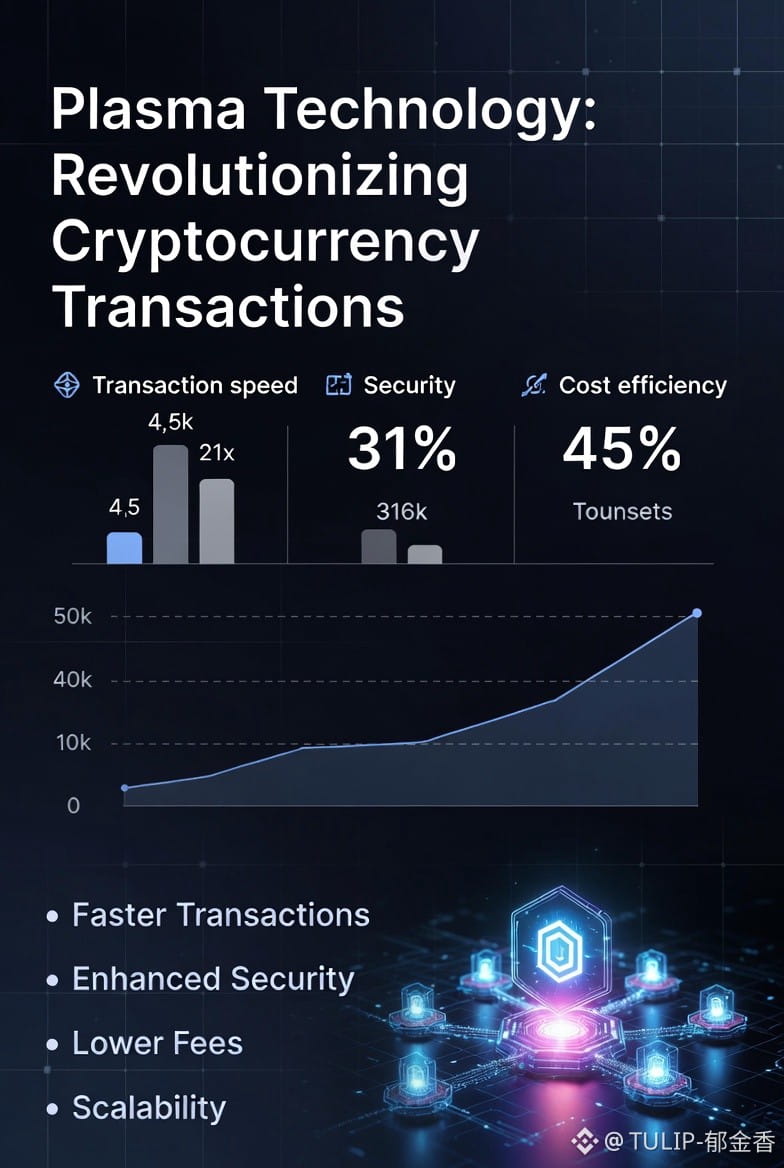
It was embarrassing. We built this brilliant system for digital dollars, then strapped it to infrastructure designed to run CryptoKitties and wondered why normies ran screaming.
Then @Plasma showed up in late 2025. And honestly? I was skeptical. Another L1 promising to "fix everything"? I’ve got a folder full of dead whitepapers that said the same thing. But something felt different here. They weren’t trying to be the "Ethereum killer" or the "Solana competitor." They basically said, "Yo, we’re just building a highway for stablecoins. That’s it. That’s the tweet."
Actually Built Different (Not Just a Slogan)
Look, most chains are like taking a Formula 1 car to the grocery store. Overengineered, expensive, and weirdly uncomfortable for simple tasks. Plasma is the first chain I’ve seen that admits USDT transfers shouldn’t require a computer science degree.
They launched in September with something wild: zero-fee USDT transfers. And I don’t mean "low fees" or "subsidized by a foundation treasury that’ll run out in six months." I mean actually, truly free. The protocol itself pays the gas using this thing called a paymaster. You send USDT, you don’t hold $XPL, you don’t even need to know what $XPL is. It just works.
The tech heads will tell you it’s all thanks to PlasmaBFT (their consensus thingy), which apparently hits sub-second finality. Translation? Your money moves faster than a TikTok scroll. By November, these maniacs had already soaked up 6.6 billion on Aave. That’s not "promising." That’s "holy shit, the market actually wants this."
But here’s the part that made me stop doom-scrolling and actually pay attention: they got Tether’s backing. Not a tweet of support—a full infrastructure partnership. When Paolo Ardoino’s crew backs something for stablecoin rails, you know there’s meat on the bone.
The Comeback Kids XPL got absolutely demolished after launch. I’m talking 0.12 lows. Brutal. The kind of chart that makes you instinctively mute the Telegram group. But fast forward to early 2026? Coinbase listed them. Not the "we might list it eventually" announcement—the actual spot trading button appeared. That’s validation you can’t fake.
Then came the boring stuff that actually matters: Anchorage Digital (yeah, the federally chartered one) built custody for them. They got VASP licensed in Italy. Covalent plugged in real-time compliance data. It’s like watching a startup grow up overnight from "degen casino" to "actual financial infrastructure."
Paul Faecks, the founder, also handled the FUD like a human instead of a corporate avatar. When people started rumors about team dumps in October, he didn’t drop a Medium post written by three lawyers. He jumped in the Discord, showed the three-year lockup contracts, and basically said "chill, we’re not going anywhere." Oversubscribed their token sale by 10x, too. When you raise 500 million in this market, you’re either selling snake oil or building something real. The receipts suggest the latter.
So… What Is $XPL Actually For? tokenomics talk usually makes my eyes glaze over, but this matters. You’ve got 10 billion tokens total. The public got 10%, unlocked at launch (unless you’re in the US—you guys wait until July 2026, sorry). Team and investors are locked for a year, then vest over two more. No sudden dumps. No "surprise, we’re selling!" notifications.
$XPL does three jobs: securing the network (staking), paying for complex smart contracts (notsimple USDT sends—those stay free), and governance later on. They’re starting with 5% inflation for validators that burns down to 3%, and fees get burned like Ethereum’s EIP-1559 setup. If enough people use the chain, $XPL actually becomes deflationary. That’s the bet.
Q1 2026 is when staking goes live. That’s the real test. Right now it’s still a bit centralized—Plasma runs the validators while they’re in beta. But when delegation opens up and anyone can stake to secure the network? That’s when this becomes decentralized infrastructure rather than a fancy app.
The Real Play (Coffee Not Included)
Here’s where it gets spicy. @Plasma One. It’s a neobank. A card. A "spend your stablecoins without converting to fiat" product. You know how every crypto card company lies to you about "no fees" but then hits you with hidden spreads? Plasma’s building the real deal—4% cashback, DeFi yields on your deposits (think 10%+), and actually spendable anywhere Visa works.
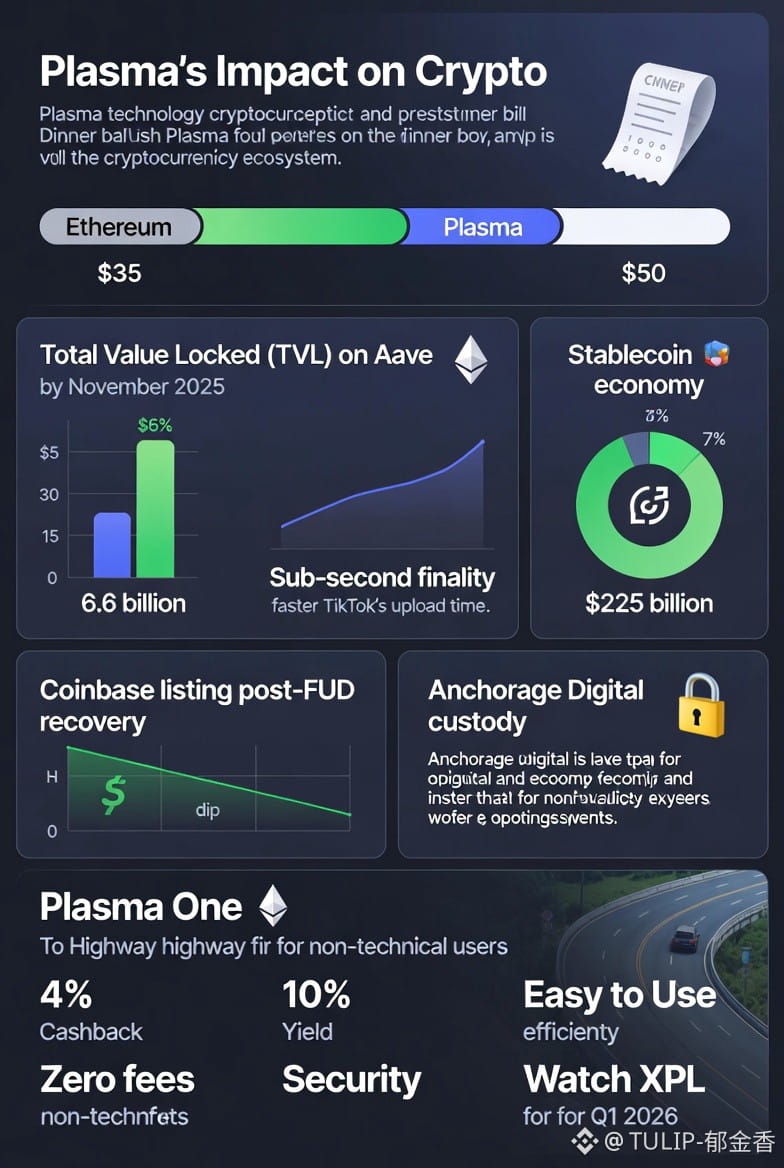
I’m not saying it’s going to replace your Chase account tomorrow. But imagine telling someone in 2010 that they’d manage their money through an app without a bank branch. This feels like that inflection point. Stablecoins have already won. They move 225 billion in volume. The only thing missing was infrastructure that didn’t suck.
@Plasma isn’t trying to kill Bitcoin. They’re not fighting for the NFT market share. They just looked at the most boring, obvious use case in crypto—moving digital dollars—and decided to stop accepting "yeah, but gas fees tho" as an excuse.
If you’ve been waiting for crypto to feel less like a diseased casino and more like… you know… money, keep your eyes on this one. Zero friction shouldn’t be revolutionary, but here we are.