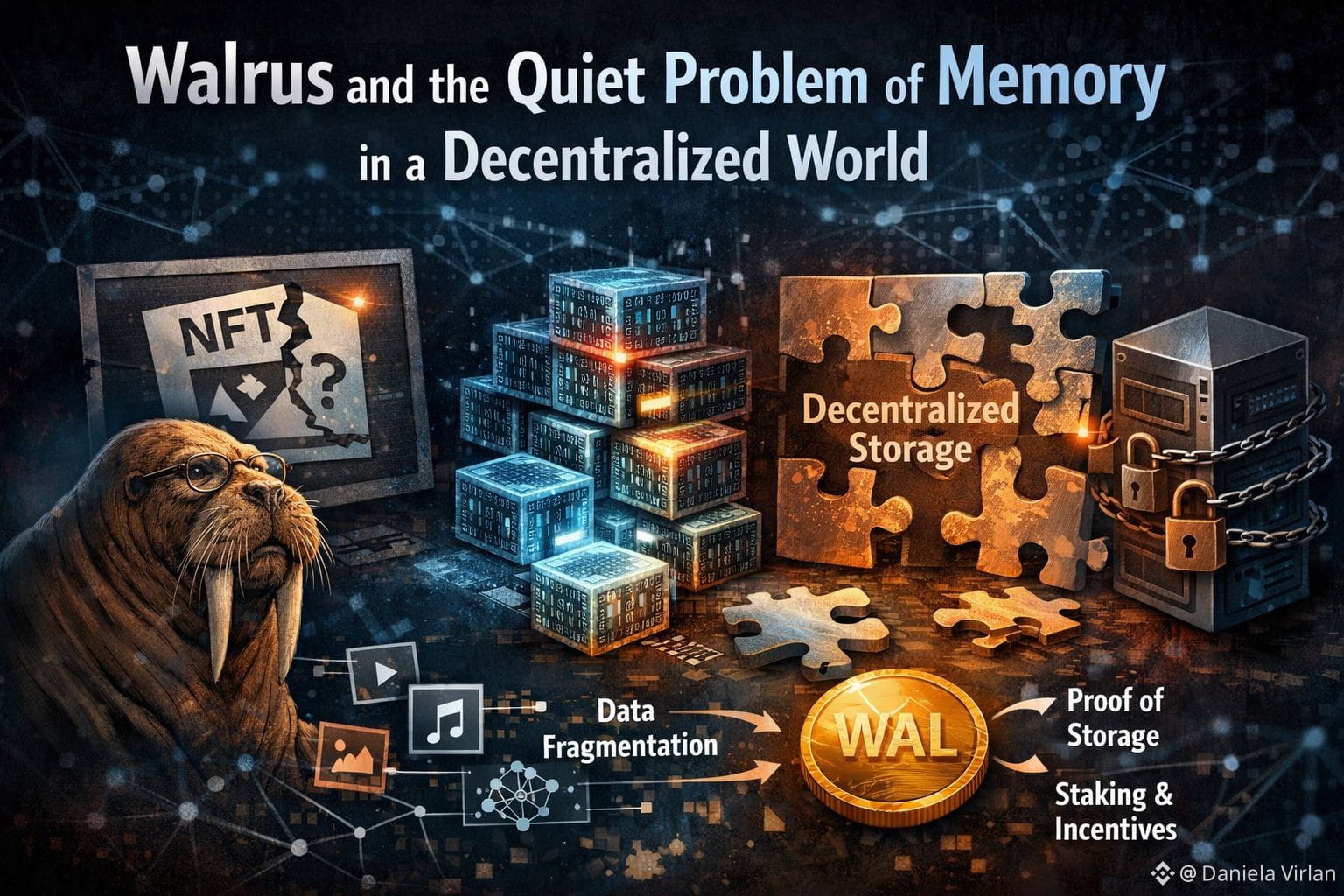
Crypto has always been good at one thing: moving value from one place to another without asking permission. What it has never been particularly good at is memory. Blockchains are brilliant ledgers, but poor libraries. They can record every transaction forever, yet they struggle the moment real, human data enters the picture. Images, videos, social posts, game assets, AI datasets, all of this still lives mostly off chain, usually on centralized servers that Web3 pretends not to depend on. Anyone who has clicked an old NFT only to see a broken image knows this problem is not theoretical. It is already here.
This is the gap where Walrus quietly steps in. Not with big slogans or dramatic claims, but with a fairly grounded question that many teams have avoided: how do you store large amounts of data in a decentralized way without making it painfully expensive or technically fragile? Developed by the team at Mysten Labs and closely connected to the Sui ecosystem, Walrus focuses on data availability and storage for large, unstructured files. It does not try to be everything at once. Instead, it aims to do one hard thing properly.
The basic idea behind Walrus is easier to understand than it first sounds. Rather than copying full files across many machines, which wastes resources, Walrus breaks data into smaller pieces using erasure coding and spreads those pieces across independent storage nodes. You do not need every node to behave perfectly. As long as enough pieces are available, the original data can be reconstructed. It is less like keeping a single backup drive and more like distributing parts of a puzzle across many locations. Lose a few pieces and the picture still comes together.
What makes this approach practical is how it fits into real developer workflows. A developer uploads data, pays for storage, and receives a cryptographic guarantee that the data will remain available for a specific period. Storage providers earn fees by reliably serving data and are penalized if they fail to do so. Proofs make sure nodes cannot claim to store data they have quietly dropped. The blockchain is used for coordination and enforcement, not for holding the data itself. Heavy files stay off chain, accountability stays on chain, which is where it belongs.
The early usage patterns around Walrus already tell a familiar story. NFT projects use it to make sure metadata and media do not disappear over time. Game developers rely on it for large asset bundles that would be unrealistic to push directly onto a blockchain. Data heavy social and AI projects are experimenting with it as a neutral storage layer that does not belong to a single company. Public metrics are still developing, but early mainnet activity has shown consistent data uploads, growing node participation, and deeper integration across the Sui ecosystem. It is not explosive growth, but in infrastructure, slow and steady adoption often matters more.
The WAL token plays a functional role in all of this. It is used to pay for storage, to incentivize reliable behavior, and to support governance over time. Storage providers stake WAL as a signal of commitment and risk losing it if they fail to meet their obligations. Users pay in WAL based on how much data they store and for how long. Governance decisions around pricing, parameters, and network rules gradually move toward token holders. The supply design appears focused on sustainability rather than aggressive short term incentives, which is a detail many projects overlook.
What stands out most about Walrus is what it does not promise. It does not claim to replace every storage system or solve every data problem in Web3. It focuses on availability and integrity rather than permanence at all costs. That distinction matters. Not all data needs to live forever, but data that users pay to store should remain accessible and verifiable for as long as promised. By keeping its scope narrow, Walrus avoids many of the economic and technical traps that earlier decentralized storage projects struggled with.
Looking ahead, the real test for Walrus will be whether it fades into the background in the best possible way. Good infrastructure eventually becomes boring. When developers stop worrying about broken links, missing files, or silent dependencies on centralized providers, the system has done its job. There are still open questions around long term economics, cross chain adoption, and scale, and those questions deserve honest discussion rather than blind optimism.
Walrus does not ask anyone to believe in miracles. It asks users to believe in incentives, cryptography, and time. Whether that is enough will be decided slowly, through usage rather than hype. And that, in today’s crypto landscape, might be exactly the right approach.#walrus @Walrus 🦭/acc $WAL