
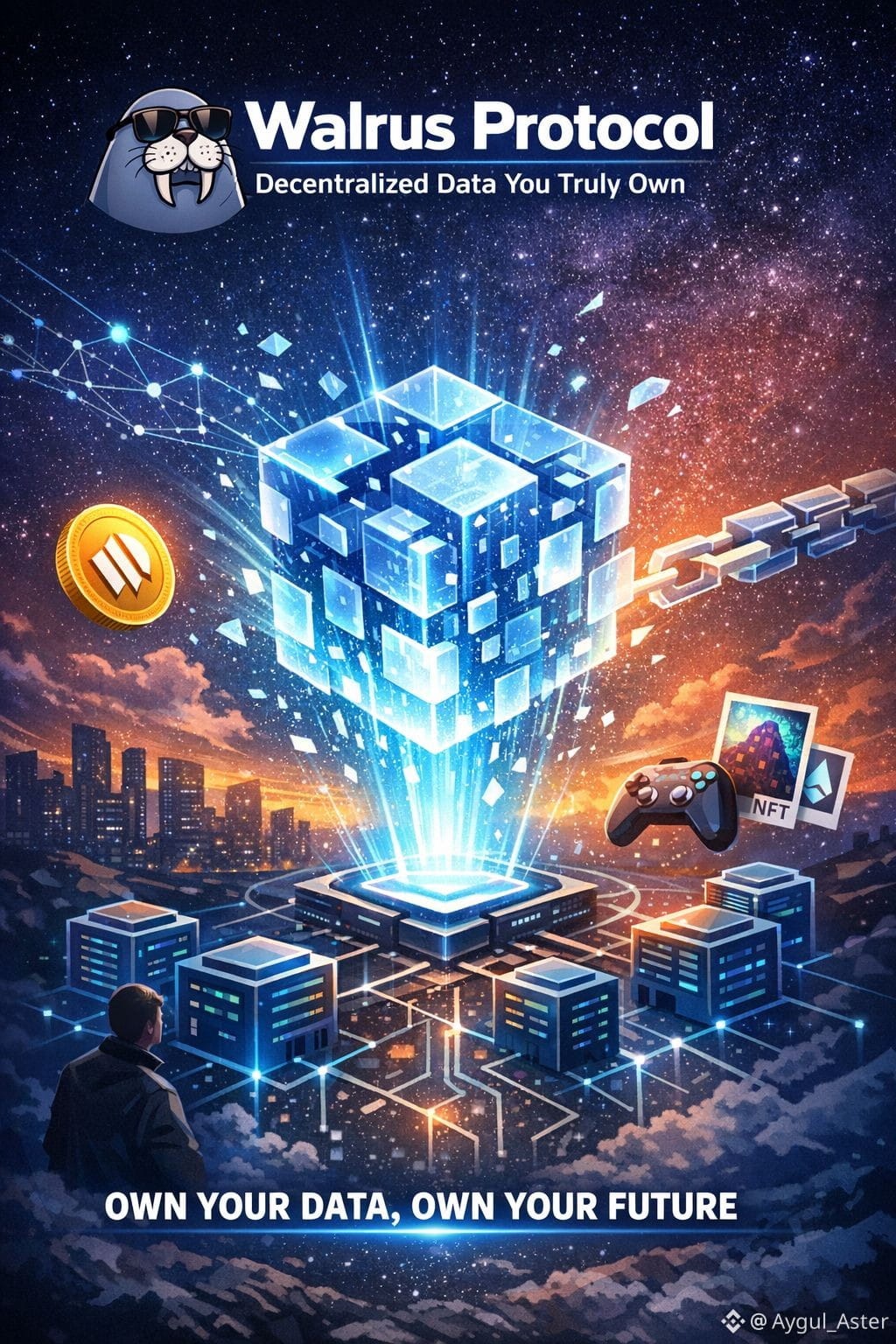
Walrus Protocol: Rebuilding the Internet’s Memory Layer
The internet runs on data, yet almost none of it is truly owned by the people who create it. Files, videos, application states, and user-generated content live inside centralized systems controlled by a small number of companies. Access can be revoked, pricing can change overnight, and entire platforms can disappear taking years of digital history with them.
Walrus Protocol starts from a simple but radical idea: data should be owned, not rented.
Rather than treating storage as a background service managed by corporations, Walrus turns it into a decentralized, verifiable, and economically secured network. It is not just a place to “store files,” but a foundational data layer designed for the next generation of internet applications.
Why Centralized Storage Is a Structural Weakness
Traditional cloud storage works well until it doesn’t. It introduces single points of failure, opaque governance, and misaligned incentives. Users trust providers to preserve data indefinitely, while providers are motivated to optimize for cost, control, and lock-in. The result is fragility disguised as convenience.
For Web3, this model is fundamentally incompatible. Blockchains promise decentralization and trust minimization, yet most applications still depend on centralized storage for the largest and most important pieces of data. That contradiction limits what decentralized systems can become.
Walrus exists to close this gap.
How Walrus Works
Walrus is a decentralized data storage protocol built on Sui, optimized for storing large, data-heavy assets. Instead of placing files on a single server, Walrus splits data into fragments and distributes them across a network of independent storage nodes.
This architecture delivers resilience by design. Data remains available even if individual nodes fail or leave the network. There is no central operator with unilateral control, and no single outage that can take the system down.
More importantly, Walrus makes storage cryptographically verifiable and economically enforced. Storage providers must stake WAL tokens, committing capital to their role. In return, they earn rewards for maintaining availability and reliability. Failure is not abstract it carries real financial consequences.
The result is a system where incentives replace trust.
The Role of the WAL Token
The WAL token is the economic engine of the protocol. It is used to pay for storage, reward node operators, and govern the network’s evolution.
Unlike speculative utility, WAL is directly tied to real network demand. As more applications store data on Walrus, demand for storage increases. As storage demand grows, so does the need for staked providers who are economically aligned with long-term data availability.
This creates a feedback loop where network usage strengthens network security.
Built for Real Applications, Not Just Theory
Walrus is especially relevant for applications that generate or depend on large volumes of data:
NFTs and their metadata, gaming assets, media platforms, decentralized social networks, AI datasets, and beyond.
Blockchains are excellent at consensus and verification but they are not designed to hold heavy files. Walrus acts as the missing data layer, allowing blockchains to remain lean while still depending on a decentralized storage backbone.
Because Walrus is built on Sui, it benefits from fast finality and low transaction costs, making it practical for production use not just experimentation. Developers can integrate storage directly into their applications without sacrificing performance or decentralization.
A Shift in How the Internet Is Built
Walrus Protocol represents more than a new storage option. It signals a shift away from corporate-controlled infrastructure toward neutral, permissionless systems.
In this model, data is protected by mathematics, incentives, and community participation not by terms of service or brand reputation. Ownership becomes enforceable, not symbolic.
As digital identity, media, and economic activity continue moving on-chain, the importance of durable, decentralized data storage will only increase. Walrus is laying the groundwork for that future quietly, deliberately, and with long-term intent.
The next version of the internet will not just need blockchains.
It will need memory it can trust.
Walrus is building that memory.

