
Most blockchain projects compete loudly on speed, TPS numbers, or short-term narratives. Yet despite years of innovation, true mass adoption of Web3 still feels distant. The problem isn’t a lack of blockchains it’s a lack of usable, scalable infrastructure that real users and developers can rely on. This is exactly where Vanar Chain is positioning itself differently.
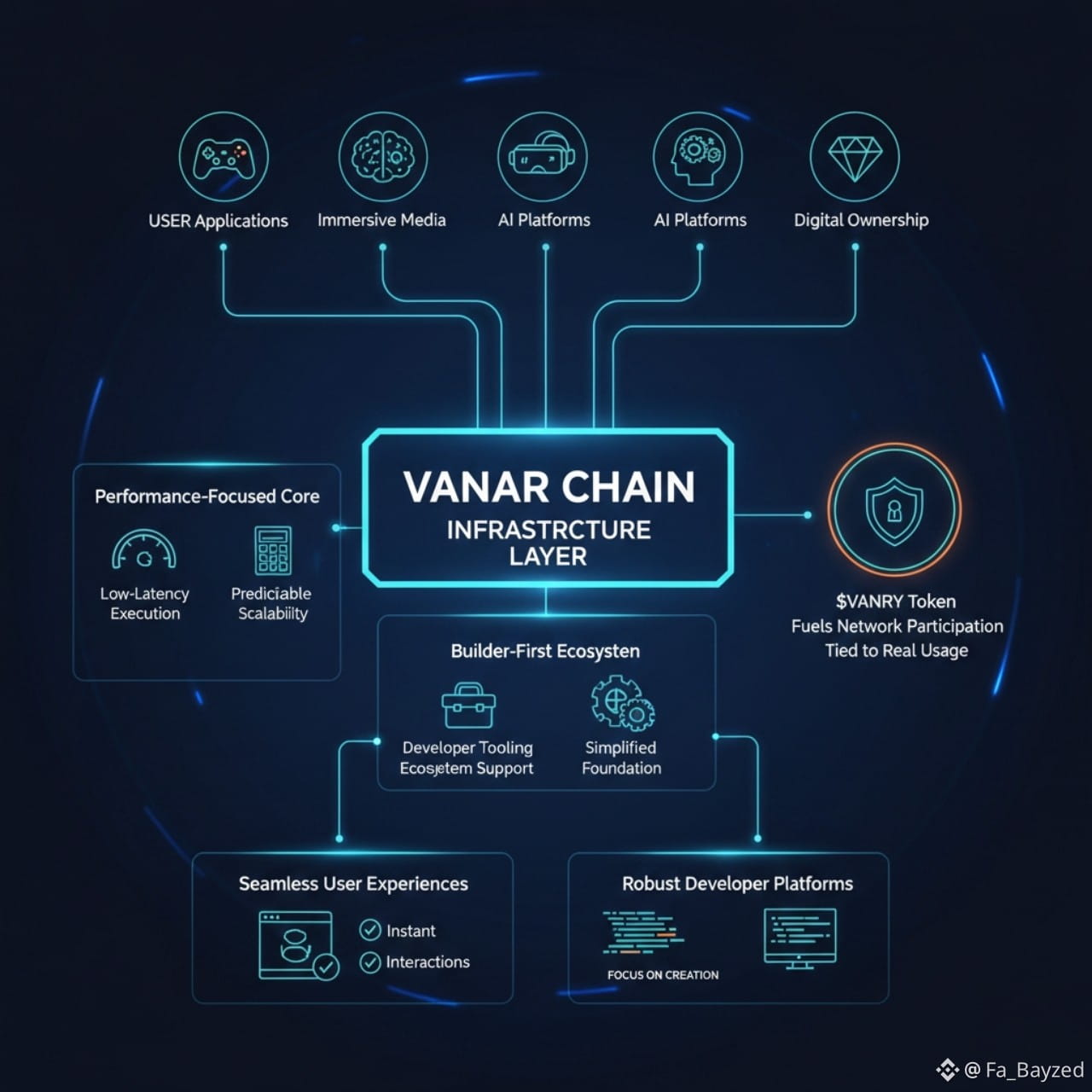
Today’s average user doesn’t care about consensus mechanisms or gas optimization. They care about seamless experiences, fast interactions, and applications that simply work. Gaming, immersive media, AI-driven platforms, and digital ownership ecosystems require blockchains that can operate efficiently in the background. This is the gap that is deliberately building for.
Vanar Chain focuses on being an infrastructure layer designed for performance-heavy applications. Instead of optimizing purely for financial transactions, Vanar emphasizes low-latency execution, predictable costs, and scalability that supports real-time environments. This makes it particularly suitable for use cases like multiplayer gaming, interactive experiences, and digital worlds where delays and friction immediately break user trust.
Another major challenge in Web3 is developer onboarding. Many promising ideas never reach production because development environments are complex, fragmented, or unreliable. Vanar Chain approaches this problem with a builder-first mindset. By prioritizing tooling, ecosystem support, and long-term scalability, it aims to reduce friction for developers who want to focus on creating products not fighting infrastructure limitations.
What also stands out is Vanar Chain’s long-term vision. Rather than chasing short-lived hype cycles, the ecosystem is structured around sustainable growth. Partnerships, creator initiatives, and ecosystem programs are designed to attract builders who are serious about shipping real applications. As the industry matures, this focus on fundamentals may prove far more valuable than short-term attention.
Security and stability remain critical as well. For enterprise-level adoption and large-scale consumer applications, reliability is non-negotiable. Vanar Chain’s architecture is designed to scale without sacrificing security, making it a viable foundation for projects that aim to operate beyond niche crypto audiences.
The role of $VANRY aligns with this infrastructure driven approach. Instead of existing purely as a speculative asset, it supports participation within the network and the broader ecosystem. As more applications are built on Vanar Chain, the token’s relevance becomes increasingly tied to real usage rather than speculation alone.
In my opinion, the next phase of Web3 adoption will not come from louder marketing or bigger promises. It will come from infrastructure that users barely notice because it works smoothly. Vanar Chain appears to be building toward that future, where blockchain technology fades into the background while enabling powerful digital experiences on the surface.
As Web3 continues to evolve, projects that prioritize usability, scalability, and real-world relevance will stand out. Vanar Chain’s focus on infrastructure over hype places it firmly in that category, making it an ecosystem worth watching as the industry moves toward mainstreablockchain
