
The first signal wasn’t speed. I thought it was, but no.
It was repetition that didn’t collapse.
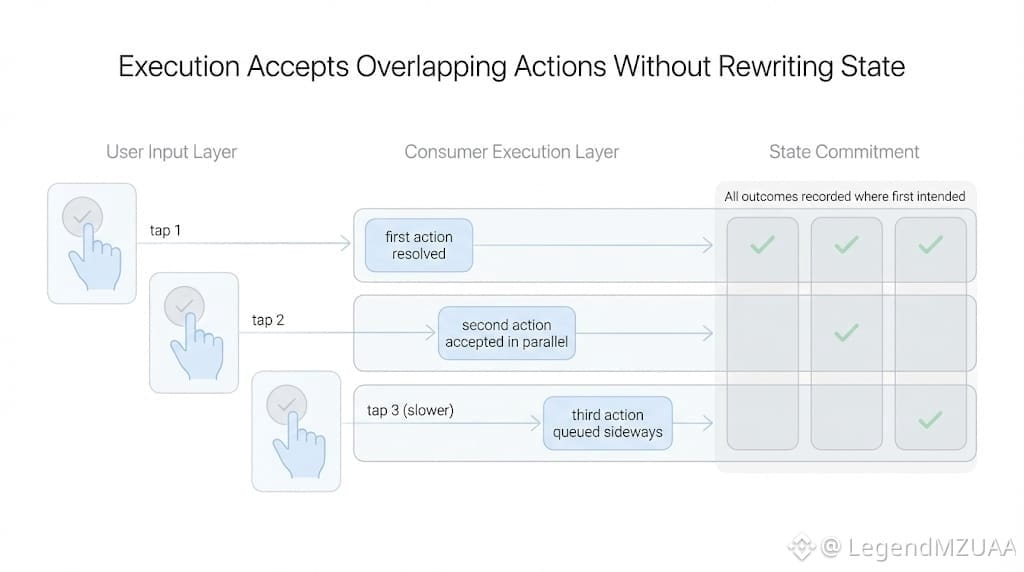
Someone tapped again before the first result fully showed. Not panic, more like doubt. The app didn’t push back. No correction banner. No “already processed.” Application execution just kept accepting shape after shape like messy intent was normal.
The execution layer, the resolver, just kept accepting shape after shape.
I assumed one would cancel the other.
Didn’t.
Later trace looked crooked. Not duplicate, more like parallel shadows of the same move. That surprised me more than failure would have.
I first blamed duplicate suppression. That wasn’t it either.
This is the part demos skip.
Watching this live on consumer rails, nothing queued politely. Nothing even tried.
In consumer rails tied to actual usage, user transaction patterns don’t queue politely.
Throughput didn’t spike.
It sort of… spread sideways.
I blamed refresh lag first. Then ordering. Then maybe my own logging window was behind. None of those stuck long.
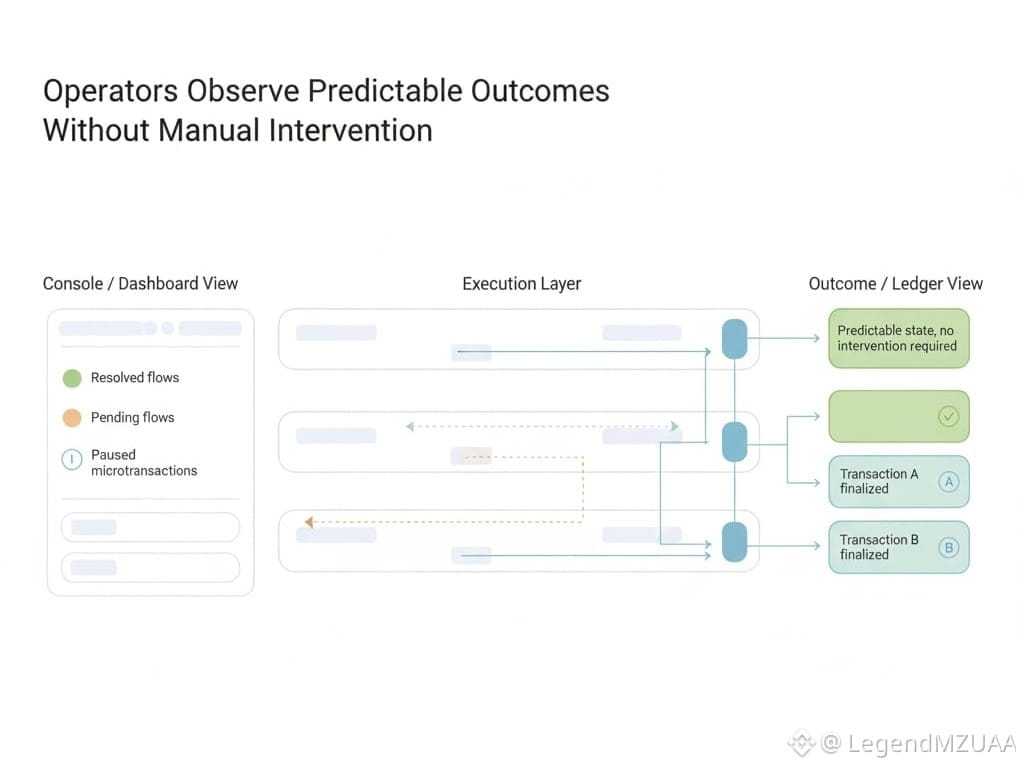
On Vanar, or whatever you want to call that app-native chain layer under these apps, execution doesn’t wait for behavioral neatness. Application execution keeps resolving even when interaction pressure comes in bent. Timing warped. Sequence improvised.
Not elegant. Just steady enough that nothing reopens.
I almost called it forgiving. That felt wrong. Too intentional.
Real interaction throughput looks emotional, not technical. Faster second tap. Slower third tap. A pause that still sends something because the finger never fully left the glass.
You can usually see when a stack expects politeness.
This one didn’t seem to.
Here it didn’t ask.
I thought one branch would roll back. It held both longer than expected. “Predictable” was the first word I wrote. Didn’t like it. Left it there anyway for a minute.
More like the ending refusing to move… even when the path limps in sideways.
That’s closer. Not perfect, closer.
The consumer infrastructure layer, or whatever that lower execution floor wants to call itself, kept closing state anyway.
Consumer infrastructure that doesn’t ask users to behave well first.
Which sounds like marketing. Still, it fit what I saw.
On Vanar rails, the consumer side, the app execution side, ordering persistence shows up in small ways. A late action doesn’t rewrite an early close. A delayed confirmation doesn’t reopen the state just to be polite. The chain layer doesn’t adapt to confusion. It just refuses to inherit it.
I nearly added extra guard delays. Would’ve created ghosts instead. Or worse, delays pretending to be safety.
Vanar showed up there sideways. Not as a feature. More like… resistance to drift. Yeah, that.
One action landed late. Still counted where it first belonged.
Maybe that’s predictability. Or something adjacent to it. Not speed. Not smoothness. Just outcomes that don’t reshuffle when behavior gets sloppy.
It held. “Held” might be too neat a word. But nothing slipped, so I kept it.