
It didn’t move.
Not broken. Not failing. Just… waiting.
I was watching a tokenized bond run through DuskTrade. Phoenix handled the confidential leg. Moonlight logged the public reporting. DuskDS sat at the center, evaluating every proof. And the €300M in real-world assets simply paused. Not because of a network fault. Not because the code failed. Because a threshold wasn’t met.
Governance and compliance weren’t abstract here, they were the gatekeepers.
The modular architecture kept unrelated flows alive. Other contracts continued. Other tokens settled. But this block, this transfer, waited. One validator rotated late. Another double-checked the staking credentials. Every signature mattered. Every vote counted. On Dusk, rules aren’t suggestions, they are obligations carried by the people operating them.
You notice it if you spend time in the logs. Builder accountability isn’t just a phrase. Every contract deployment interacts with real assets, and every misstep is visible. On DuskTrade, you can’t hide a missing confirmation.
You can’t override a threshold. Phoenix hides data, Moonlight exposes what regulators need, but the chain doesn’t negotiate.
I leaned back. The pause stretched longer than expected. You start to feel the weight of human participation. The modular layers isolate failures, so the rest of the system keeps running. But for this one block, the chain’s integrity depended on the humans.
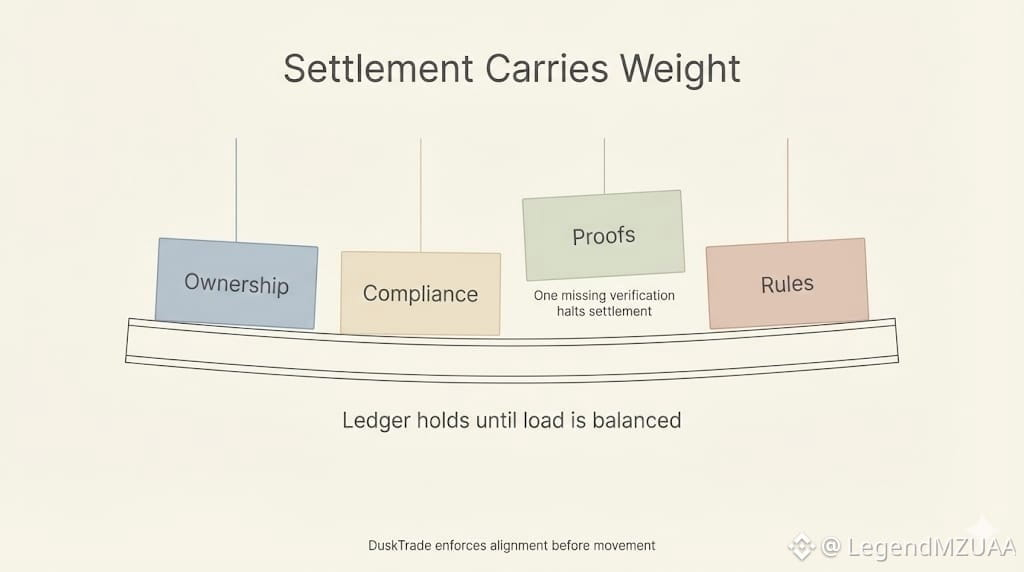
Eventually, the missing signatures arrived. DuskDS confirmed. Phoenix reconciled privacy proofs. Moonlight posted the public report. The €300M moved. Smoothly. Safely. But the lesson lingered. One missed rotation, one delayed vote, and the assets wait. The chain enforces discipline before settlement, not afterward.
On DuskTrade, institutional-grade DeFi doesn’t run on assumption. It runs on proof, on human accountability, and on layers designed to absorb mistakes without collapse. Every asset that moves carries evidence of compliance, modular isolation ensures failures don’t spread, and governance upgrades land with visible consequences.
You build trust not by shortcuts, but by respecting the system’s boundaries. You wait when the ledger waits. You inspect when it pauses.
And sometimes, that pause feels longer than the transaction itself.