
The screen lit up again. Not because I tapped, but rather because I was about to be surprised by something unexpected.One corner captured a reward. In another, I saw the start of a micro-transaction, which was closing while the first one had not finished processing. I found myself somewhat confused, perhaps I double-tapped. Perhaps I didn’t. Vanar L1 layer didn’t seem to care. It was just executed. The order was dictated by signals, not intention.
I figured one flow would override the other.
It didn’t.
Through the session, interactions accumulated. Swipes, clicks, inventory shifts. The consumer rails, gaming UI, live product feeds, metaverse panels, self folded. Nothing stopped. Application execution across every overlapping touch continued. I noticed the timing was not aligned to my expectations, but to the one captured by Vanar.
Someone next to me complained about lag. I ignored him. It wasn’t a lag. It was the friction of human behavior, meeting deterministic settlement, which was manifested unevenly.
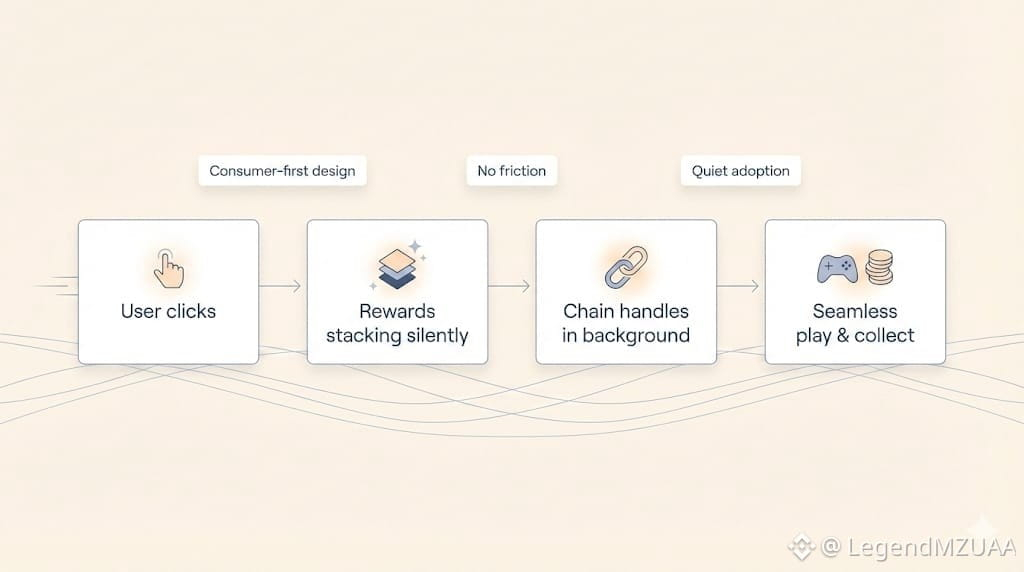
A tap that appeared to be a miss created two divergent paths. State confirmed in both. No error. No rollbacks. The UX was coherent despite the perception gaps. In the moments like this, Vanar's consumer-first design does not announce itself. It absorbs the strain.
As I got closer, I noticed the screens, and a small animation finished while a settlement was finalized. The app's performance seemed to be perfect, and the infrastructure was invisible.
I could feel the pressure of trying to track every signal, as I knew the chain wasn’t waiting for me to catch up.
On Vanar, micro-transactions finish while the user's finger is still moving. User flows don’t stop to entertain the user's curiosity. Features finish, and the chain continues to accept overlaps, restarts, pauses, and even mis-taps.
I felt like I needed to reach for a throttle, but that would have broken the relaxation I had.
As I streamed in the next session, I noticed that the app had registered two instances of the same action. One user dragged an item as they were rewarded, and the other was the same action. Neither was wrong. They lagged in human timing, but the app had executed flawlessly, and Vanar responded to the rest.
I expected that this would feel like chaos, but it felt like no flinching while trying to hold a live wire hand. It felt like tension.
Nothing is self announcing in this ecosystem of multi-products. State locks happen as the $VANRY moves. The UX moves the result while the perception continues to lag.
I gave up on guessing the order and just observed instead. One tap landed. Another one landed on the first. Transactions completed. The inventory changed. The rhythm was uneven and slightly off. But it was the Vanar's heartbeat.
Then it went on.
No more guessing. No more waiting. No more taping and landing. No more inventory and no more micro-transactions. Just living. Just moving. Just the system.
Then it went on.