
I logged into the dashboard.
Nothing had cleared yet.
Waiting. €300M in tokenized securities.
Phoenix has processed some of the confidential proofs. Moonlight has shown the rest to the auditors.
DuskDS remains quiet.
One validator is yet to sign.
A governance upgrade is waiting in the queue.
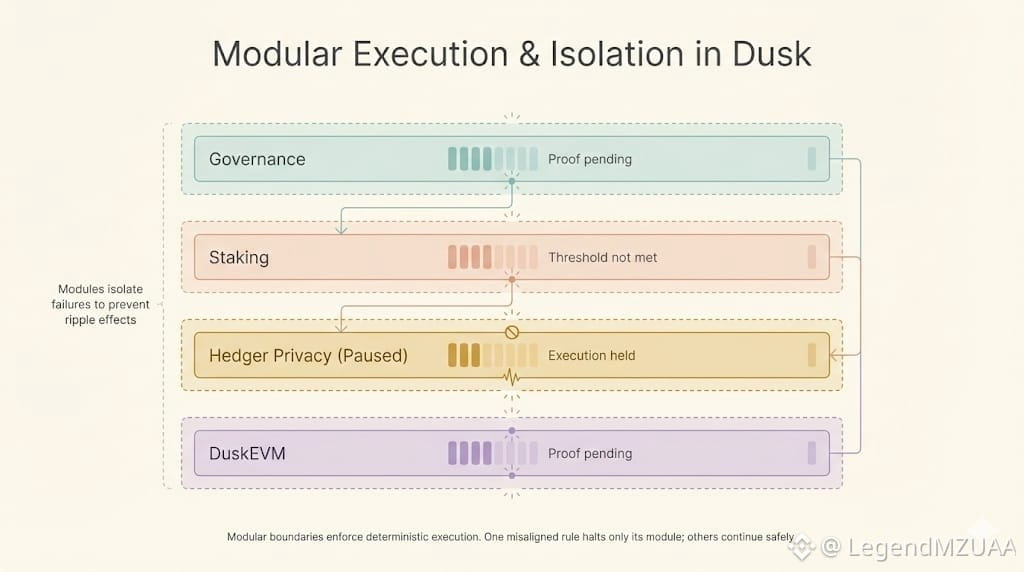
Modular architecture keeps everything else in a steady state. Other contracts keep moving. Other assets keep settling.
But this one transfer? It waits.
Builders target contracts expecting them to be executed. On Dusk, that expectation is meaningless.
Compliance is not an afterthought. It is built in. Permissions, signatures, staking, governance approval thresholds, every piece matters before state changes.
I lean back.
The pause goes on.
You begin to see the patterns of humanity. Hesitations. Re-do’s. Late rotations. Every operator’s move is legible in the ledger.
The modular layers soak up the risk. A single delay doesn’t ripple through the network. That’s what DuskTrade is for. Phoenix keeps private data private. Moonlight shows what is needed for the regulators. DuskDS keeps the settlement disciplines.
And yet.
That waiting feels heavy.
Finally, the signatures are here. The assets move. The block is finalized. €300M flows.
Private where needed. Auditable. Smooth.
But it doesn’t feel smooth.
Every pause on Dusk is a reminder of the human staked on the other end. Builder accountability is not a theory. It’s a fact.
I check the logs one more time.
Every rotation documented. Every vote on the blockchain governance is accounted for. Every asset transfer connected to a decision made by a human.
That’s what DuskTrade demonstrates.
There can be real-world assets existing on-chain. There can be settlements without concession. But only if the humans involved do their part.
And sometimes, patience is the price of assurance.