
In February 2025, while the crypto market was still struggling under the shadow of liquidity tightening, a project on the Solana chain called SSE (Solana Social Explore) burst into the public eye at an astonishing speed, becoming the most关注ed 'phenomenal' social data tool in the bear market.
Behind this achievement lies not only Solana's deep exploration of AI technology but also reflects the strong demand from the crypto community for a new narrative of 'data + social + trading.'
SSE's positioning: The 'AI navigator' of on-chain social data
The core function of SSE is to provide users with automated analysis and insights of on-chain social data, helping to optimize token trading decisions.
Its toolkit covers four major modules:
1. Address activity tracking: Real-time monitoring of fund flows and interaction behaviors of on-chain addresses, identifying abnormal trading patterns;
2. Monitoring popular tokens: Using AI algorithms to filter tokens with a surge in trading volume or high community discussion heat in the short term;
3. Analysis of top traders: Tracking the position changes and strategies of high-yield traders to generate replicable trading signals;
4. Building social graphs: Visualizing the interaction relationships between users and on-chain addresses to reveal potential funding flows and community influence networks.
Unlike traditional on-chain analysis tools, SSE differentiates itself by deeply integrating AI-driven data mining with social interaction.
For example, users can discover high-frequency interactions between an anonymous address and multiple KOL wallets through SSE's social graph, thereby inferring the market trends behind it. This integration of 'data + relationship chains' has made it a new favorite in the Degen (crypto speculator) community.
Behind the scenes: The Tapestry protocol and Degen culture marketing
The technical foundation of SSE relies on the social graph protocol Tapestry of the Solana ecosystem. This protocol aims to provide social functionality infrastructure for decentralized applications (dApps), such as user relationship networks and content distribution logic.
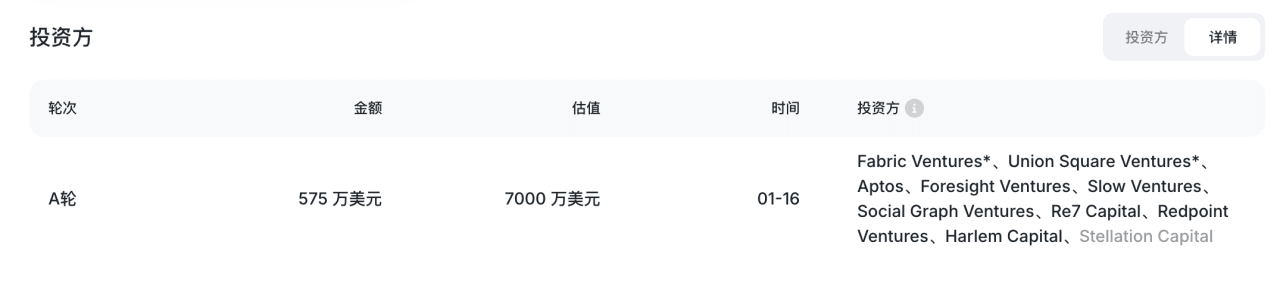
In January 2025, Tapestry completed a $5.75 million Series A financing with a valuation of $70 million, led by Fabric Ventures and Union Square Ventures, showing the long-term optimism of capital for the social graph track.
The Tapestry team understands the culture of the crypto community well, and its marketing strategy is full of 'Degen-style' satire and interaction:
The contract address acrostic: When announcing the SSE contract address, the official Twitter embedded the first four characters 'H4PH' in an acrostic poem, triggering a community decryption craze;
Developer earnings exposure: The team wallet's earnings were exposed by on-chain tracking tools (nearly $2.5 million), and then the developer 'nemoblackburn' released an internal testing invitation code on the social application VECTORDOTFUN and pinned the tweet 'i love degens', further reinforcing the project's binding with speculative culture.
This strategy of 'transparent operations + community collaboration' successfully attracted on-chain players eager for a new narrative.
As Tapestry founder David Gabeau said, 'On-chain addresses are essentially similar to email, both are carriers of identity and behavior.' And SSE is a key attempt to transform this concept into an operable tool.
Technical architecture: How does AI empower on-chain social?
The technical highlight of SSE lies in the real-time interaction between AI models and on-chain data:
1. Dynamic data cleaning: By utilizing Solana's high throughput characteristics (tens of thousands of transactions per second), SSE can capture and clean on-chain data in real-time, reducing noise interference;
2. Behavioral pattern recognition: Using machine learning algorithms to analyze address transaction history to identify common strategies of 'smart money' (such as targeting low liquidity tokens, batch orders, etc.);
3. Quantifying social influence: Based on interaction frequency and funding relevance between users and addresses, build a decentralized 'social credit scoring' system.
It is worth noting that SSE's AI model is not completely closed. According to the developer documentation, users can earn token rewards by contributing data or computing power, forming a closed loop of 'data input - model optimization - profit feedback.'
This design not only reduces the risk of centralized data monopoly but also aligns with the open spirit of Web3.
Ecological synergy: Solana's 'AI social matrix'
The rise of SSE is not an isolated event but a reflection of the gradual formation of the AI social matrix within the Solana ecosystem.
By the end of 2024, several AI agent projects emerged from the hackathon co-hosted by the Solana Foundation and SendAI, such as:
Cod3x: No-code construction of AI-driven DeFi strategy agents;

Boltrade: An autonomous agent that tracks smart money and generates trading signals;
Griffain: A 'yellow pages-style' platform integrating multiple AI agents, supporting on-chain communication between agents (SAIMP protocol).

These projects together form a complete supply chain from data infrastructure (Tapestry), development tools (Solana Agent Kit) to application layer (SSE, Griffain). SSE's role is more like a 'data entry point', providing real-time decision-making basis for upper-layer agents.
For example, Griffain's AI agent can obtain social heat data of a certain token through SSE, automatically triggering buy or short-selling actions.
Controversy and challenges: A flash in the pan or long-term value?
Despite attracting significant attention in the short term, SSE’s long-term development still faces multiple challenges:
1. Data privacy and abuse risks: The transparency of on-chain data may lead to excessive tracking of user behavior, potentially becoming a tool for market manipulation;
2. Model interpretability: AI-generated trading signals lack transparent logic, which may lead to 'black box dependency' issues;
3. Community fatigue: Projects driven by Degen culture often face periodic declines in popularity, requiring continuous iteration of features to maintain user stickiness.
In addition, the competitive landscape for SSE is rapidly forming. For example, social applications like VectorDotFun and Warpcast have begun integrating similar data analysis modules, while the Ethereum ecosystem's Virtuals Protocol has also launched tokenized AI agent features.
Whether SSE can establish barriers with its first-mover advantage still needs to be observed in its technical iteration and ecological cooperation progress.
Disclaimer: The content of this article is for reference only and does not constitute any investment advice. Investors should rationally view cryptocurrency investments based on their own risk tolerance and investment goals and should not follow the trend blindly.