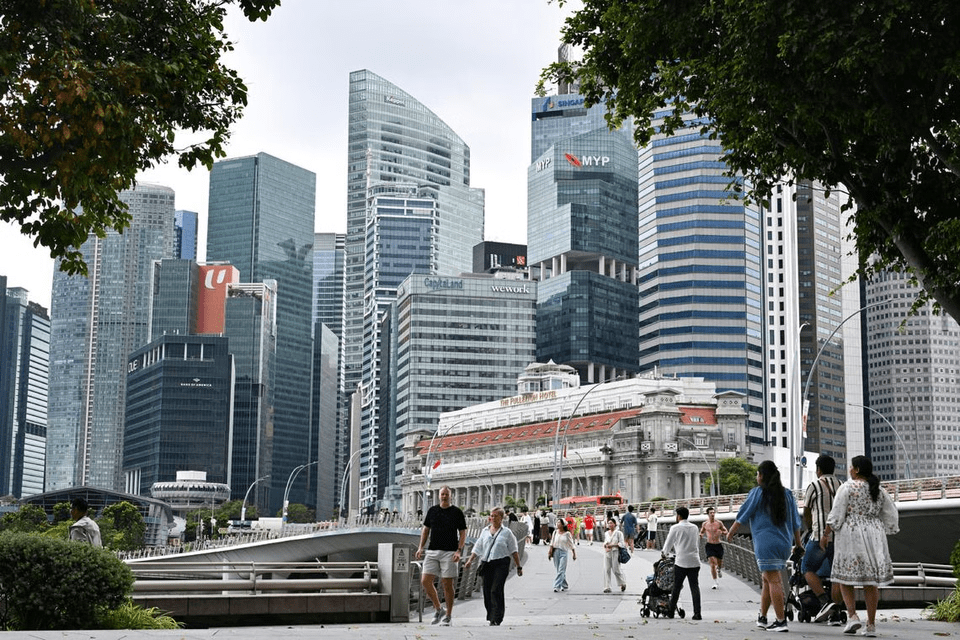
The Ministry of Trade and Industry (MTI) has lowered its growth forecast for Singapore in 2025 to between 0% and 2% ahead of the tariff war between the U.S. and China, while some economists warn of the potential for a technical recession in 2025.
MTI's new forecast published on April 14 indicates a reduction from the previous 1% to 3%. Singapore's economy is expected to grow by 4.4% in 2024.
On the same day, the Monetary Authority of Singapore continued to slow the pace of appreciation of the local currency against the trade-weighted basket to cope with the declining inflation and increasing risks to economic growth.
MTI also indicated that Singapore's economy grew by 3.8 percent year-on-year in the first quarter of 2025, according to preliminary estimates. This figure is slower than the 5 percent growth in the fourth quarter of 2024 and some market forecasts.
On a seasonally adjusted quarterly basis, the economy contracted by 0.8 percent, reversing a growth of 0.5 percent in the fourth quarter of 2024.
Bloomberg-polling analysts expect a year-on-year growth of 4.5% and a quarterly decline of 0.4%.
MTI stated that it will continue to closely monitor domestic and global developments and will further adjust the new forecast if necessary.
In the minister's statement regarding U.S. tariffs on April 8, Prime Minister and Finance Minister Lawrence Wong stated that Singapore may or may not fall into recession in 2025, but the country's growth will be significantly affected.
On April 9, U.S. President Donald Trump announced a temporary suspension of tariffs for 90 days, except for tariffs on China, which currently stands at an astonishing 145 percent. In retaliation, China has raised tariffs on U.S. goods to 125 percent - effective April 12.
Singapore still faces a fixed tariff rate of 10 percent that Mr. Trump imposed on goods from all foreign countries, effective April 5.
The Trump administration later excluded electronic devices like smartphones and laptops from reciprocal tariffs, meaning they would not be subject to the 145 percent tax as applied to China.
But hours later, they announced that they fall under the semiconductor import tariff and are subject to a separate import tax.
MTI warns that the tariff war poses "significant downside risks" to the global economy. MTI stated that the increase in uncertainty could lead to a larger-than-expected decline in economic activity as businesses and households adopt a "wait-and-see" approach before making spending decisions.
Retaliatory tariff moves could lead to a global trade war, disrupting global supply chains, raising costs, and leading to a much more severe global economic recession.
The global deflation process could also be disrupted and recession risks increase in both advanced and emerging markets, leading to unstable capital flows that could create potential vulnerabilities in the banking and financial system.
Mr. Song Seng Wun, an economic advisor at CGS International Securities, stated that Singapore is facing the risk of a technical recession, "due to many uncertainties surrounding the trajectory of economic growth."
Technical recession is defined as two consecutive quarters of declining gross domestic product (GDP).
Mr. Song said, "Although not ideal, this is a more positive outcome compared to the prolonged recession scenario."
Ms. Selena Ling, chief economist and director of global market research and strategy at OCBC Bank, stated that "there are still no clear signs of a bottom."
She said, "A technical recession may occur as the impact of the initial tariff announcements from the U.S. has caused significant havoc in the financial markets in April and is expected to have real economic consequences in the months ahead."
In the second half of 2025, Ms. Ling stated that the Singapore economy is likely to decline further from the high baseline seen in the second half of 2024, when growth was 5.7 percent year-on-year in the third quarter and 5 percent in the fourth quarter. She indicated that this would bring her full-year 2025 growth forecast closer to 1.6 percent - assuming the 10 percent tariff on Singapore remains intact.
Maybank economist Brian Lee maintains the GDP growth forecast for 2025 at 2.1%, slightly higher than MTI's new forecast.
He said, "We are anticipating growth to slow down, but not a recession at this stage."
He said that the U.S. suspension of tariffs on most countries as well as the redirection of trade and financial flows could alleviate the impact on Singapore's economy.
Mr. Lee noted that domestically, lower interest rates, a construction boom, and more financial support will also help support growth.
He also noted that growth in the manufacturing sector is stronger than expected at 5% in the first quarter of 2025, although slowing down from 7.4% growth in the fourth quarter of 2024.
This indicates that activities took place earlier in March in the context of a rush to produce and ship orders before the U.S.'s retaliatory tariff announcement on April 2.
MTI's data shows that the construction sector grew by 4.6 percent, extending the 4.4 percent growth from the previous quarter.
Among the service sectors, wholesale and retail trade as well as transportation and warehousing saw an overall growth of 4.2%, down from a growth of 5.6% in the previous quarter.
All sectors in the group, except for retail, experienced growth in the quarter.
Growth in the information and communication, finance and insurance, and professional services sectors has decreased to 3 percent.
Singapore's finance and insurance sector expanded due to strong banking activity and operations primarily related to payment companies.
Growth in the remaining services sectors, including accommodation and food services, real estate, and administrative and support services, remained unchanged from the previous quarter at 2.5 percent.
Binance registration link: https://www.generallink.top/referral/earn-together/refertoearn2000usdc/claim?hl=vi&ref=GRO_14352_4ANEH&utm_medium=app_share_link
PLEASE SUPPORT US BY LIKING, SHARING, COMMENTING, FOLLOWING
THANK YOU VERY MUCH!