The U.S. Constitution indeed stipulates that all taxation powers belong to Congress, and the president cannot act arbitrarily. However, to compensate for the slow decision-making process in Congress, it also stipulates that Congress must delegate some executive decision-making power to the White House in special circumstances. Trump's major tax increase campaign has precisely found loopholes in (National Emergencies Act) + (International Emergency Economic Powers Act).
On April 2, Trump first issued a statement saying the U.S. border is riddled with holes, the energy crisis is imminent, the trade deficit is urgent, and the people are suffering greatly, officially declaring a national emergency. Once the country enters a state of emergency, the president's powers will be infinitely amplified, and both of the aforementioned laws contain provisions stating that 'the president has the authority to take control measures on all assets related to foreign interests in a state of emergency.' No one in the U.S. had previously interpreted 'assets related to foreign interests' here as tariffs; Trump is the first to stand up and explain it this way.
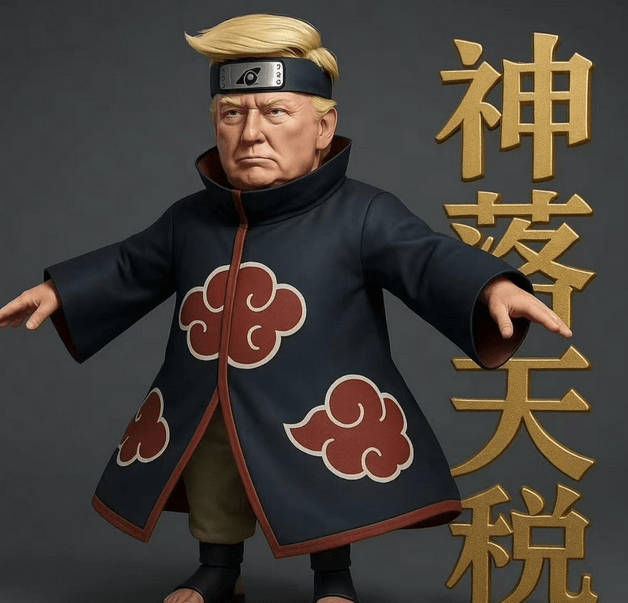
Can the U.S. Congress propose a bill to reject Trump's major tax increase policy? The answer is very difficult. First of all, the Republican Party currently has the advantage in Congress, and the first round of proposal voting may not even pass. Even if the first round of voting passes, Trump can directly reject the proposal. According to the process, Congress can vote a second time, and at this point, a 2/3 majority is needed to trigger a second proposal, which is even less likely than passing the first round of voting.
Can the U.S. Supreme Court directly intervene to rule Trump's major tax increase policy invalid? The answer is also very difficult. First of all, several Supreme Court justices are Trump’s confidants, and additionally, there are simply too many cases related to Trump piling up at the Supreme Court, they can't even handle them all.
The reality over in the U.S. is like this: the intention of delegating some executive decision-making power from Congress to the White House is to improve efficiency in a national emergency and take swift actions to deal with crises. However, the bug here is that the definition of a national emergency is also handed over to the White House. Theoretically, Trump could declare the U.S. to be in a state of emergency every single day of the year, thus bypassing Congress to obtain several significant powers without oversight. Moreover, in this game, most players and referees are Trump’s people.
"Once the U.S. enters a state of emergency, the U.S. president can do whatever he wants, and no one can stop him," Trump said in a public speech, pretty straightforward, right?
Trump's administration showcases extremely reckless and hasty decision-making externally while being able to precisely identify various American bugs to infinitely expand power internally. Now, let alone the American people, even those congressmen dare not ask too many questions; asking is a state of emergency, and MAGA needs no more words!

\u003cc-39/\u003e\u003cc-40/\u003e\u003cc-41/\u003e