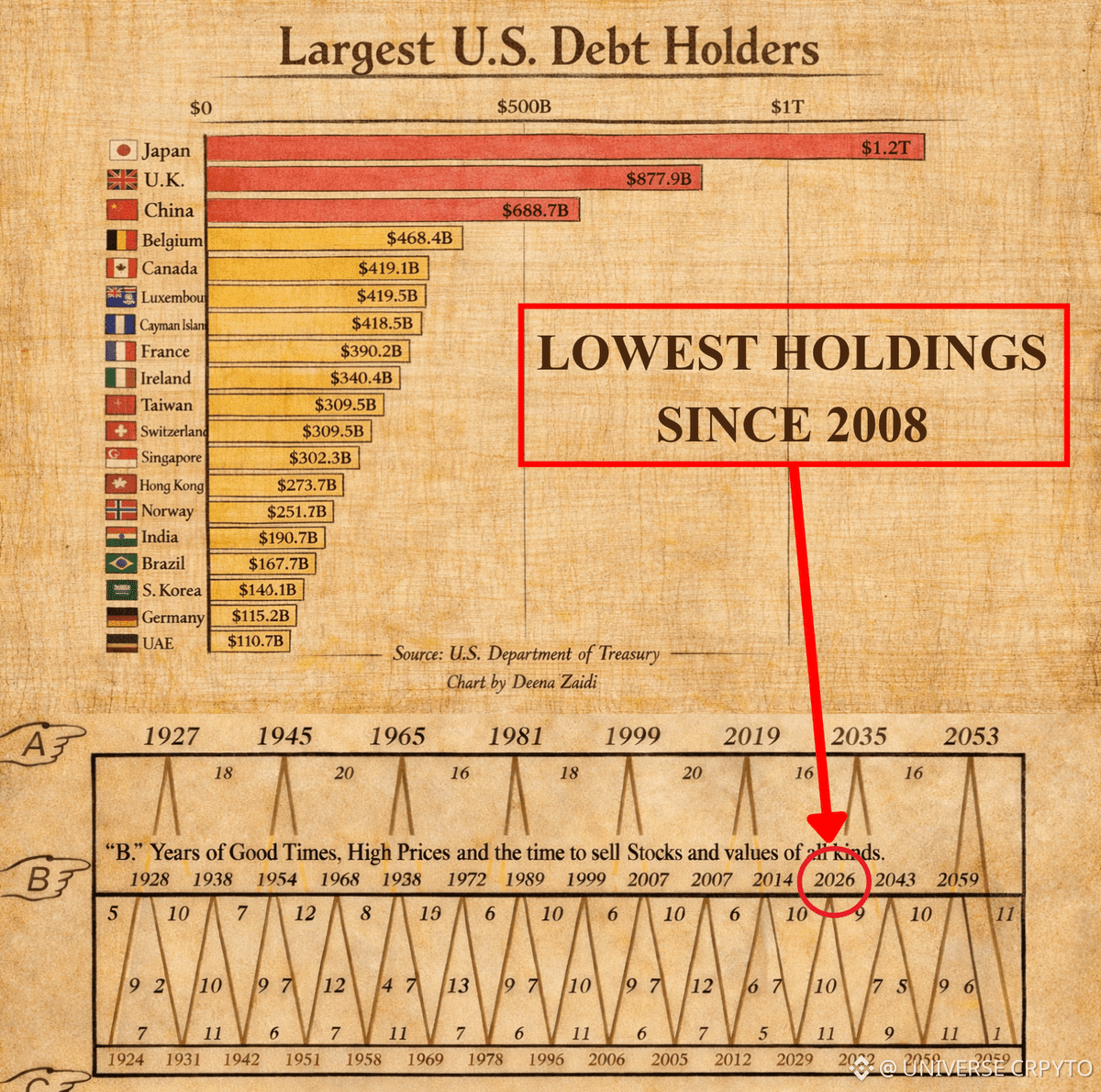
📊 What This “Largest U.S. Debt Holders + 2026 Cycle” Chart Really Means (And Why Crypto Traders Should Pay Attention)
Recently a chart has been circulating showing two ideas combined:
Who owns U.S. government debt (Treasuries)
A long-term economic cycle pointing toward the year 2026
Many people are sharing it without explanation — so let’s actually break it down properly.
Part 1 — Largest Holders of U.S. Debt
The first half of the chart shows countries holding U.S. Treasury bonds.
Top holders: • Japan ≈ $1.2T
• United Kingdom ≈ $877B
• China ≈ $688B
• Belgium, Canada, Luxembourg, Cayman Islands, France, Ireland, Taiwan follow after.
What does this mean?
When a country buys U.S. Treasuries, it is basically lending money to the United States government.
Why would they do that?
Because U.S. Treasuries are considered: ✔ very liquid
✔ globally accepted
✔ historically one of the safest assets
Countries park their reserves there instead of holding cash.
So this is not a “weakness” — it actually shows how central the U.S. dollar system is to the global economy.
Why the “Lowest Holdings Since 2008” part matters
The chart claims foreign holdings are at their lowest level since 2008.
In simple words: Some countries are slowly reducing reliance on U.S. debt and diversifying into: • gold • local currencies • trade agreements • sometimes Bitcoin
This doesn’t mean the dollar collapses tomorrow.
It means the global financial system is gradually changing.
Part 2 — The 2026 Economic Cycle (The Important Section)
The bottom part of the image shows a repeating historical pattern.
It is based on a very old market observation:
Financial markets move in long cycles, not straight lines.
The chart highlights:
“Years of good times, high prices and the time to sell stocks and assets”
Examples shown: 1929 → Great Depression
1968-1972 → inflation & oil crisis period
1999-2000 → Dot-com bubble
2007 → Housing crash / Global Financial Crisis
The next projected peak on that cycle is around 2026.
This does NOT mean a crash must happen exactly in 2026.
It means: Markets may enter a late-cycle overheating phase around that period.
Why This Is Important for Crypto
Crypto doesn’t move alone.
Bitcoin and Ethereum are now tied to: • liquidity • interest rates • money printing • global risk appetite
Here is the key relationship:
When central banks print money →
liquidity increases →
risk assets rise →
crypto bull market.
When interest rates stay high →
liquidity drops →
risk assets struggle →
crypto slows or corrects.
The Bigger Picture
Right now the world is in a transition:
Old system: Bank-centered, debt-based, dollar-dominant
Emerging system: Digital assets, tokenization, decentralized settlement
This is why: Gold is rising
Central banks are buying assets
Bitcoin ETFs were approved
And institutions are entering crypto
A Possible Timeline (Educational View)
2024-2025 → liquidity expansion phase
2025-2026 → late bull market / hype stage
After → potential macro correction cycle
Again — this is not a prediction, but a historical pattern observation.
What Traders Should Learn
The chart is not telling you to panic.
It is teaching a very important lesson:
Markets are not random.
They are liquidity driven.
If you only look at candles, you see noise.
If you understand macro cycles, you see context.
Crypto traders who survive long-term are not the ones who trade the most —
they are the ones who understand when the environment is favorable.
Trade smart. Manage risk. Think in cycles, not days.
#USIranStandoff #BitcoinGoogleSearchesSurge #RiskAssetsMarketShock #ADPDataDisappoints
BNBUSDT
Perp
636.74
-1.6%
ETHUSDT
Perp
2,073.53
-0.6%
BTCUSDT
Perp
70,051.2
+1.24%