

 Most Layer 1 blockchains are still competing for the attention of Crypto Twitter. Faster TPS, louder narratives, bigger incentive programs but the real question remains:
Why hasn't Web3 made a proper breakthrough in mainstream entertainment and gaming yet?
Vanar Chain approaches this question from a different angle. Instead of trying to onboard users to crypto, this chain follows a simple idea:
Make crypto invisible.
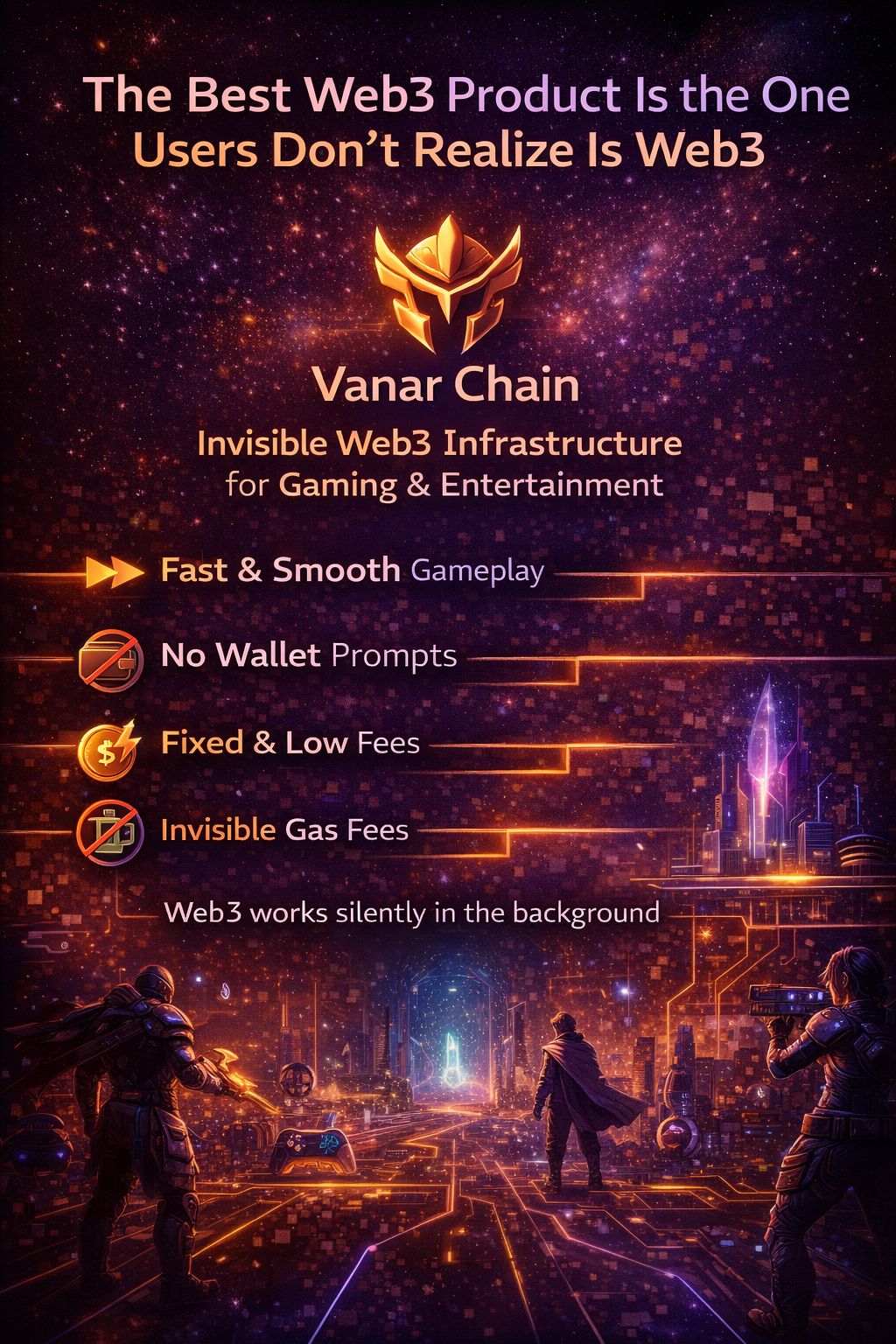
The user just wants the experience the game, the content, the interaction. Wallet prompts, gas fees, signing transactions all of this creates friction. Vanar's focus is on building Web3 not as a "feature," but as background infrastructure.
Infrastructure First, Narrative Second
Vanar doesn't market itself by becoming a buzzword chain. Creating hype by calling itself an "AI chain" or a "gaming chain" is not its main approach.
Its focus is on infrastructure treating AI and data as a stable foundation. Through the Neutron and Kayon architecture, Vanar pushes an important idea:
Data shouldn't just be stored, it should also be usable and programmable.
This point is crucial for the future AI agent economy. Because AI-driven systems don't pause. In-game economies, automated actions, content pipelines everything runs 24/7.
And if the blockchain is slow or the fees are unpredictable, this entire vision collapses. Vanar's fixed-fee mindset and low-latency execution seem designed for this nonstop activity.
Why Entertainment Needs a Different Blockchain
Gaming and entertainment are unforgiving spaces. If there's a delay, the immersion is broken. If a wallet prompt appears, the user quits.
This is why many Web3 games have failed. The problem wasn't ownership. The problem was that friction killed the fun.
Vanar chain is being built understanding this reality:
Fast confirmations so gameplay doesn't pause
Predictable cost for micro-actions
Stability during peak demand
Studio-friendly tooling that helps with shipping
This isn't just "good enough" performance. This performance is designed according to entertainment standards where the experience needs to feel instant.
VANRY’s Role: Utility Before Hype
Vanar doesn't make the token the product. Vanar makes the ecosystem the product. It treats VANRY like an engine, not a marketing object.
VANRY's role is clear:
network execution and transactions
builder and user incentives
shared economic activity in ecosystem apps
governance (with future maturity)
Vanar's bet is simple: if real usage grows, the token's relevance will naturally grow. No constant narrative rotation needed.
VGN and the Invisible Blockchain Thesis
The Vanar Gaming Network (VGN) further strengthens Vanar's core idea.
The ideal outcome of blockchain gaming is not that players understand decentralization. The ideal outcome is that players don't even realize that blockchain is being used.
Fast start, instant actions, native-feel trading, ownership quietly running in the background.
If assets within the ecosystem can move across games, then value won't be trapped in a single title. Then isolated economies will start becoming a connected network and that's the next step of real Web3 gaming.
Final Take
Vanar feels less like a blockchain project and more like an infrastructure company positioning itself for the future of entertainment and AI.
If the tech remains invisible, experiences remain smooth, and real usage grows, then VANRY won't be a narrative VANRY will be the fuel.
And in the long term, the networks that matter are those where execution is prioritized over hype.