

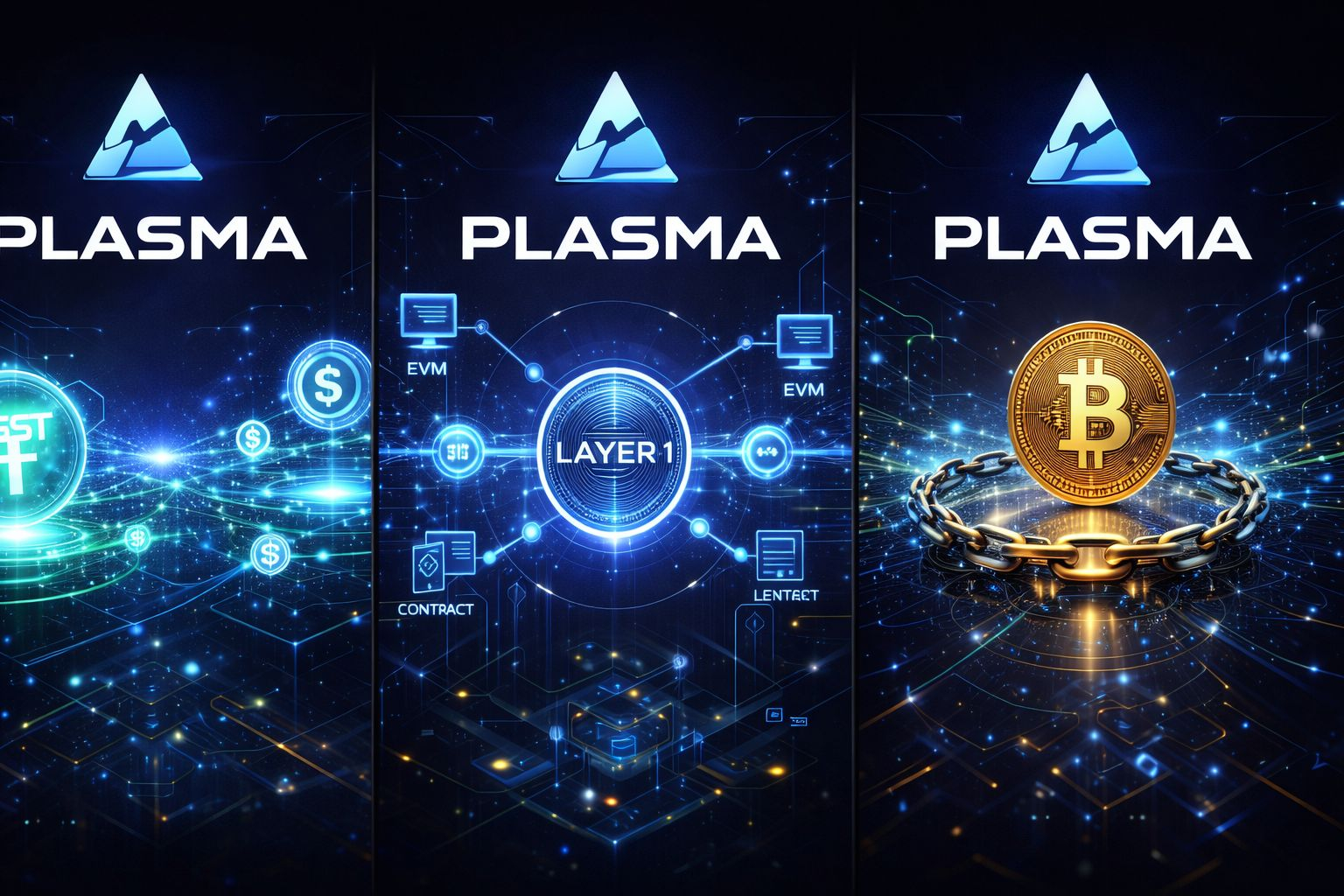
Most people in crypto are still staring at charts, waiting for breakouts, arguing about resistance levels, and chasing momentum. But underneath all that noise, something much quieter is being built. Plasma isn’t trying to win attention with hype cycles or flashy promises. It’s positioning itself as a Layer 1 blockchain designed specifically for stablecoin settlement, and that focus alone makes it different from most networks in the market. While many chains try to be everything at once—DeFi hub, NFT playground, gaming ecosystem—Plasma narrows its vision to one thing: becoming the most efficient, frictionless rail for stablecoin movement. In a world where USDT and other stablecoins move billions daily across exchanges, desks, payment systems, and cross-border transactions, building a chain optimized purely for that purpose starts to look less like a niche idea and more like a strategic inevitability.

#Plasma is built with sub-second finality, meaning transactions confirm almost instantly. That isn’t just a technical flex; it directly impacts capital efficiency. When funds settle faster, liquidity moves faster. When liquidity moves faster, markets become more efficient. For traders, institutions, and payment processors, settlement speed is not a luxury—it’s infrastructure. On top of that, Plasma introduces stablecoin-first mechanics like gasless USDT transfers and the ability to use stablecoins as gas. This removes one of the biggest friction points in crypto: needing to hold a separate volatile token just to move value. For users in emerging markets or businesses using stablecoins for payments, this design choice can dramatically simplify adoption.
At the same time, Plasma stays EVM-compatible, which is a smart move rather than a rebellious one. Developers don’t need to relearn everything or abandon existing tooling. Smart contracts built for Ethereum-style environments can migrate without major friction. Crypto history shows that developers follow convenience, users follow cost-efficiency, and liquidity follows stability. Plasma seems engineered to align with all three. Instead of trying to reinvent the wheel, it refines it for a specific use case—stablecoin settlement at scale.
Another subtle but powerful aspect of Plasma’s architecture is its Bitcoin-anchored security model. By tying its security assumptions to Bitcoin, the most battle-tested network in crypto, Plasma isn’t just marketing speed—it’s reinforcing trust at the base layer. In a market that is slowly transitioning from speculative mania to real-world financial integration, security credibility matters more than ever. Institutions don’t move serious capital on narratives; they move it on reliability and risk assessment. Anchoring to Bitcoin strengthens Plasma’s long-term positioning in that conversation.
Of course, specialization carries risk. A chain focused on stablecoins must ensure that stablecoin usage continues expanding and that liquidity doesn’t fragment across too many competing rails. Ethereum Layer 2s are reducing fees. High-throughput chains are increasing speed. Competition will be real. Execution will matter more than storytelling. But if stablecoins continue becoming the backbone of crypto payments, remittances, on-chain commerce, and global value transfer, then networks purpose-built for that exact function may quietly become essential infrastructure rather than optional alternatives.
@Plasma isn’t trying to dominate headlines; it’s trying to dominate settlement. And infrastructure rarely trends on social media until the moment everyone realizes they’ve been using it all along. The real shift in crypto isn’t just about price cycles anymore—it’s about maturation. As the industry moves deeper into its infrastructure phase, projects that focus on efficiency, usability, and capital flow mechanics may end up carrying more weight than the loudest speculative plays. Plasma represents that quieter thesis: build the rails first, and the liquidity will eventually follow.

