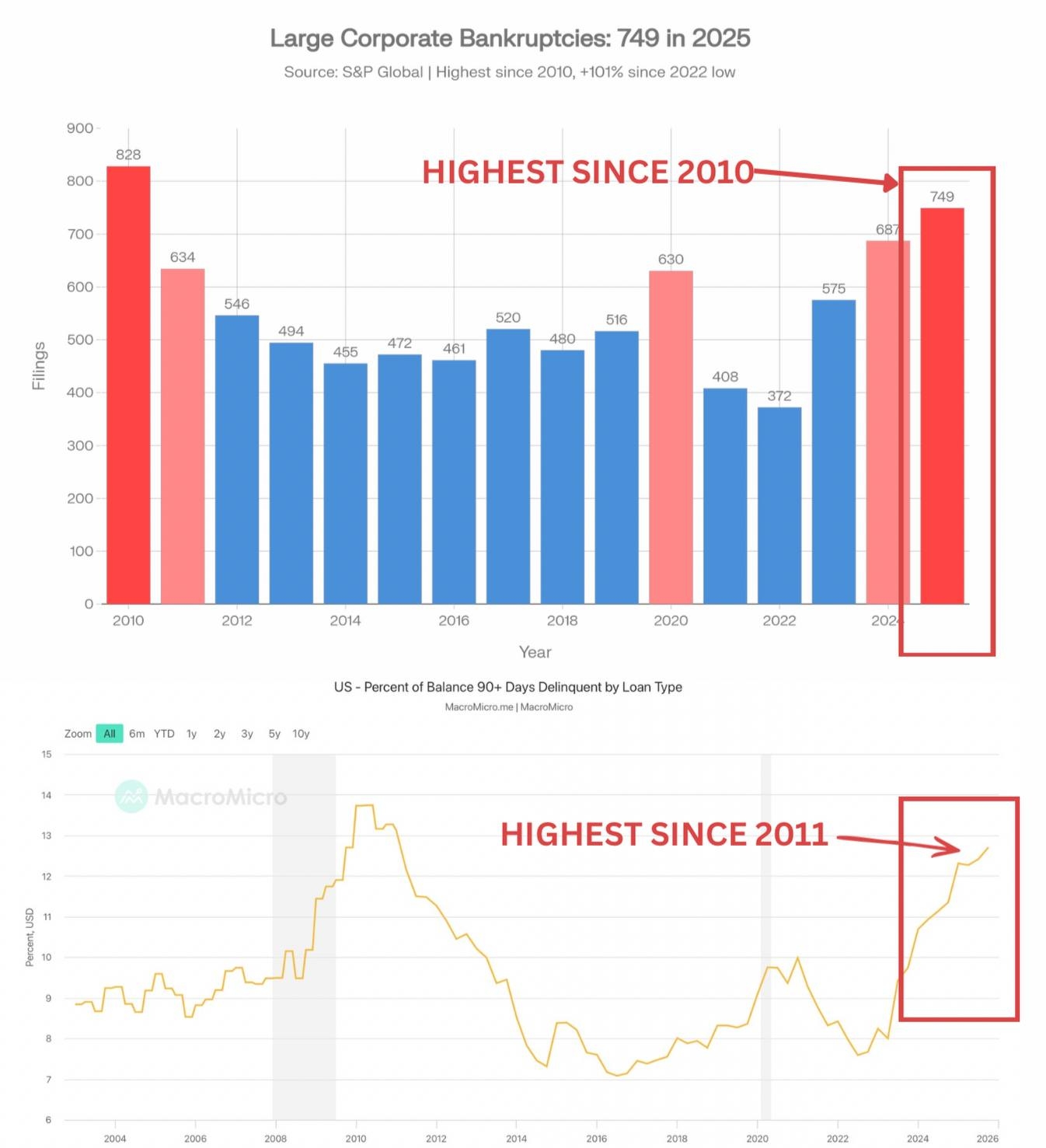
BREAKING: Financial stress across U.S. companies and households has reached levels not seen since the last major crises.
Corporate distress is accelerating rapidly. Over the past three weeks, 18 large U.S. companies — each carrying more than $50 million in liabilities — have filed for bankruptcy. Last week alone saw 9 major corporate failures.$BTC
This has pushed the three-week average to 6 large bankruptcies, the fastest pace since the 2020 pandemic shock. For context, the most severe period of this century was during the 2009 financial crisis, when that same average peaked at 9. Current conditions are now approaching crisis-level territory.
The pressure on consumers is even more alarming.
Serious credit-card delinquencies climbed to 12.7% in Q4 2025, the highest reading since 2011, when the economy was still recovering from the 2008 collapse. Since Q3 2022, these delinquencies have surged by 5.1 percentage points — a sharper increase than what occurred during the 2008–2009 crisis.
This shows that missed payments are accelerating, not leveling off.
Late-stage stress is also building. The share of credit-card balances that are 90 days or more past due has risen to 7.1%, now the third-highest level since 2011.
Younger consumers are feeling the greatest strain:
Ages 18–29 are seeing serious delinquency rates near 9.5%
Ages 30–39 are around 8.6%
Both are significantly higher than older age groups. Since younger households account for a large portion of discretionary spending, this trend carries major economic risk.
Meanwhile, U.S. household debt has reached a new all-time high of $18.8 trillion, increasing by $191 billion in Q4 2025 alone. Since early 2020, total household debt has grown by $4.6 trillion.
Every major debt category is now at record levels:
Mortgage debt: $13.2 trillion
Credit card debt: $1.3 trillion
Auto loans: $1.7 trillion
Student loans: $1.7 trillion
All of this is happening at the same time:
Corporate bankruptcies are rising quickly
Consumers are falling behind on payments
Delinquency rates are climbing sharply
Debt balances are already stretched to record highs
This combination typically appears late in the economic cycle — when growth is slowing but leverage remains elevated.
If business failures continue and consumers struggle further, the pressure will spread to employment, consumer spending, and credit markets.
That’s usually when policymakers step in.
The Federal Reserve’s primary responses include cutting interest rates, providing liquidity, and potentially expanding its balance sheet if financial stress begins to threaten system stability.
In simple terms: lower borrowing costs, easier access to credit, and more money injected into the economy to support growth.
However, policy action usually follows clear signs of damage in the data.
Right now, the message from bankruptcies, delinquencies, and rising debt is clear:
Financial stress is accelerating — and the moment for policy intervention is drawing closer.