

USD1 and Why Issuer Discretion Is a Real Issue for Digital Dollars. $USD1 $WLFI
Digital dollars have changed the internet’s financial landscape. Stablecoins now move billions every day, drive DeFi, make global payments easier, and back up all sorts of crypto finance. But beneath the “1:1 backed” marketing, there’s a problem that doesn’t get enough attention: how much power do issuers really have?
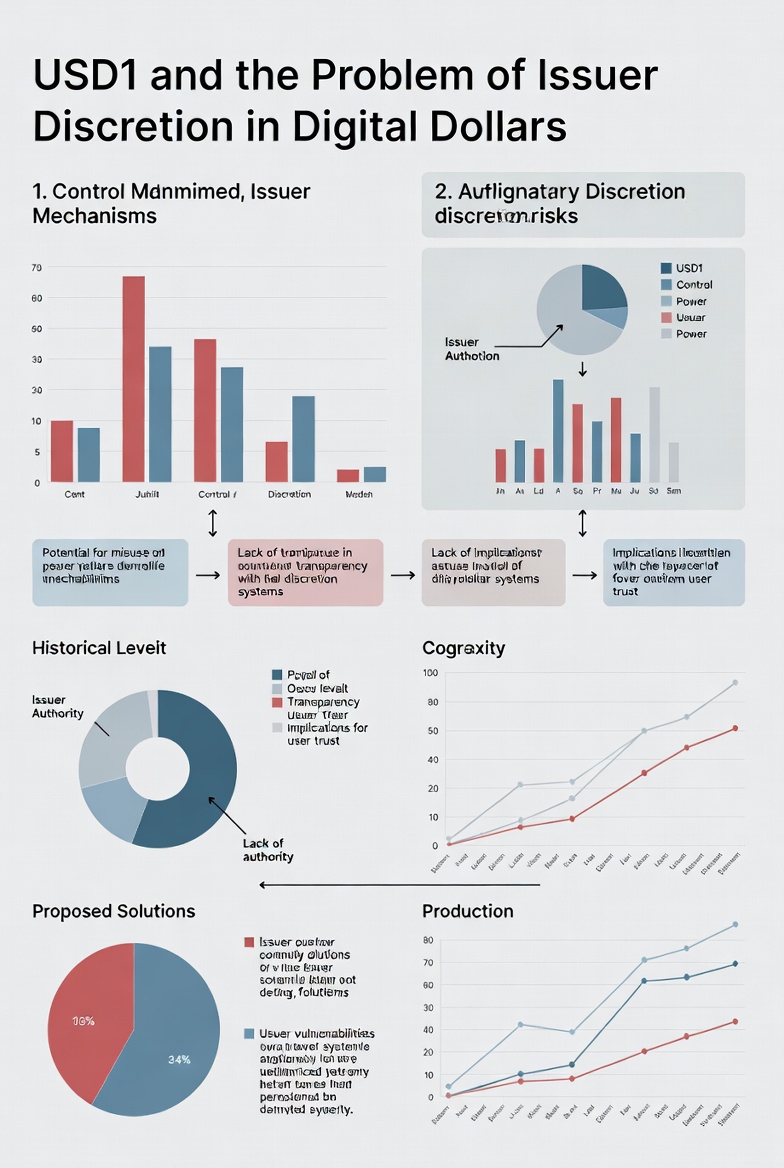
USD1 steps into this space with a clear idea. It’s not trying to be a yield machine or some governance experiment. It treats the dollar as infrastructure—plain and simple. That brings up the big question: just how much control should someone have over a digital dollar?
The Real Issue: Discretion vs. Neutrality
Every centralized stablecoin is basically someone’s IOU. The issuer controls everything: minting, redemptions, managing reserves, freezing, blacklisting, growing the supply. Sure, they say these controls are for stability and compliance. But here’s the catch:
The more power the issuer has, the less neutral the digital dollar is.
But if you take away that power, operating under real-world regulations gets tough.
How Issuer Discretion Actually Shows Up
1. Freezing or Blacklisting
Most fiat-backed stablecoins let issuers freeze addresses. Sometimes that’s about following the law. But if the rules aren’t clear or if things seem arbitrary, users start to doubt the whole thing.
2. Supply Games Without Clarity
When issuers mint or burn coins, it can shift markets and affect DeFi. If people think these moves are strategic instead of just following demand, trust drops fast.
3. Changing the Reserves
If the issuer swaps out safe reserves for riskier stuff, they’re gambling with user funds. Holders almost never get a say.
4. Blocking Redemptions
If only big players can redeem, regular users get stuck relying on the secondary market. They’re not really equal participants.
This isn’t just theory. These are baked into how every fiat-backed digital dollar works.
Why Discretion Hits Harder in Digital Money
Banks have legal backstops, deposit insurance, and years of tradition. With digital dollars, money moves instantly, everywhere, no permissions needed. So issuer decisions hit way harder, and everyone feels it.
People don’t just hold digital dollars. They use them in smart contracts, as lending collateral, in automated treasuries, or simply to reach dollars from outside the U.S. banking system.
If the issuer freezes coins or blocks redemptions, the effects ripple out immediately—through lending apps, exchanges, even across blockchains.
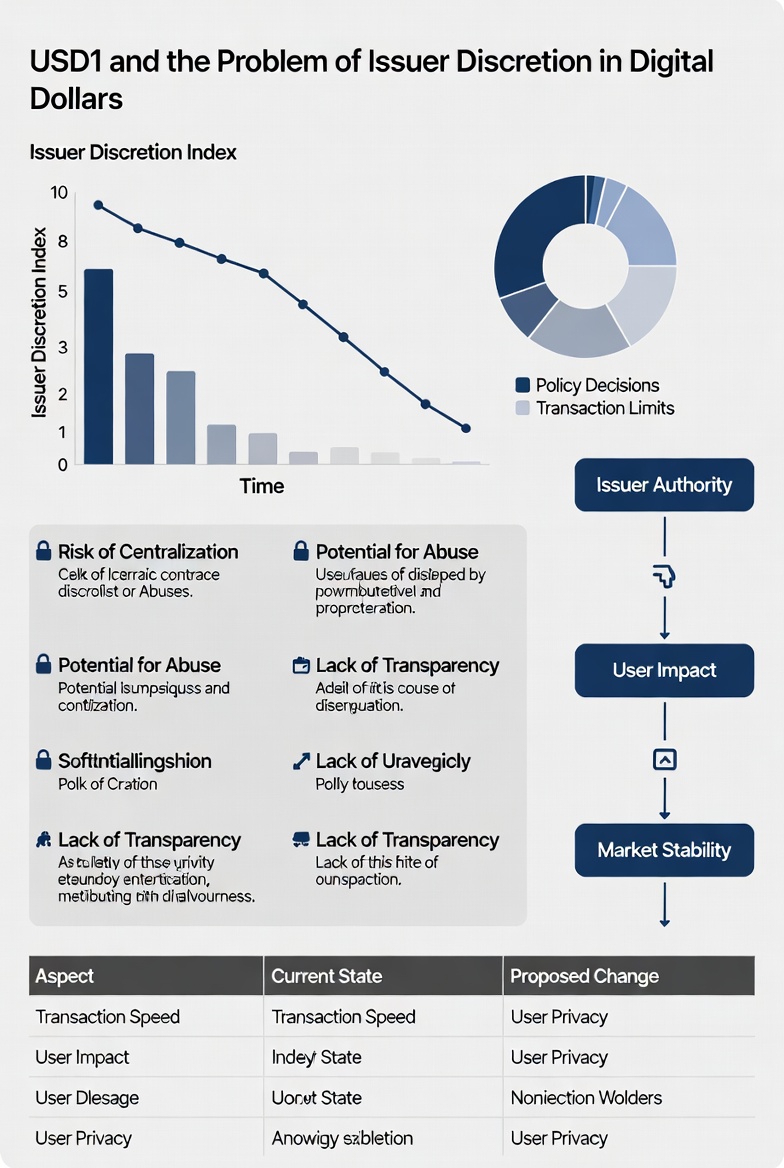
How USD1 Handles This
USD1 tries to keep its ambitions small. It’s not piling on new features, tokens, or yield games. It wants to be a basic building block—a monetary primitive.
That’s the point. By not chasing every new innovation, USD1 says stability comes from doing less, not more. The fewer knobs the issuer can fiddle with, the more everyone can trust what’s happening.
Of course, no centralized issuer can get rid of discretion entirely. But you can change what you do with it:
Discretion should be about following rules, not making policy.
Let supply respond to real demand, not someone’s strategy.
Keep reserves safe and liquid, forget about chasing yield.
Think of the issuer as a utility operator, not a hedge fund manager.
Governance Tokens: Mostly an Illusion
Some projects try to fix discretion by letting token holders vote on decisions. But that just shifts the problem. Big holders can take over. People chase quick rewards instead of long-term stability. And responsibility gets blurry.
USD1 skips all that. No governance tokens, no distractions. Just a focus on running things with discipline and letting people see what’s going on.
The Trade-Off No One Can Dodge
Here’s the uncomfortable truth: as long as you’re following the law, you can’t make a fiat-backed digital dollar that’s totally neutral. Some controls are required. The real challenge is to keep those controls predictable and limited.
So maybe the future isn’t about getting rid of issuer discretion. Maybe it’s about putting real boundaries around it.@Sacccc #USD1 #WLFI @Jiayi Li