There’s a quiet shift happening in blockchain. Not louder marketing. Not shinier primitives. Something rarer.
Operational maturity.
isn’t trying to dominate the narrative cycle. It’s trying to solve a harder problem: making shipping feel normal again.
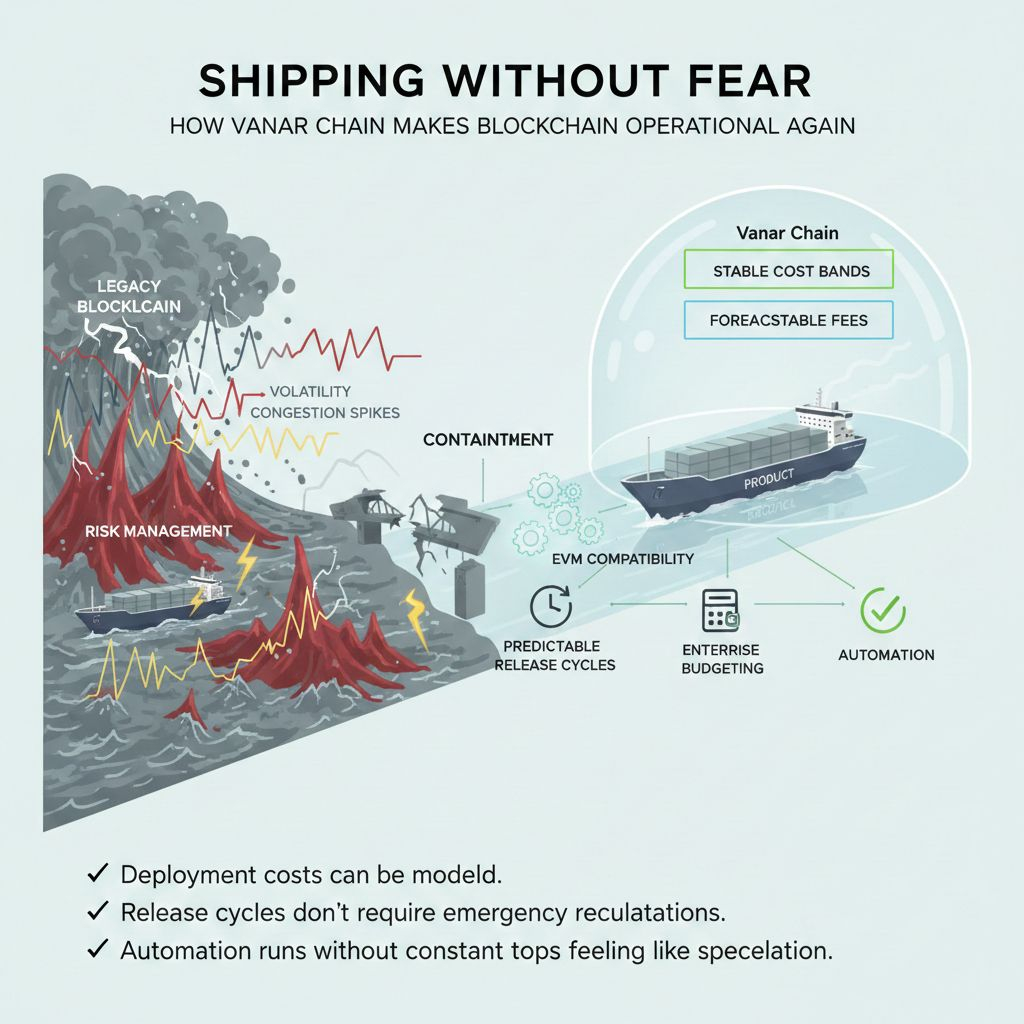
Because somewhere along the way, deploying on-chain stopped feeling like product execution and started feeling like risk management.
Builders learned to overestimate gas. To pad budgets. To design around congestion spikes that could rewrite economics overnight. A simple feature release required contingency trees, fallback flows, and fee buffers “just in case.” Execution wasn’t about clarity. It was about defense.
That’s not innovation. That’s volatility management.
Vanar takes a different posture. Instead of pushing unpredictability onto developers, it absorbs it at the infrastructure layer. Builders operate inside stable cost bands. Fee expectations remain within forecastable ranges. Congestion variance doesn’t spill directly into application logic.
The result isn’t flashy. It’s functional.
Deployment costs can be modeled.
Release cycles don’t require emergency recalculations.
Automation runs without constant fee recalibration.
Enterprise budgeting stops feeling like speculation.
Vanar doesn’t eliminate blockchain complexity. It contains it.
And containment changes everything.
Compatibility as Risk Discipline
The didn’t make the EVM successful by making it perfect. It made it resilient. Over years, the ecosystem endured congestion waves, MEV extraction pressure, security incidents, and adversarial stress that would have broken less mature systems.
The EVM survived.
That endurance turned it into an industrial standard.
Vanar’s EVM compatibility isn’t a growth hack. It’s operational risk discipline. If something works on Ethereum, it behaves the same way here. Deterministic execution semantics. Familiar gas logic. Consistent opcode behavior. Toolchains that don’t require relearning under pressure.
In distributed systems, surprise is expensive.
Compatibility reduces unknown unknowns. Audited contracts deploy without semantic drift. Wallet integrations behave predictably. Monitoring infrastructure transfers cleanly. Engineers don’t need to reinterpret execution rules mid-crisis.
Adoption rarely follows hype. It follows confidence.
Upgrades Without Spectacle
Crypto culture treats upgrades like product launches. Infrastructure teams treat them like surgical procedures.
Rollback paths mapped in advance.
Failure states simulated.
Validator coordination rehearsed.
Edge cases documented, not discovered live.
Mature systems prioritize backward compatibility and gradual deprecation over abrupt runtime shifts. When execution semantics are standardized, consensus engineering can focus on stability and liveness instead of reinventing core behavior.
The metric isn’t applause.
It’s the absence of drama.
If an upgrade lands and nobody tweets about chaos, that’s success.
Real-Time Execution Without the “Retry” Reflex
The philosophy becomes most visible in environments where latency meets human psychology — like live experiences inside the metaverse.
In real-time drops and branded events, user patience is measured in seconds. If confirmation feels ambiguous, behavior adapts instantly. Double taps. Inventory refreshes. Logouts and relogs. Screenshots “for proof.”
The most dangerous button in real-time systems is “Retry.”
Because retry signals doubt.
Vanar’s approach is simple but critical: if a claim is accepted, it commits once. If it’s not, the system resolves the ambiguity internally. The UI doesn’t offload uncertainty onto the user.
Equip once.
Claim once.
Move forward.
Deterministic finality alone isn’t enough. The human window between resolution and recognition must be tight. If ambiguity lingers, users begin socially arbitrating settlement. And social arbitration spreads faster than any technical explanation.
Vanar minimizes that gap.
Continuity Over Campaign Cycles
Even scheduled events reveal the mindset.
A brand drop may end at midnight on the calendar. But persistent systems don’t shut off in perfect unison. Sessions overlap. Inventory reconciles. State continues resolving under the surface.
The date changes.
The chain keeps closing state cleanly.
That continuity isn’t glamorous. It’s hygiene. And hygiene is what separates prototypes from infrastructure.
Predictability Is the Product
Vanar’s positioning doesn’t rely on being louder. It relies on being predictable.
EVM compatibility narrows execution risk.
Stable fee mechanics reduce financial uncertainty.
Operational discipline minimizes ambiguity during stress.
Success on this path won’t look viral.
It will look uneventful.
Contracts deploy without emergency patches.
Upgrades land without incident threads.
Congestion bends but doesn’t fracture user flow.
In consumer apps, that might seem boring.
In infrastructure, that’s maturity.
And in a market that has seen enough chaos to last a decade, maturity might be the most disruptive feature of all.