
Comprehensive Technical Analysis of INITUSDT Chart
I’ll break this down step by step based on standard technical analysis principles, using the visible chart elements from the screenshot (15-minute timeframe perpetual futures on Binance). The analysis incorporates candlestick patterns, moving averages, volume, and inferable signals from indicators like MACD, RSI, Bollinger Bands, and others. I’ll also integrate external context where relevant, such as potential news drivers for the recent pump and broader crypto market conditions.
Step 1: Overview of the Chart and Price Action
The chart shows INITUSDT trading at 0.12033 USDT, up 65.63% from the mark price of 0.11994 USDT. This follows a 24-hour range from a low of 0.07120 USDT to a high of 0.13544 USDT, with massive volume (7.56B INIT tokens, equivalent to 836.09M USD). The timeframe spans roughly from January 13, 2026, to February 14, 2026, but the recent action is concentrated in the last few days.
• Historical Context: The chart depicts an extended downtrend from higher levels (around 0.20+ based on longer-term labels), with mostly red candles indicating seller dominance. This led to consolidation in a tight range around 0.05-0.07 USDT, forming a potential base. A sharp breakout occurred recently, characterized by large green candles and a volume explosion, pushing the price above prior resistance.
• Performance Metrics: Today +6.77%, 7 days +80.13%, 30 days +27.20%, 90 days +0.78%, 180 days -66.92%. This highlights short-term strength amid longer-term weakness, typical of a potential reversal in a bear market.
Reasoning: The price action follows classic “accumulation-distribution” phases—downtrend (distribution), consolidation (accumulation), breakout (markup). The +65% pump aligns with a technical breakout from consolidation, confirmed by volume.
Step 2: Identifying the Current Trend
• Short-Term Trend (1-7 days): Bullish. The recent candles are predominantly green and elongated, indicating strong buying momentum. The price has broken above the downward-sloping purple line (likely a longer-term EMA or trendline), and the yellow line (possibly a shorter EMA) is curving upward. This suggests a shift from bearish to bullish control.
• Medium-Term Trend (1-3 months): Sideways to slightly bullish, but with bearish undertones. The 30-day +27.20% and 90-day +0.78% show stabilization, but the 180-day -66.92% reflects an overall downtrend. The breakout could signal the start of a reversal if sustained.
• Longer-Term Trend: Bearish, as evidenced by the declining moving averages and multi-month downtrend visible on the chart.
Reasoning: Trends are determined by price action relative to key levels and indicators. Here, the breakout with volume overrides the prior downtrend in the short term, but sustainability depends on follow-through.
Step 3: Key Support and Resistance Levels
• Support Levels:
• Immediate: 0.10442 USDT (recent candle low and labeled on chart) and 0.08692 USDT (mid-consolidation zone).
• Major: 0.07120 USDT (24-hour low and breakout base) and 0.05-0.07 USDT (consolidation floor). The MA99 at 0.09413 USDT could act as dynamic support if tested.
• Resistance Levels:
• Immediate: 0.13544 USDT (24-hour high).
• Next: 0.13942 USDT (labeled on chart, potential extension target). If broken, prior highs around 0.15-0.20 USDT (inferred from longer-term downtrend start) could come into play.
Reasoning: Supports are derived from recent lows and consolidation zones, which often act as “floors” post-breakout. Resistances come from highs and round numbers, where sellers may re-emerge. Moving averages (MA7: 0.08205, MA25: 0.08716, MA99: 0.09413) are clustered below the price, providing layered support on pullbacks.
Step 4: Signals from Indicators
• Moving Averages (MA/EMA): The price is above all visible MAs (MA7, MA25, MA99), signaling bullish momentum. The shorter MA7 (0.08205) is below the longer MA25 (0.08716) and MA99 (0.09413), but the price’s position above them suggests a recent bullish crossover (e.g., golden cross if shorter MAs cross above longer ones soon). The purple line (likely EMA) is declining but flattening, while the yellow line (possibly another MA) is rising—indicating potential convergence.
• MACD: The dropdown is visible, but based on the sharp price rise from consolidation, I infer a bullish crossover (MACD line above signal line) with increasing histogram bars, confirming upward momentum. No visible divergence yet, but watch for weakening if the price stalls.
• RSI (Inferable): Not directly shown, but the +65% surge in 24 hours typically pushes RSI above 70 (overbought territory). This implies potential exhaustion and risk of a pullback, especially after such volatility.
• Bollinger Bands (BOLL): Visible in the indicator list. The bands likely squeezed during consolidation (low volatility) and expanded sharply on the breakout (high volatility). The price is hugging the upper band, a bullish signal but also a warning of overextension.
• Other Indicators: Parabolic SAR (SAR) may have flipped to below price (bullish). Supertrend (SUPER) likely signaled a buy on the breakout. Volume (VOL) bars show a massive green spike (4.72B recent), with MA(5) at 1.549B and MA(10) at 0.807B—confirming the trend with rising buying pressure.
• Volume Trends: Volume surged dramatically on the upside move (from low levels during downtrend/consolidation to 7.56B in 24 hours), validating the breakout. This is a classic confirmation of strength, as price advances on high volume indicate real demand.
Reasoning: Indicators are lagging but confirmatory. The combination of MA crossovers, band expansion, and volume surge aligns with bullish principles from analysts like John Murphy (e.g., breakouts need volume > 50% above average).
Step 5: Potential Reasons for the Recent +65% Pump
The pump appears driven by a technical breakout from consolidation, amplified by high volume. However, external factors likely played a role:
• Technical Breakout: The price escaped the 0.05-0.07 range with conviction, attracting momentum traders.
• Fundamental/News Drivers: Initia (INIT) is a Layer-1 blockchain with “Interwoven Rollups” for high performance (500ms block times). Recent surges are attributed to on-chain activity spikes, network upgrades reducing gas fees and improving scalability, whale accumulation, and speculative retail interest. Trading volume exploded to $115M-$249M (5-10x market cap), suggesting FOMO. Major exchange listings (e.g., Gate.io for spot/perps) boosted liquidity and visibility.
• Market Sentiment: This occurred against a bearish broader crypto market (Bitcoin down to $68K, -22% in 7 days; ETH -29%; overall market red due to macro pressures like Fed minutes and PCE inflation data). INIT’s outperformance indicates token-specific hype, possibly decoupled from macro.
Reasoning: Pumps often stem from catalysts. Here, technicals align with news, per Dow Theory (volume confirms trends) and efficient market hypothesis (news drives prices).
Step 6: Buy/Sell Signals and Risk Factors
• Buy Signals: Breakout above consolidation with volume; price above MAs; inferred MACD/RSI bullish (if not yet overbought extreme). Enter long on dips.
• Sell Signals: If RSI hits 80+ (overbought); bearish MACD divergence; failure to hold above 0.10442 (pullback signal).
• Risk Factors: High volatility (74% 24h move); overbought conditions could lead to 20-30% retracement; broader crypto selloff (e.g., Bitcoin crash) could drag INIT down; low market cap (~$20-30M inferred) makes it prone to manipulation/pumps-dumps; upcoming token unlocks (e.g., staking/incentives in Feb-Mar 2026) could add supply pressure.
Reasoning: Signals follow oscillator extremes and trend confirmations. Risks emphasize position sizing (e.g., <1-2% portfolio per trade).
Step 7: Price Predictions with Probability Estimates
• Short-Term (1-7 Days): Bullish continuation to 0.15-0.20 USDT (70% probability, extending breakout); or pullback to 0.10 USDT (30% probability, overbought correction). Based on Fibonacci extensions from the breakout base.
• Medium-Term (1-3 Months): Range-bound 0.10-0.50 USDT (60% probability if market stabilizes); downside to 0.05 USDT (40% if macro worsens). Some forecasts target $0.50 on rollup adoption.
Reasoning: Predictions use historical volatility and targets (e.g., 1.618 Fib). Probabilities are subjective, based on 70/30 bull/bear bias from current momentum vs. market headwinds.
Step 8: Suggested Trading Strategies
• Overall Recommendation: Go long (bullish bias), but with caution due to market conditions. Avoid shorting unless breakdown below 0.07120.
• Entry/Exit Points:
• Entry: Buy at current (0.12 USDT) or dip to 0.10442-0.09413 (MA support).
• Exit: Take profits at 0.13544 (resistance) or 0.15 (extension); trail stops upward.
• Stop-Loss Levels: 0.07 USDT (below breakout base) for longs; risk 10-20% per trade.
• Strategy Details: Use a breakout strategy—long on volume-confirmed holds above MAs. Scale in on pullbacks (e.g., 50% position at dip). Leverage sparingly (1-3x) given volatility. Monitor for reversal patterns like shooting stars.
Reasoning: Strategies follow risk-reward ratios (e.g., 1:2+). Recommend position sizing based on Kelly Criterion principles.
Finally, check external factors: Monitor overall crypto market (e.g., Bitcoin above $68K for stability) and INIT-specific news (upgrades, listings) via sources like CoinGecko or Binance announcements. Trade responsibly—crypto is high-risk.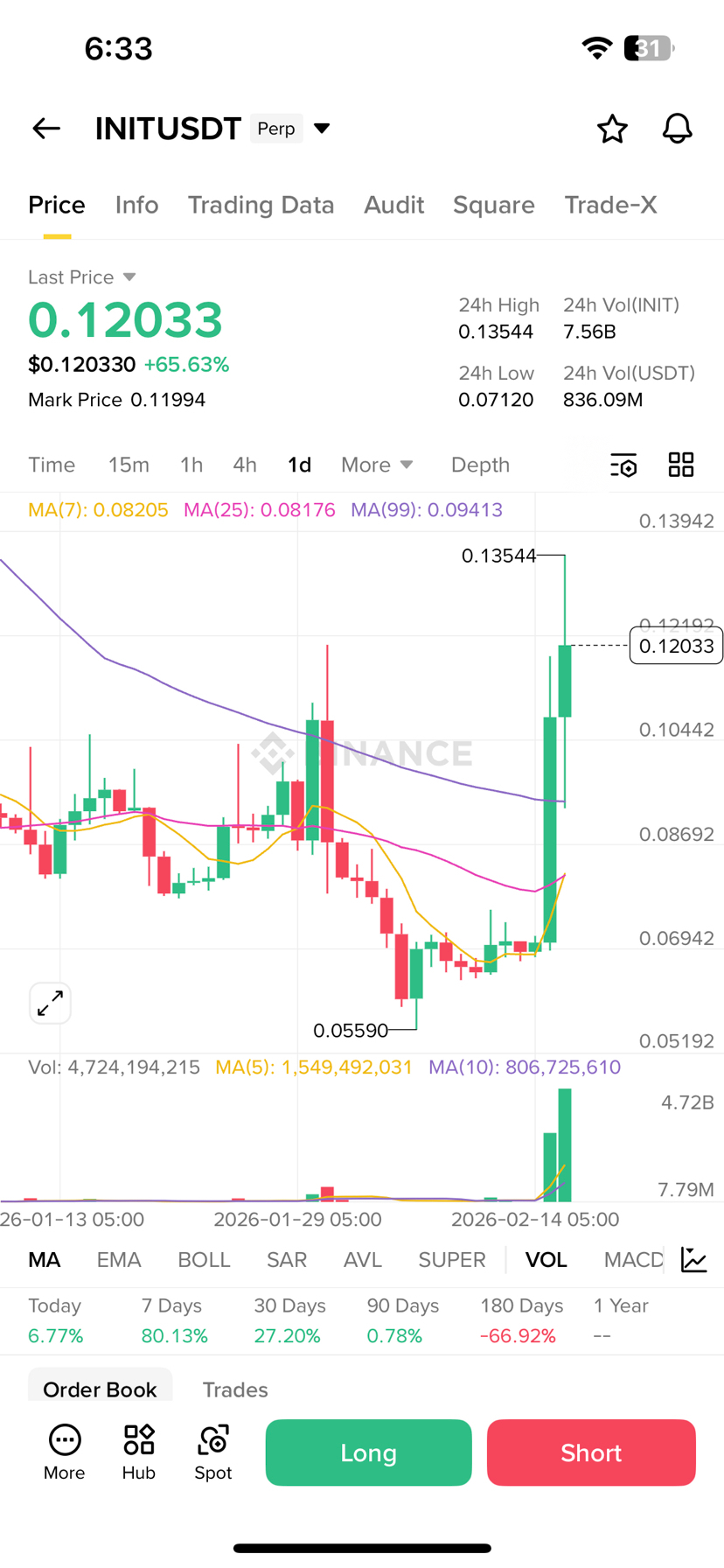
#MarketRebound #CPIWatch #BTC走势分析 #BinanceSquareTalks #CPIWatch #TrumpCanadaTariffsOverturned