

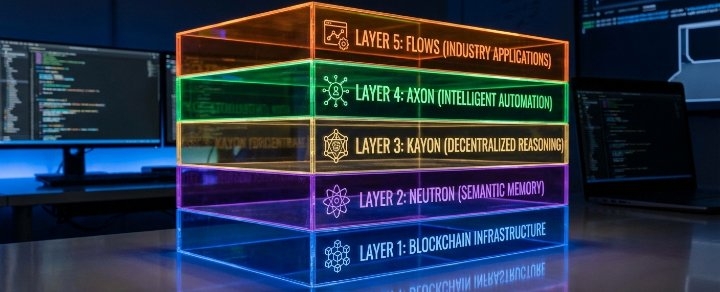
The technical distinction of Vanar Chain lies in its five-layer stack, a modular architecture designed to move beyond simple transaction execution to on-chain data reasoning and semantic memory. This design philosophy addresses the "amnesia" inherent in traditional blockchains, where smart contracts often lack the persistent context necessary for complex AI agent behavior.
Layer 1: The Fundamental Blockchain Infrastructure
The base layer of the stack is the Vanar Chain L1, which provides the security and consensus mechanisms required for the entire ecosystem. Following the November 2025 V23 upgrade, the network transitioned to an architecture based on the Stellar SCP (Stellar Consensus Protocol) framework, integrating Soroban smart contract functionality. This upgrade was not a minor patch but a deep reconstruction that enabled the chain to achieve 99.98% transaction success rates even as the number of on-chain nodes reached 18,000 by January 2026.
The integration of the SCP architecture allows for low-latency, sub-second execution, which is critical for gaming and real-time AI inference. Furthermore, the network maintains an EVM-compatible environment, allowing developers to port existing Ethereum-based applications with minimal friction while granting those applications access to Vanar's native AI "superpowers".
Layer 2: Neutron and Semantic Memory
The second layer, Neutron, serves as the semantic memory foundation. Its primary function is to rewrite and restructure data for the AI economy, transforming raw files and logs into light, queryable, and cryptographically verifiable units known as "Neutron Seeds". Neutron introduces an "intelligent compression" engine that achieves a 500:1 ratio, capable of compressing a 25MB video file into a 50KB seed stored directly on-chain.
The technical specifications of Neutron include a three-path approach to data management: neural structuring, semantic embedding, and algorithmic layering. This allows for the creation of "knowledge objects," where a PDF or a legal receipt becomes an interactive entity that an AI agent can query or index. This solves the industry's reliance on fragile external storage systems like IPFS, ensuring that data is not just stored but remains functional and private through client-side encryption and granular permissions.
Layer 3: Kayon and Decentralized Reasoning
Kayon serves as the contextual AI reasoning layer. It functions by turning the semantic seeds generated in Neutron into auditable insights and predictions. In early 2026, the launch of Kayon marked a significant milestone, moving the industry toward "non-oracular reasoning". Unlike traditional AI agents that require external oracles to feed them data—creating potential points of failure—Kayon allows agents to "open their eyes" and think for themselves using purely on-chain data.
Layer 4 and 5: Axon and Flows
As of the current 2026 roadmap, the final two layers—Axon (Intelligent Automation) and Flows (Industry Applications)—are designated as "coming soon". Axon is intended to provide the automation frameworks for complex cross-industry processes, while Flows will serve as the top-level application layer for real-world services. Together, these layers are designed to form a complete ecological closed loop, distinguishing Vanar from chains that focus solely on reducing gas fees or increasing TPS.