If you’ve been watching DeFi lately, you can feel the attention drifting away from flashy launches and toward the unglamorous parts: settlement, custody assumptions, and the routes assets take when users move between ecosystems. @Falcon Finance expanding its cross-chain reach through an Axelar integration fits that moment. It’s not a spectacle. It’s a piece of infrastructure work, and that’s exactly why people are paying attention.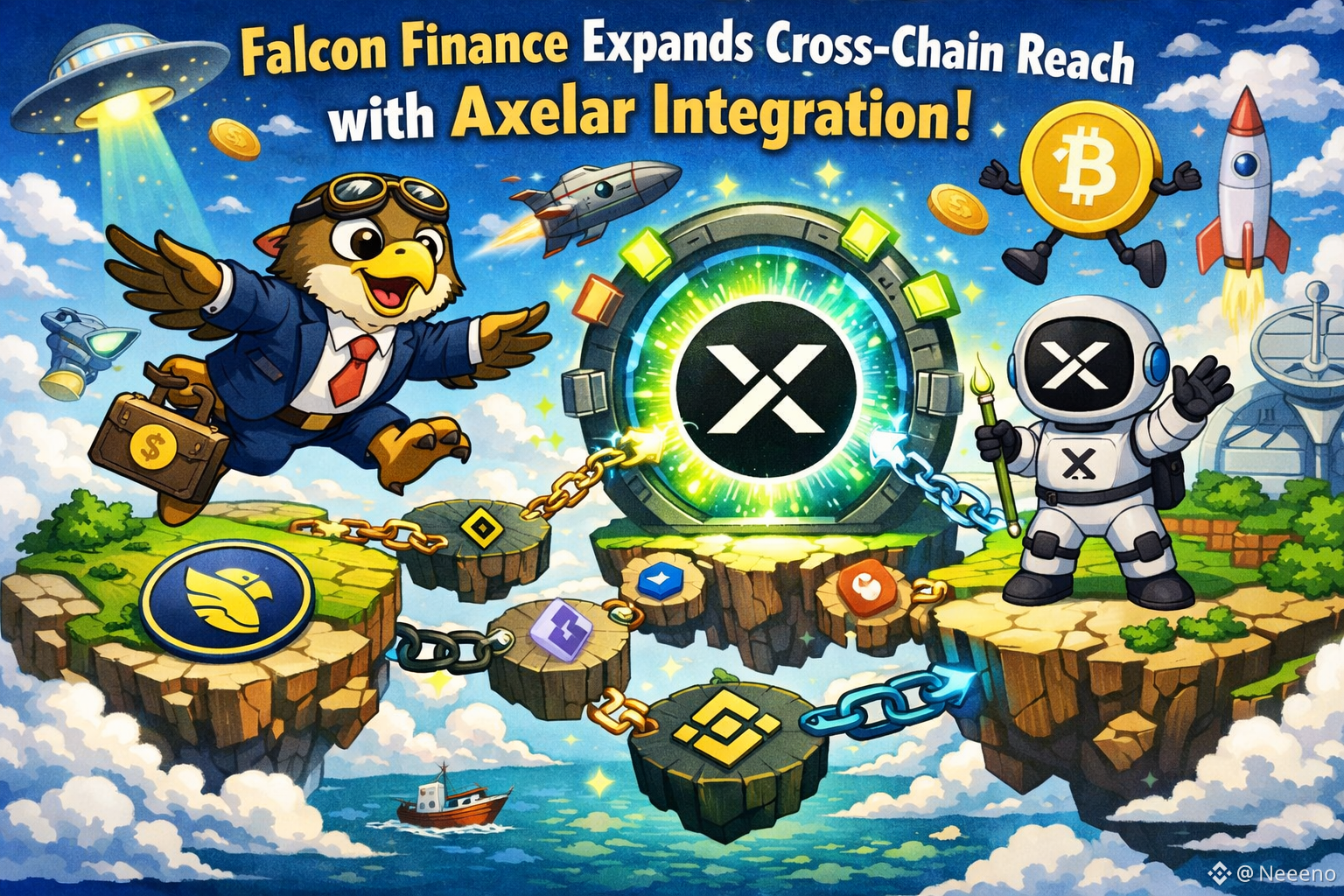
Falcon Finance is built around a simple promise: let people use a wide range of liquid assets as collateral to mint USDf, an overcollateralized synthetic dollar, and optionally stake it into a yield-bearing form called sUSDf. The idea isn’t brand new, but the timing is. In 2025, “a stable unit on one chain” often feels less useful than “a stable unit that can show up wherever the user already is.” If an asset can’t travel, it eventually becomes a silo, no matter how clever the mechanics behind it are.
Falcon’s own updates make the point in plain terms: USDf liquidity is available on the XRP Ledger’s EVM chain via Axelar, and it’s live on BNB Chain too. On the surface, that reads like a distribution checkbox. Under the hood, it’s an answer to a very human hesitation: the little pause people take before bridging anything of value. Cross-chain transfers have burned users often enough that even confident traders have a reflexive second thought. I’ve seen that pause become almost ritualistic in communities—people swapping horror stories, double-checking contract addresses, and asking friends to confirm what should be a basic transaction.
Axelar’s role here matters because it represents a particular approach to interoperability. Axelar describes itself as a decentralized network that connects chains using a validator set and general message passing, rather than relying on a single custodian or a tiny committee. Axelar also points to having more than 75 validators and a record of zero exploits. I don’t treat any of that as a guarantee—cross-chain systems are complex, and complexity is where surprises live—but it does signal that the industry has matured past “trust me” bridges. Today’s expectation is closer to “show me how it fails.”
The broader trend is that crypto has stopped pretending there will be one chain to rule them all. Layer-2 networks grew up. App-specific chains became normal. Here are three simple, clean rewrites with slightly different tones. Each keeps the meaning but uses more everyday language.
Some of the older networks that once felt outside the DeFi core are now opening the door to EVM apps. The space no longer feels like a single center, but more like a connected region with many distinct parts. In that setup, moving easily between chains matters just as much as what happens on any one of them.It’s the transportation system.
The XRPL EVM angle is especially interesting. XRP has a wide, mainstream holder base, but connecting that liquidity into the everyday “DeFi Lego” environment has historically been awkward. If USDf can circulate where XRPL-adjacent users are experimenting with EVM tools, it changes the onboarding story. Instead of asking someone to start fresh on a new chain, you offer something that meets them halfway. That sounds small, but it’s how a lot of real adoption happens: through reducing the number of moments where a user has to feel brave.
There’s also the capital-efficiency side, which is less emotional but just as practical. A synthetic dollar becomes more useful when it can be posted as collateral, traded, and moved between venues without forcing users to unwind positions. Falcon has already leaned into integrations and transfer standards—like adopting Chainlink CCIP and related tooling to make USDf transferable across supported blockchains. The point isn’t “more chains” as a trophy. The point is fewer dead ends.
Of course, expanding across chains can create its own problems. Liquidity can fragment. Risk models can drift between deployments. Governance can get messy when different communities start treating “their” version of an asset as the default. That’s why another theme is rising alongside cross-chain growth: chain abstraction. More teams are trying to make the chain choice feel invisible, like a routing detail instead of a user decision. If that vision works, it will change how people judge stable-value assets. The question won’t be “what chain is it on?” but “can I use it wherever I need it, without thinking?”
What I like about Falcon’s Axelar move is that it nudges DeFi toward that quieter standard of progress. It doesn’t require anyone to believe in a miracle. It asks for something more grounded: better routes, clearer risk boundaries, and a stable asset that can actually keep up with how people use crypto in late 2025. If it succeeds, the best sign might be that nobody talks about it much at all. The transfer just works, and the user moves on with their day. And if it stumbles, the lesson will still be valuable: cross-chain convenience has to be earned, step by careful step for everyone.
@Falcon Finance #FalconFinance $FF