@APRO Oracle The easiest way to lose someone in a Web3 app isn’t a scary warning banner or a confusing wallet prompt. It’s a quiet moment when the numbers stop feeling believable. A price that lags what the user just saw elsewhere. A lending position that gets liquidated “out of nowhere.” A market that won’t settle even though the match ended hours ago. Users rarely say “your oracle failed.” They say the app is broken, or they say nothing and never come back. Data is invisible until it isn’t, and in late 2025 it has become hard to ignore because so many products now sit on top of each other. One weak data dependency doesn’t just hurt one dApp; it can spill into every place that dApp plugs into.
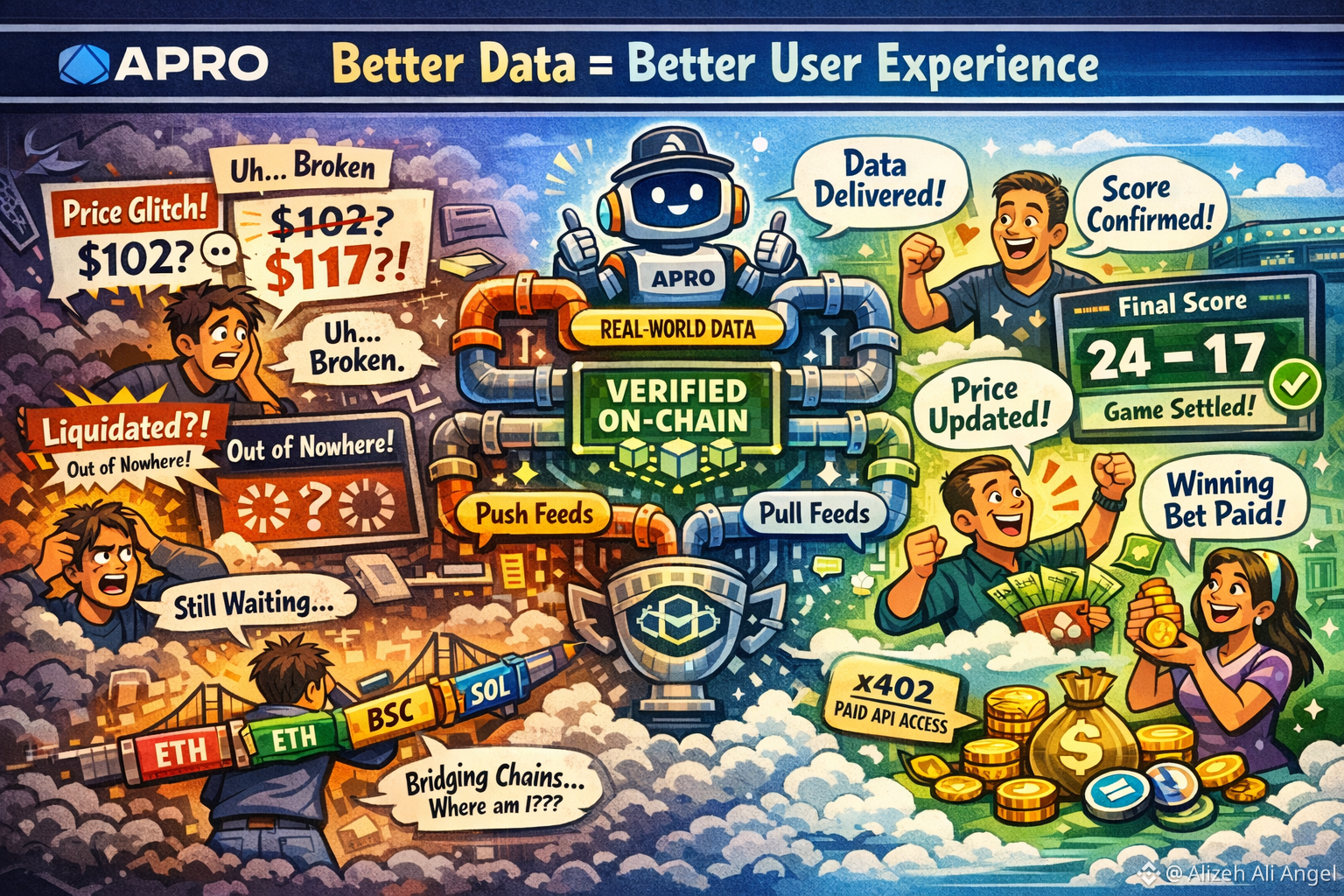
That’s the frame where APRO feels most relevant: not as “more infrastructure,” but as a practical answer to why a good-looking product still feels unreliable once real money and real expectations show up. APRO’s core pitch is straightforward: take information that exists outside the chain, process it off-chain, and then make it verifiable on-chain so contracts can use it without hand-waving. When that works, it doesn’t merely prevent dramatic failures; it removes the steady drip of small mismatches that erode confidence. In my experience, users don’t rage-quit because of one big bug as often as they do because of three or four “huh, that’s weird” moments in a row. Data quality is usually the hidden cause.
A lot of UX work in crypto has been poured into the front door: smarter wallets, fewer pop-ups, fewer ways to get trapped by gas or approvals. The goal is sensible—make onboarding feel less like setting up a server. But once the user is inside, the experience is still held together by inputs smart contracts can’t generate on their own. Prices, settlement outcomes, and “did this real-world thing happen?” confirmations have to be delivered, checked, and updated. If that layer is inconsistent, every other improvement becomes cosmetic. You can ship a clean interface and still end up with an app that feels like it’s guessing.
APRO’s “push” and “pull” split is one of those design choices that sounds technical, but it maps directly to how users experience time and trust. Push feeds exist for situations where stale numbers are dangerous—think liquidations, tight spreads, and anything that reacts to fast moves. Pull feeds exist for moments where you only need a value at a decision point—like settlement, a one-time calculation, or an on-demand check. APRO documents these as two first-class models rather than an afterthought, and it matters because it forces teams to decide what “fresh” really means for each screen and each action. A number that updates too slowly makes users feel tricked. A number that jitters without clear rules makes them feel anxious. The best UX isn’t just speed; it’s predictability.
This topic is also trending now because the bar is moving outside crypto’s usual bubble. In the U.S., FanDuel and CME launched a prediction market product in five states in December 2025, with plans to expand, and DraftKings formally launched its own prediction markets offering around the same time. When brands like that normalize “event contracts” for mainstream users, the old excuses start to sound thin. “Finality was delayed” or “the oracle updated later” is not a satisfying answer to someone who thinks they placed a simple bet on a game outcome. People expect a resolution that matches reality, on time, every time. That expectation rolls downhill into Web3-native prediction markets too, whether they like it or not.
This is why APRO’s move into verifiable, near real-time sports data is more than a headline—it’s a direct attempt to turn data reliability into a calmer user experience. Reports around its sports launch describe coverage across multiple sports, with the NFL highlighted as an early major-league integration, packaged through an Oracle-as-a-Service subscription model. If you’ve ever watched support tickets pile up after an event ends but markets don’t settle cleanly, you know what’s really being bought here: operational clarity. The app can show what it’s waiting on, when it last updated, and what source path it trusts. That reduces the two worst UX emotions in prediction markets—confusion and suspicion.
The subscription angle is quietly important, too, because it nudges teams toward treating data like a product dependency you can observe and manage, not a mysterious pipe you hope won’t burst. Some coverage mentions APRO’s OaaS model supporting standardized access and x402 payment support. And x402 itself is being positioned as an “internet-native payments” approach for paid endpoints—essentially making “pay-to-access” APIs more natural over HTTP. Even if most users never hear the phrase “x402,” the effect is practical: clearer entitlements, cleaner metering, and fewer improvised workarounds for who can query what and when. That’s the kind of plumbing that, when done well, makes an app feel stable without the user knowing why.
Then there’s the multi-chain reality. Users bridge assets, hop networks, and assume the app will keep up. That assumption is brutal on data layers because it multiplies edge cases and amplifies small inconsistencies. #APRO explicitly positions itself as a multi-network data service, and its docs describe a broad set of supported price feeds across many chains, which is exactly the kind of boring coverage that prevents “why is the price different here?” moments. I’m not romantic about multi-chain anymore; I mostly see it as a tax on coherence. Anything that reduces divergence across environments improves UX in a very immediate way.
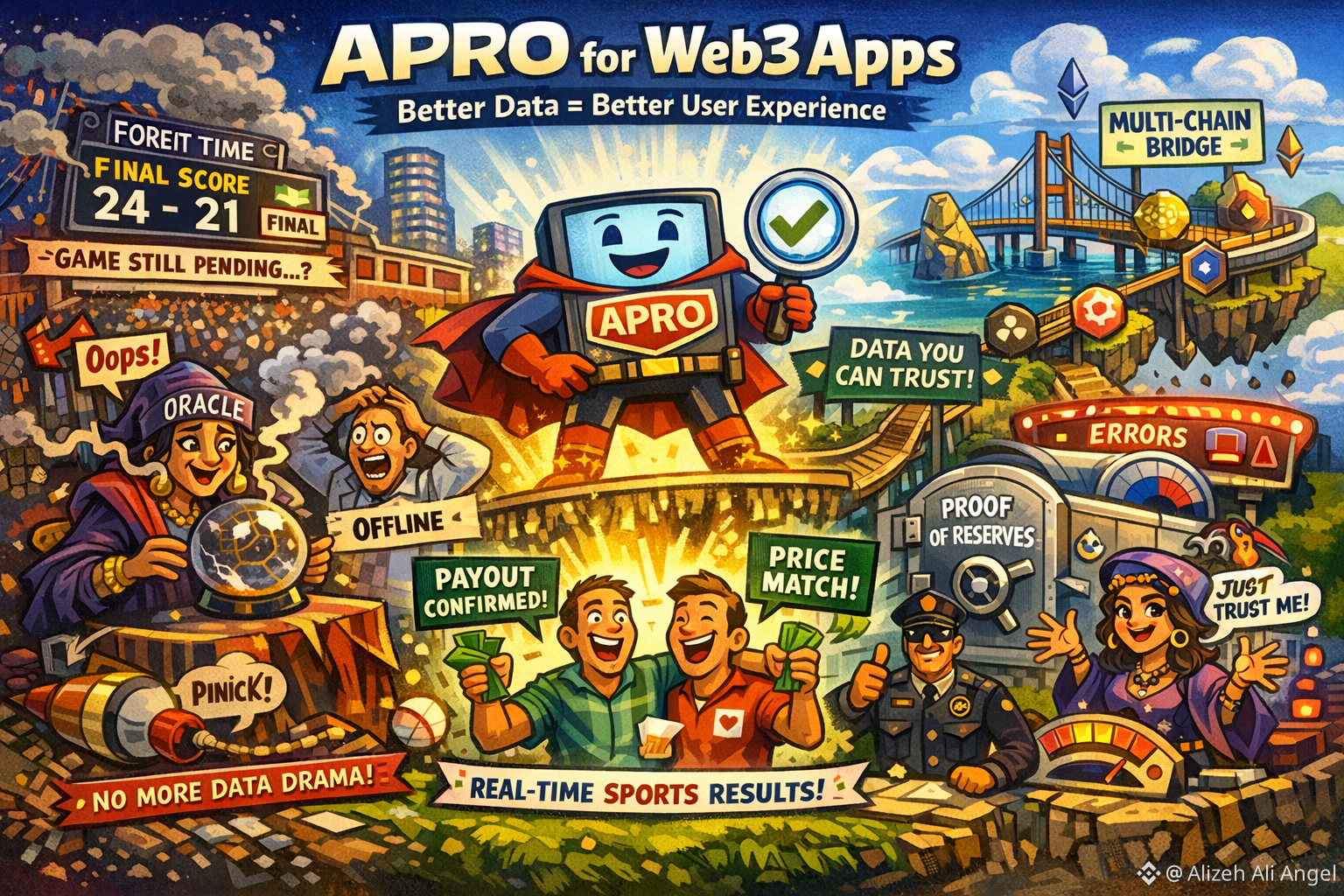
Funding and accountability are pushing this forward as well. APRO’s strategic funding round led by YZi Labs was described as support for next-generation oracle infrastructure geared toward prediction markets, AI, and real-world assets. I tend to read rounds like this less as hype and more as a sign that teams are bracing for scrutiny. Real-world assets, for instance, don’t survive on vibes. If you’re tokenizing something that’s supposed to be backed 1:1, users and counterparties need proof and auditability, not reassurances. APRO’s documentation around proof-of-reserve style data and RWA-oriented feeds is aligned with that more sober direction.
The most grounded takeaway is almost boring: treat data as part of product design, not a backend checkbox. Decide what needs push freshness versus pull certainty. Make update timing visible in a way that doesn’t overwhelm. If you don’t design for disputes and delays up front, users will discover the cracks for you. And when that happens, teams often respond with ‘cover yourself’ UI—cryptic alerts, sneaky limitations, and wording that puts the burden on the user instead of the system. When teams do it well, the product feels fair. And “fair” is the word that matters most when money is involved.
Better data won’t magically make Web3 simple, but it does make it honest. It shrinks the gap between what a person thinks they agreed to and what actually executes. That’s why APRO’s relevance shows up not in abstract architecture diagrams, but in the everyday moments users care about: the price that matches what they just saw elsewhere, the position that doesn’t get nuked by a stale feed, and the market that settles when the game is over—cleanly, consistently, without drama.