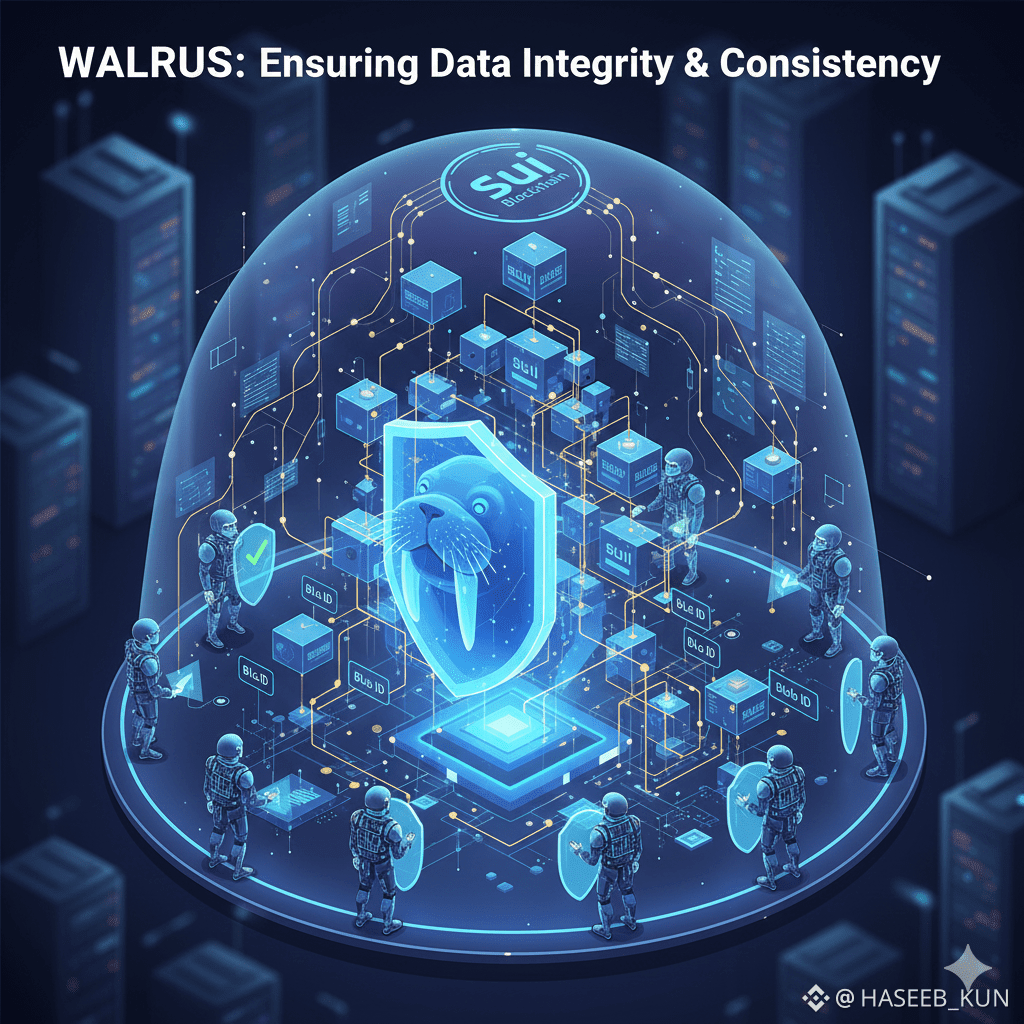
In the decentralized era, data is far more than a collection of bits—it forms the foundation of trust, computation, and digital collaboration. From powering AI models and blockchain rollups to supporting NFT platforms and media-rich dApps, the reliability of storage directly impacts the resilience of entire ecosystems. Yet decentralized networks face a fundamental challenge: how to guarantee that data remains authentic, retrievable, and consistent, even when some nodes are faulty or malicious. Walrus, a next-generation decentralized storage protocol, addresses this challenge by integrating cryptographic rigor, advanced erasure coding, and verifiable consistency mechanisms. By embedding integrity and reliability into every layer of storage, Walrus transforms data from a fragile resource into a robust, auditable, and governable digital asset.
Central to Walrus’s strategy is the use of blob identifiers (blob IDs). Every dataset uploaded to the network is assigned a unique cryptographic fingerprint, which acts as a tamper-evident reference. When a client retrieves a blob, its hash is compared to the blob ID, immediately revealing any alterations, corruption, or partial loss. Unlike traditional storage systems that rely on trust in individual nodes or centralized operators, blob IDs enable verification without assumptions, ensuring that each piece of data is permanently linked to its original content. Even in Byzantine environments—where nodes may behave unpredictably or maliciously—the integrity of stored data can be mathematically guaranteed.
Building on blob IDs, Walrus employs Merkle-tree authentication, a scalable cryptographic construct that allows efficient verification of large datasets. By recursively hashing data blocks into a hierarchical tree structure, Merkle trees enable clients and nodes to validate specific fragments without needing to access entire datasets. Any tampering with even a single fragment alters the Merkle root, immediately alerting the system to inconsistencies. This approach is particularly critical for AI training datasets, blockchain archives, and multimedia assets, where full-byte validation would otherwise be impractical and resource-intensive.
Consistency verification provides another vital layer of reliability. Walrus supports both default and strict consistency checks, giving developers control over performance and rigor. Default checks confirm that blobs are retrievable and match their blob IDs across the network, offering strong assurances with minimal overhead. Strict consistency checks enforce rigorous validation of each fragment against Merkle-tree proofs, ensuring that every stored object adheres to the protocol’s cryptographic and structural rules. This configurable verification is especially valuable for mission-critical systems, such as decentralized AI pipelines or financial applications, where even minor discrepancies can have cascading effects.
Sliver-based erasure coding underpins the protocol’s space-efficient and resilient storage model. Unlike full replication, which stores multiple complete copies of a dataset, sliver-based coding splits blobs into smaller fragments distributed across multiple nodes, embedding redundant parity information. This allows full reconstruction of the original dataset even if some fragments are missing or corrupted. The benefits are twofold: storage overhead is minimized, making large-scale datasets economically viable, and resilience against Byzantine faults is enhanced, as cryptographic checks can detect inconsistencies and reconstruct correct data from available fragments. Combined with blob IDs and Merkle-tree authentication, sliver-based erasure coding ensures data is both space-efficient and reliably recoverable.
Integrity in Walrus extends beyond individual blobs to dynamic, decentralized governance of storage nodes. Each node is accountable for a subset of blobs during defined epochs, with responsibilities tracked on-chain. Nodes must provide cryptographic proofs demonstrating correct storage, and failure to maintain integrity or availability results in economic penalties, including slashed stakes or reduced rewards. This creates strong incentives for reliable behavior, ensuring data consistency across the network without reliance on central authorities. By combining decentralized monitoring, verifiable proofs, and economic alignment, Walrus guarantees that data remains authentic and accessible even in adversarial conditions.
The robustness of Walrus becomes particularly significant when managing large-scale datasets, such as those used in AI pipelines. Training datasets often span hundreds of gigabytes, and any corruption or loss can degrade model accuracy or introduce bias. With blob IDs, Merkle-tree authentication, consistency checks, and sliver-based erasure coding, Walrus ensures that each fragment is verifiable and recoverable. Nodes that fail or serve corrupted data are bypassed, and the network reconstructs affected blobs automatically, maintaining uninterrupted operations. This reliability allows developers, researchers, and decentralized platforms to treat storage as a trusted infrastructure layer rather than a fragile dependency.
Proof-of-availability mechanisms add yet another layer of security. External parties, auditors, and smart contracts can confirm that a blob exists and is retrievable without needing to access the full dataset. Combined with strict consistency checks and sliver-based erasure coding, these proofs ensure that the network can detect and correct deviations, preserving data integrity and operational continuity even under dynamic or adversarial conditions.
Walrus also offers programmable, flexible data management. Developers can define verification intervals, replication strategies, and consistency levels to match application requirements. AI pipelines can enforce frequent dataset verification, blockchain platforms can audit transaction histories and state snapshots, and NFT or media dApps can implement rigorous content verification for provenance and retrievability. This adaptability ensures that integrity and consistency are maintained without compromising performance or workflow flexibility.
Long-term data stewardship is another cornerstone of Walrus’s design. Through cryptographic verification, epoch-based governance, and decentralized storage, datasets remain authentic, accessible, and consistent over time. Historical blockchain data, AI model checkpoints, and media archives can be preserved with verifiable reliability, providing a foundation for reproducibility, compliance, and research. In decentralized ecosystems where trust cannot rely on central authorities, this protocol-level stewardship ensures accountability and permanence.
Economic incentives are deeply intertwined with technical guarantees. WAL token rewards motivate nodes to maintain integrity, while penalties discourage negligence. By aligning financial incentives with protocol requirements, Walrus ensures that storage nodes have a vested interest in delivering reliable, consistent, and verifiable service. This economic layer transforms decentralized storage from a passive infrastructure cost into a resilient, accountable network resource.
By combining sliver-based erasure coding, cryptographic blob IDs, Merkle-tree proofs, configurable consistency checks, and on-chain governance, Walrus creates a storage ecosystem uniquely suited to the demands of modern decentralized applications. AI datasets, blockchain archives, NFT media, and other mission-critical data can be stored and retrieved with confidence, mitigating Byzantine faults and ensuring operational continuity. In effect, Walrus elevates storage from a passive repository to a programmable, accountable infrastructure layer, capable of underpinning the next generation of decentralized systems.
In conclusion, ensuring data integrity and consistency in decentralized storage requires a multi-layered, holistic approach, and Walrus delivers this with precision and elegance. By embedding cryptographic identification, scalable verification, space-efficient redundancy, configurable consistency, and economic accountability into every aspect of its architecture, Walrus guarantees that data remains authentic, available, and recoverable—even in adversarial or dynamic environments. For AI applications, blockchain rollups, NFT platforms, and other decentralized ecosystems, Walrus transforms storage from a potential vulnerability into a strategic, verifiable, and governable asset, setting a new standard for trust in the decentralized era.