

@Walrus 🦭/acc Most people meet Walrus at the wrong moment. They meet it when everything is working. A transaction lands, the UI updates, the market moves, and everyone’s attention snaps forward to the next block, the next trade, the next headline. In those moments, storage feels like background noise. WAL feels like just another ticker. But Walrus is not built for the moments when life is smooth. Walrus is built for the long pause after the moment when someone comes back with a question, a doubt, a dispute, or a quiet need to prove what really happened.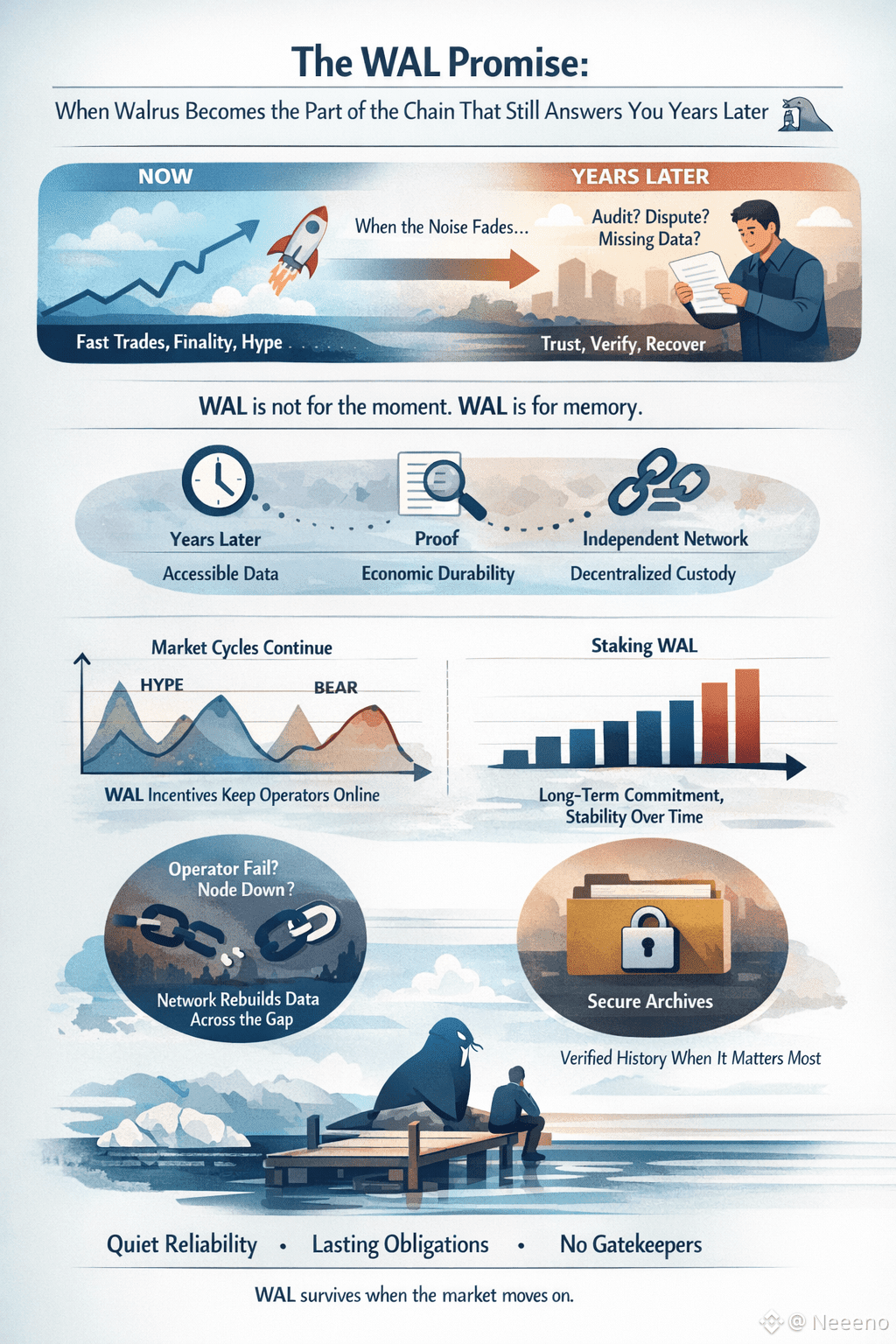
That difference is not philosophical. It’s emotional. When data disappears, people don’t just lose files. They lose confidence. They lose the ability to settle arguments without begging a third party. They lose the simple comfort of being able to verify something on their own terms. Walrus exists because blockchains don’t only create outcomes. They create memory. And memory is where trust either stays intact or slowly leaks away.
If you’ve been around long enough, you learn that “finality” is not the end of a story. It’s the start of accountability. A settlement can be final while the consequences are still unfolding. A trade can be done while the audit is still coming. A bridge withdrawal can be valid while someone is still checking whether the historical data was available when it mattered. And when that moment arrives, nobody cares how fast the chain was last year. They care whether the receipts still exist, whether they can still be fetched, and whether the system can still answer without asking them to trust a privileged archive.
This is the uncomfortable truth Walrus is designed around: transactions are short-lived, but the data they point to is not. Walrus pushes that long-lived responsibility into a network whose entire job is to keep answering—quietly, repeatedly, under conditions that are rarely glamorous. That’s why WAL matters. WAL isn’t there to decorate the story. WAL is there to make long-term data availability economically survivable, even when attention fades and markets stop rewarding optimism.
Walrus didn’t appear as a vague promise. It shipped through concrete phases that mirror how serious infrastructure actually grows: an early developer preview, then a public testnet, then mainnet—each phase forcing Walrus to be less of an idea and more of a habit that independent operators can run and maintain.The shift to mainnet in late March 2025 wasn’t just ceremonial. It marked the moment Walrus became something other people could break by accident, misconfigure in real life, and still keep alive. Walrus mainnet went live March 27, 2025, with Epoch 1 beginning March 25, and the network described as operated by over 100 independent storage node operators.
That independence matters because it’s the difference between a demo and a promise. When one team runs everything, reliability is mostly a matter of discipline. When many operators run it, reliability becomes a matter of incentives, coordination, and graceful failure. Walrus was built to survive operator churn without turning every churn event into a crisis, and the public description of its resilience goes as far as claiming continued availability even if a large fraction of nodes go offline. That’s not just a technical flex. It’s a psychological one. It’s the system saying: “You don’t have to know who is online today. You only have to know that the network, as a whole, is still obligated to answer.”
Here’s where Walrus feels different in the gut: it treats storage as a time-based obligation instead of a one-time event. WAL is presented as the token people use to pay for storage, but the deeper idea is that you’re paying for a duration—paying for a promise that lasts. The protocol’s own description emphasizes paying upfront for a fixed time and then distributing that payment across time to those doing the work. That detail looks small until you’ve lived through a bear market, when “one-time fees” and “ongoing obligations” stop matching up. Walrus tries to close that gap by making the economics explicitly about time, not hype.
That’s also why Walrus keeps insisting on predictable pricing in everyday terms, not just in token terms. The WAL page frames the mechanism as designed to keep storage costs stable in fiat terms, explicitly acknowledging that token prices fluctuate while storage obligations don’t.This is one of those design choices that feels boring until you realize it’s the difference between a user trusting the system for years versus treating it like a short-term experiment. If your “permanent data” becomes unexpectedly expensive, it’s not only a budget problem. It’s a betrayal problem.
When you follow the data flow in Walrus, you start to see why that betrayal is the real enemy. Walrus uses a base chain as a coordination layer—an on-chain record of what was stored, for how long, and under what obligations—while the actual bytes live across a separate network of storage operators. Walrus’s own writing describes publishing an on-chain certificate on Sui as a verifiable public record of custody that marks the official start of the storage service.That certificate is not just a receipt. It’s a social contract made machine-checkable: the network is publicly acknowledging responsibility.
And responsibility is where human behavior shows up. If the system only worked when everyone was honest and awake, it wouldn’t be meaningful.
Walrus plans for messy behavior: lazy participants, unexpected failures, active attackers, and nodes that go offline and never come back. That’s why WAL is tied to staking and ongoing rewards—because long-lived obligations need participants who can’t cheaply walk away from the consequences. The Walrus Foundation’s explanation of proofs and rewards explicitly connects eligibility for rewards to staking WAL, and points toward financial penalties for failure as the system matures.
You can read that and treat it like generic token design, but it’s more personal than that. In real life, people behave differently when a promise is enforceable. They also behave differently when the enforcement is legible. Walrus tries to make data custody legible: not “trust us,” but “here is the public record that custody was accepted, and here is the ongoing incentive to keep honoring it.” That legibility is what reduces the need for blind faith, and blind faith is what turns infrastructure into a fragile social game.
The part that many traders miss is that WAL is designed to punish short-termism specifically because short-termism creates real costs for everyone else. The WAL documentation describes penalties for noisy short-term stake shifts, partly burned and partly redistributed to long-term stakers, explicitly because frequent reallocation forces expensive data migration and harms the network. This is not moralizing. It’s acknowledging an ugly truth: selfish behavior doesn’t just look bad, it physically moves data around the network and makes the system less stable. Walrus is trying to make “being flaky” expensive, not with shame, but with math.
That’s a pattern with Walrus in general: it doesn’t ask you to be virtuous. It asks you to be consistent. It tries to turn consistency into a paid job. And in a world where most people only show up when rewards are loud, that’s the only kind of honesty that scales.
The “recent updates” around Walrus have been quietly reinforcing this theme rather than changing it. In August 2025, the Walrus Foundation published a detailed explanation of how its on-chain custody record and incentive design fit together, emphasizing that the proof is not only about initial storage but about anchoring a verifiable audit trail of availability across time. That kind of writing usually appears when a team is trying to teach the ecosystem how to reason about the system during stress, not just how to use it when everything is easy.
Then in September 2025, Mysten Labs highlighted how Walrus can be paired with an access-control layer so that stored data can remain protected and only authorized parties can decrypt it.This matters because the real world does not only need data to be available. It needs data to be available to the right people at the right time. The fear here isn’t only censorship. It’s exposure. Walrus is starting to feel like infrastructure that understands both fears at once: the fear of losing data and the fear of leaking it.
If you want a clean example of how Walrus turns “ecosystem growth” into something practical, look at the Walrus Foundation’s RFP program launched in March 2025. It explicitly aimed to fund projects that advance and support the ecosystem—work that tends to be unsexy but essential: the glue that turns a protocol into something developers can rely on without heroics.A system becomes emotionally safe when it becomes boring to operate. RFPs are one of the ways you buy boredom: you pay for tooling, reliability work, and integrations that nobody tweets about once they exist.
Walrus also didn’t try to pretend this could be built in a financial vacuum. In March 2025, the Walrus Foundation announced a $140M fundraising led by Standard Crypto. Major outlets reported the raise as a private sale of WAL, framing it as capital meant to accelerate the protocol ahead of mainnet, and noting participation from well-known investors.Whether you like fundraising narratives or not, there’s a practical reality here: long-term data systems need sustained funding because the hard parts are slow, and the boring parts cost money.
Now, about the token itself—because people will ask. As of the market data shown on major trackers at the time of writing, WAL’s circulating supply is about 1.577B, with a maximum supply shown as 5B, and market cap fluctuating around the low-to-mid hundreds of millions USD.I don’t bring that up as a price call. I bring it up because supply, float, and valuation shape how the market treats WAL: as a short-term vehicle or as a long-term claim on a network that has to keep doing work when nobody is watching.
That “nobody is watching” part is where Walrus becomes real.
The worst failures in crypto are rarely sudden. They are quiet degradations. A dApp works until it doesn’t. A link resolves until it 404s. A proof can be computed until someone realizes the underlying data isn’t retrievable without trusting a third party. And the emotional shift is immediate: users stop feeling protected by verification and start feeling dependent on someone’s goodwill. That’s when people become cynical, and cynicism is corrosive because it spreads faster than any technical fix.
Walrus is explicitly designed to stop that slide into cynicism by making the custody promise checkable and by distributing responsibility so that no single operator becomes the silent king of your data. The academic framing of Walrus describes combining a blockchain control plane with a separate committee of storage nodes and an encoding approach that supports recovery under churn at scale. Even if you never read the paper, you can feel what it’s trying to accomplish: reduce the number of ways a human can become your single point of failure.
And humans will always be the point of failure if incentives are naive. That’s why the Walrus team keeps talking about economics as if it’s a security primitive. Because it is. If operators are only profitable during hype, they will leave during boredom. If users are only willing to pay during excitement, they will stop renewing during fatigue. If governance can be swung cheaply by short-term capital, long-term obligations become political footballs. Walrus is trying to price and structure WAL so that boring persistence remains a viable business, not a charitable act.
One of the most honest things about Walrus is that it doesn’t pretend “forever” is free. It treats persistence as something you continually honor, not something you wish into existence. That’s how grown-up systems behave. They don’t promise immortality. They promise a process that keeps working as long as people keep paying attention to the obligation, and Walrus tries to make that attention minimal by automating the accountability.
When markets get volatile, this becomes even more important. Volatility makes people cut corners. It makes teams pause expenses. It makes operators chase yield. It makes communities rewrite narratives to cope. In those phases, a storage system that survives is not the one with the loudest community. It’s the one whose incentives keep functioning when nobody feels inspired. WAL is positioned as the lever that keeps Walrus running through those cycles—not by demanding faith, but by making reliability the rational default.
And that is what “data outliving transactions” really means. It means the system is still there when the original builders are gone, when the app has rebranded, when the Discord is quiet, when the token chart is boring, when the only people left are the ones who need the truth. It means Walrus still answers the investigator, the auditor, the angry user trying to reconstruct a timeline, the builder trying to migrate without losing history. It means WAL isn’t just rewarding capacity. It’s rewarding the willingness to keep showing up.
I think the mature way to see Walrus is as a kind of quiet liability management. Walrus takes on the liability that chains and apps don’t want to hold forever: the burden of keeping data available and provable over time. WAL is the mechanism that tries to pay that liability down gradually, instead of pretending it disappears after the first upload. That’s why Walrus feels like infrastructure rather than a trend. It’s not trying to win attention. It’s trying to reduce the number of times users have to feel that cold, sinking realization that the system can’t answer them anymore.
In the end, that’s what real trust looks like. It’s not a vibe. It’s the absence of panic. It’s the ability to verify without pleading. It’s the quiet confidence that if something is challenged later, you won’t be forced into a relationship with a gatekeeper just to retrieve your own history. Walrus and WAL are built for that kind of trust—the kind that survives boredom, survives conflict, survives time.
Invisible infrastructure is easy to ignore until you need it. Walrus is choosing to live in that invisible layer on purpose, taking responsibility for the parts of blockchain life that don’t fit neatly inside a transaction. WAL, at its best, is not a story about hype. It’s a story about paying people to keep promises when nobody is applauding. And in a world that keeps confusing attention with importance, that kind of quiet responsibility is exactly what reliability is made of.

