

@Walrus 🦭/acc is a decentralized storage protocol designed to address a long-standing constraint in blockchain ecosystems: while blockchains excel at validating transactions and enforcing logic, they are poorly suited for storing large volumes of data. As decentralized applications expand beyond simple value transfers into areas like media, gaming, digital identity, artificial intelligence, and enterprise software, they increasingly rely on heavy data such as images, videos, documents, machine learning models, and datasets. To handle this, many projects quietly fall back on centralized cloud providers, which weakens decentralization, introduces censorship risks, and recreates single points of failure. Walrus was created to solve this contradiction by delivering a storage system that is decentralized in real-world operation while remaining practical and affordable.
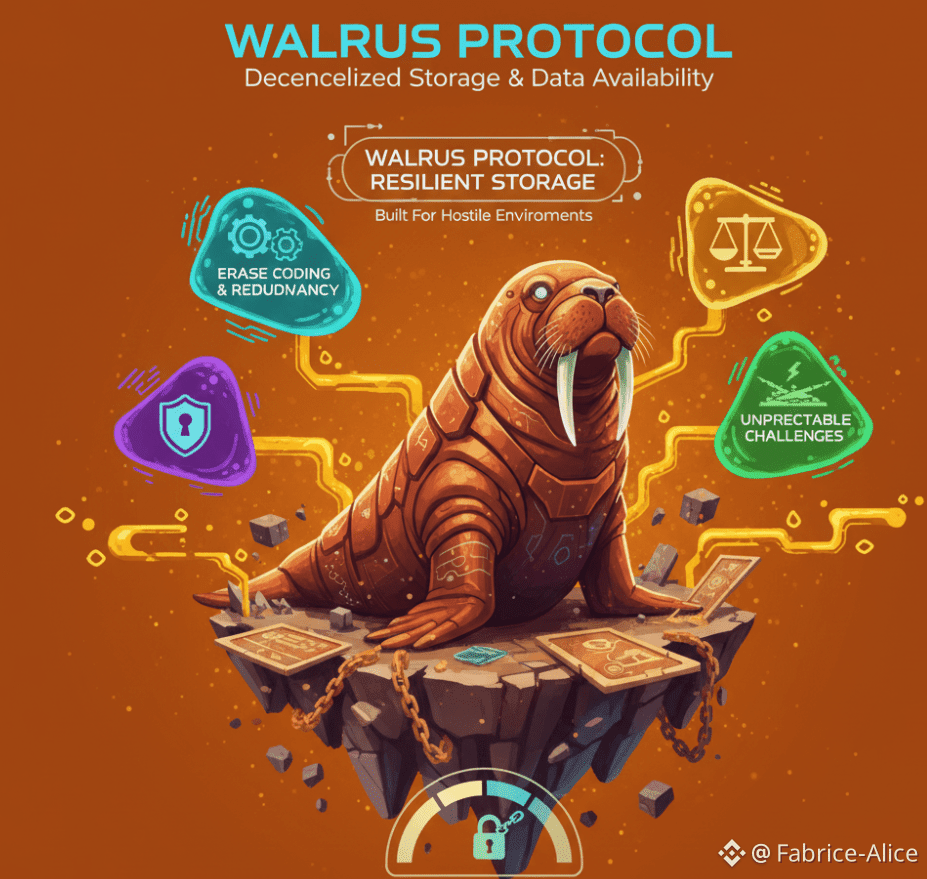
At its core, Walrus distinguishes between storing data and coordinating data. Rather than placing large files directly on a blockchain—which would be slow and prohibitively expensive—the protocol divides files into smaller, encoded fragments and distributes them across a network of independent storage nodes. This method relies on erasure coding, allowing the original data to be reconstructed even if some fragments are temporarily unavailable. As long as a sufficient subset of pieces remains online, the file can be recovered. This significantly improves fault tolerance while minimizing unnecessary duplication, which helps keep storage costs low. Meanwhile, the coordination layer—responsible for tracking data locations, payments, and availability—is handled on the Sui blockchain. In this setup, Sui serves as a lightweight but authoritative record keeper without being burdened by the data itself.
Sui’s design is a key factor in making Walrus viable at scale. Built for fast execution and object-based logic, Sui can efficiently manage storage metadata, ownership structures, access controls, and cryptographic proofs that data is still being stored. When a user uploads data through Walrus, Sui records a compact on-chain reference along with verifiable guarantees of availability. Applications can later check these guarantees directly on-chain, allowing stored data to become an active, programmable element of smart contracts instead of a black-box external dependency. Put simply, Sui handles the rules and records, while Walrus focuses on storing the data.
The protocol’s economic model is centered on the WAL token. Rather than being designed primarily for speculation, WAL functions as an incentive and coordination mechanism. Users pay WAL to store data, and those payments are distributed to storage providers who supply disk space and bandwidth. Node operators must also stake WAL as collateral, giving them a direct financial incentive to act honestly and maintain uptime. Providers who consistently fail to meet network requirements risk having part of their stake penalized. This creates a self-enforcing system where reliable behavior is rewarded and poor performance is discouraged without centralized oversight.
Beyond payments and incentives, WAL also supports governance. Token holders are expected to influence decisions about protocol parameters such as pricing, upgrades, and incentive adjustments. This flexibility is important because decentralized storage is not a fixed problem—hardware costs shift, usage patterns evolve, and new application types emerge. A governance-driven approach allows Walrus to adapt over time instead of locking in assumptions that may become obsolete. At the same time, the protocol aims to keep storage costs stable and predictable for users, even if the market value of WAL fluctuates, which is crucial for long-term developer and enterprise adoption.
Walrus is also designed to integrate with the wider blockchain ecosystem rather than existing in isolation. Although it is closely tied to Sui for coordination, its storage layer can support applications built on other blockchains as well. Developers working in ecosystems like Ethereum or Solana can use Walrus to store large assets while keeping their core logic on their preferred chain. This positions Walrus as shared infrastructure rather than a closed system, making it easier for projects to remain decentralized end-to-end instead of reverting to centralized cloud services as they scale.
Early use cases are already emerging in areas where decentralized storage has traditionally struggled. Identity and credential platforms benefit from data that must remain available yet resistant to censorship or tampering. NFT projects use Walrus to store media assets without depending on centralized gateways. Some developers are experimenting with fully decentralized websites whose frontends are hosted entirely on Walrus, reducing the risk of takedowns. Perhaps most notably, artificial intelligence presents a major opportunity: large datasets and models need to be stored, shared, and verified across applications, and Walrus offers a way to do this in a decentralized yet verifiable manner.
That said, Walrus is not without challenges. The decentralized storage landscape is competitive, and attracting developers requires not only strong technology but also intuitive tooling and clear economic benefits. Ensuring consistently high availability across a large, permissionless network of storage nodes becomes more complex as the system grows. Incentives must be carefully balanced to avoid underpaying providers or overcharging users. There is also the long-term risk of centralization, as well-capitalized operators could accumulate disproportionate storage capacity if safeguards are not properly maintained.
Looking ahead, Walrus appears well positioned to become a foundational data layer rather than a niche solution. As blockchains support increasingly sophisticated applications, demand for dependable decentralized storage will continue to rise. Walrus’s architecture points toward a future where storage is a first-class component of decentralized systems, deeply integrated with smart contracts and application logic. If the project continues to balance strong technical design with real-world usability, it may become an invisible but essential piece of infrastructure—reliable, understated, and quietly critical to the next phase of Web3.

