Most crypto conversations these days feel like déjà vu. A new coin launches, people shout “100x,” Telegram groups go crazy for a week, and then everyone quietly moves on to the next thing. After enough cycles like that, it’s easy to assume every token is just another spin of the same wheel.
WAL doesn’t really fit that mould, because it’s attached to an actual product that solves a real problem instead of chasing pure hype.
So what is Walrus, really?
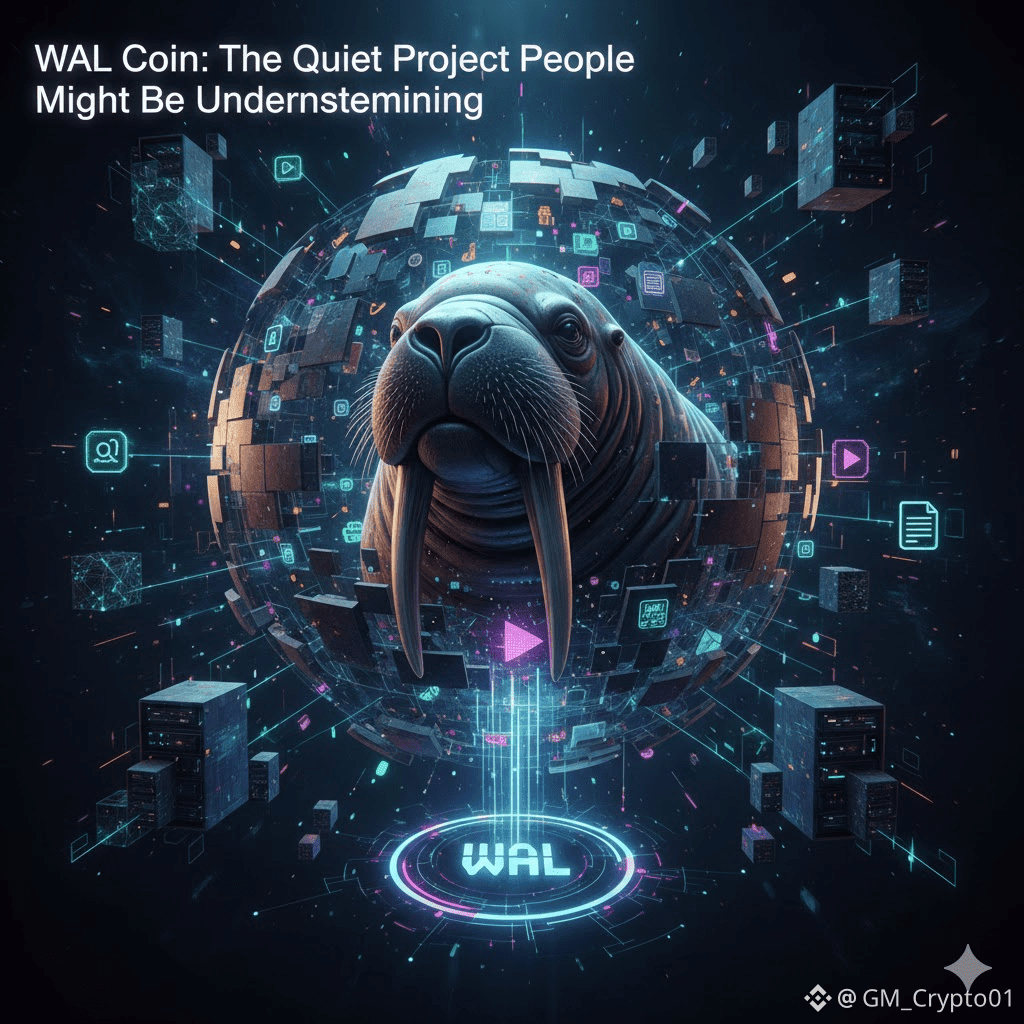
At its core, Walrus is about storing data, but not in the old school, bigtech way. Instead of trusting one company’s servers, Walrus spreads storage across many independent providers. Data is broken up, distributed, and verified by the network, not owned by a single platform.
That matters more now than it did a few years ago.
We’re entering a phase where data isn’t just “big,” it’s enormous. AI training sets, high-resolution game assets, long-form video, permanent on-chain records — they don’t fit neatly into the traditional cloud pricing model anymore. And people are starting to notice the risks of centralization: lock-ins, sudden cost increases, and the uncomfortable reality that your data only exists at someone else’s permission.
Where WAL Coin actually comes into play
WAL isn’t just a logo sitting next to the project. It’s the tool that makes the network function.
If you want to store data on Walrus, you pay in WAL. If you want to provide storage to the network, you stake WAL. That stake can be slashed if a provider cheats or fails, which is exactly what motivates honest performance. In other words, the token is tied directly to real network behavior, usage and security.
That’s the key difference between “token first, product later” projects and systems like this where the token exists because the network needs it.
What’s changing in the market right now
A few trends make this particularly interesting at the moment:
AI development is accelerating, and data costs now matter as much as compute
builders are actively looking for decentralized infrastructure to avoid single-points of failure
Web3 apps are shifting from experiments to production-level tools that need reliable storage
We’re already seeing more teams think about multi provider and decentralized storage options to hedge risk. Walrus is positioning itself right inside that conversation.
But it’s not automatic success
Competition is real: Filecoin, Arweave, Storj and others have been in the space for years. Walrus still has to win developers, partnerships, and integrations, and that takes time and actual delivery.
The token will only truly reflect value if the network gets used at scale. Until then, price movement will be the usual mix of speculation, sentiment, and market noise.
Final thought
WAL won’t appeal to everyone chasing overnight gains, and that’s fine. Its appeal is that it’s tied to infrastructure the internet increasingly needs: cheaper, censorship resistant, failure resistant storage.
If Walrus succeeds in getting real-world adoption, WAL is positioned at the center of that ecosystem, not as a marketing accessory, but as the fuel that keeps it running.
Not guaranteed. Not hype free. But very much real enough to watch closely.