

@Walrus 🦭/acc begins with a simple idea that is now becoming hard to ignore. Blockchains are no longer just ledgers for value transfer. They are turning into execution layers for complex applications that generate and depend on large volumes of private data. The moment social graphs, AI-driven tools, encrypted workflows, and enterprise use cases move on-chain, the limits of smart contract storage become visible. Walrus enters this shift as a data-first protocol built to work inside the Sui ecosystem rather than around it.
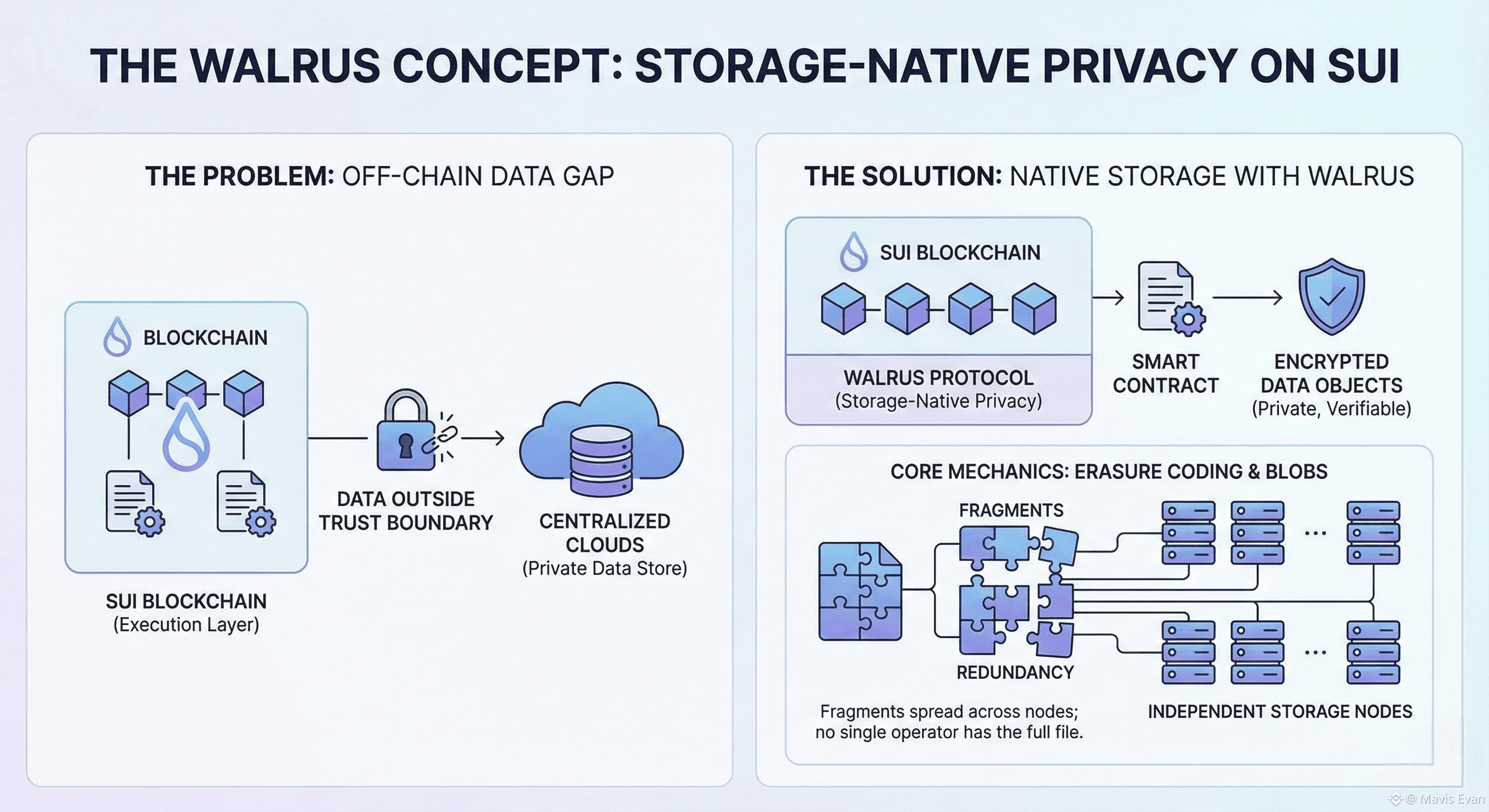
The timing matters because most high-throughput chains still treat data as an external problem. Smart contracts execute fast, but anything heavier than a few kilobytes is pushed to centralized clouds or weakly coordinated off-chain systems. This creates a quiet contradiction. Applications claim decentralization while their most valuable asset, user data, sits outside the trust boundary. Walrus positions itself as the missing layer that closes this gap without breaking privacy guarantees.
At the core of Walrus is the idea that private data should be handled as a network primitive, not an afterthought. Instead of asking developers to bolt storage onto existing apps, the protocol offers a native environment where encrypted data objects can be stored, retrieved, and referenced from Sui smart contracts in a predictable way. This design choice changes how developers think about data availability and trust, because it removes the need for centralized pinning services or bespoke storage clusters.
Internally the system relies on two pillars, erasure coding and blob storage. Erasure coding breaks large files into fragments, adds redundancy, and spreads them across independent nodes. No single operator holds enough information to reconstruct a file, which preserves privacy even in adversarial conditions. Blob storage treats these fragments as content-addressed objects that can be verified on retrieval. Together they allow Walrus to offer both durability and confidentiality without falling back to trusted intermediaries.
Sui’s object-centric model plays a key role here. Unlike account-based chains, Sui handles state as individual objects that can be processed in parallel. Walrus maps naturally onto this structure by treating stored data as first-class objects with their own lifecycle. When a dApp on Sui references a Walrus object, it is not calling out to a foreign system. It is interacting with a data primitive that respects the same execution semantics as the chain itself.
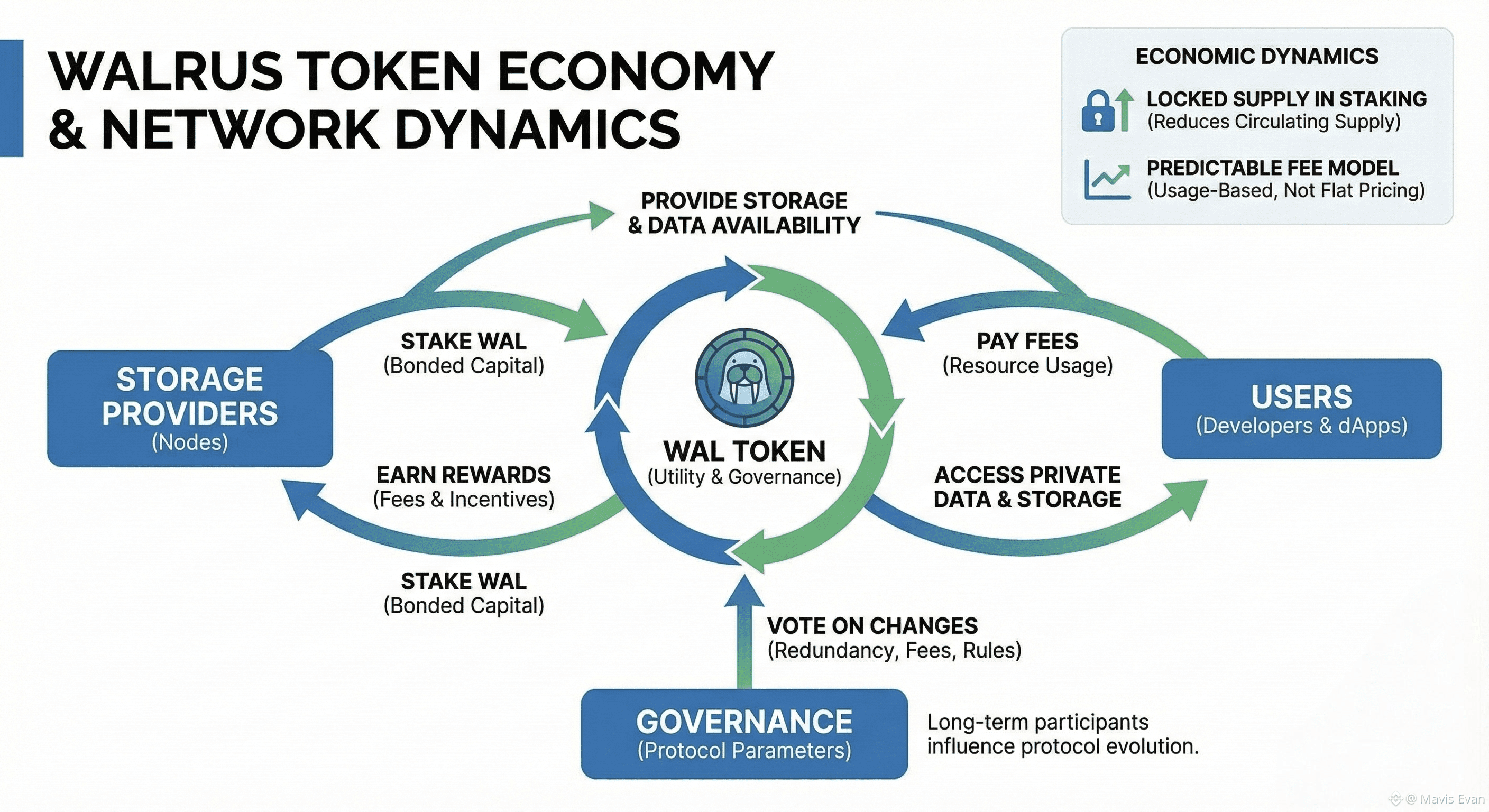
The WAL token sits at the center of this flow. Storage providers stake WAL to participate in the network, which aligns their incentives with data availability and integrity. Users pay WAL to store and retrieve data, creating a direct link between usage and economic value. Governance also flows through the token, giving long-term participants influence over parameter changes such as redundancy levels, fee models, or admission rules for new nodes.
This token utility matters because storage networks fail when their economics are misaligned. If providers are underpaid, data disappears. If users are overcharged, adoption stalls. Walrus attempts to balance this by tying fees to measurable resource usage rather than flat pricing. Erasure coding lets the protocol tune redundancy dynamically, so the network can respond to demand spikes without pushing costs into unsustainable territory.
On-chain behavior gives early clues about how this design is being used. Even without precise numbers, patterns around WAL transfers and staking suggest that the token is not being treated purely as a speculative asset. A growing share of supply appears locked in validator or provider roles, which is consistent with a network that requires bonded capital to maintain service quality. This reduces circulating supply and introduces a natural dampener on short-term volatility.
Wallet growth on Sui also offers indirect evidence. As more applications integrate data-heavy features, the pressure to adopt native storage increases. Walrus benefits from this trend because it is not competing with Sui for attention. It extends Sui’s utility, which means that every new developer exploring object-based execution is a potential Walrus user by default.
Transaction patterns reinforce this view. Storage-related calls create a different on-chain footprint than typical DeFi activity. They involve fewer high-frequency trades and more periodic interactions tied to application behavior. Over time this should result in a distinct fee profile where a steady base of low-noise transactions replaces the bursty activity seen in yield-driven protocols.
The market impact of this shift is subtle but important. Liquidity around WAL is not only a function of trader interest. It also reflects how much capital is being locked to secure the network. As staking participation rises, available float tightens. This does not guarantee price appreciation, but it changes the supply dynamics in a way that is structurally different from pure governance tokens.
For builders, Walrus reduces the friction of launching privacy-aware applications. Instead of stitching together cloud storage, encryption libraries, and access control layers, they can rely on a native service that speaks the same language as their smart contracts. This shortens development cycles and lowers the risk of silent data leaks caused by integration errors.
Investors looking at the Sui ecosystem are likely to treat Walrus as infrastructure rather than a standalone product. This framing matters because infrastructure tokens tend to capture value slowly but persistently as usage compounds. They rarely produce explosive growth tied to single narratives, but they also avoid the boom-and-bust patterns common in application-level tokens.
That said, the protocol faces real constraints. Erasure coding is computationally expensive, and maintaining acceptable latency while scaling storage volume is non-trivial. If retrieval times degrade as the network grows, developers will quietly revert to centralized alternatives. The success of Walrus depends on continuous optimization of node performance and network topology.
Economic risks also deserve attention. If WAL price appreciates too quickly, storage costs in fiat terms may become unpredictable. Enterprises are sensitive to this volatility, and they will only commit to decentralized storage if pricing remains within narrow bands. The protocol may need fee smoothing or hedging mechanisms to maintain competitiveness with traditional cloud providers.
Governance is another open question. Token-based voting can skew toward large holders, which may prioritize yield over network health. Storage networks need conservative parameter changes because mistakes have lasting consequences. If governance becomes reactive to market noise, it could undermine the reliability that data-centric applications require.
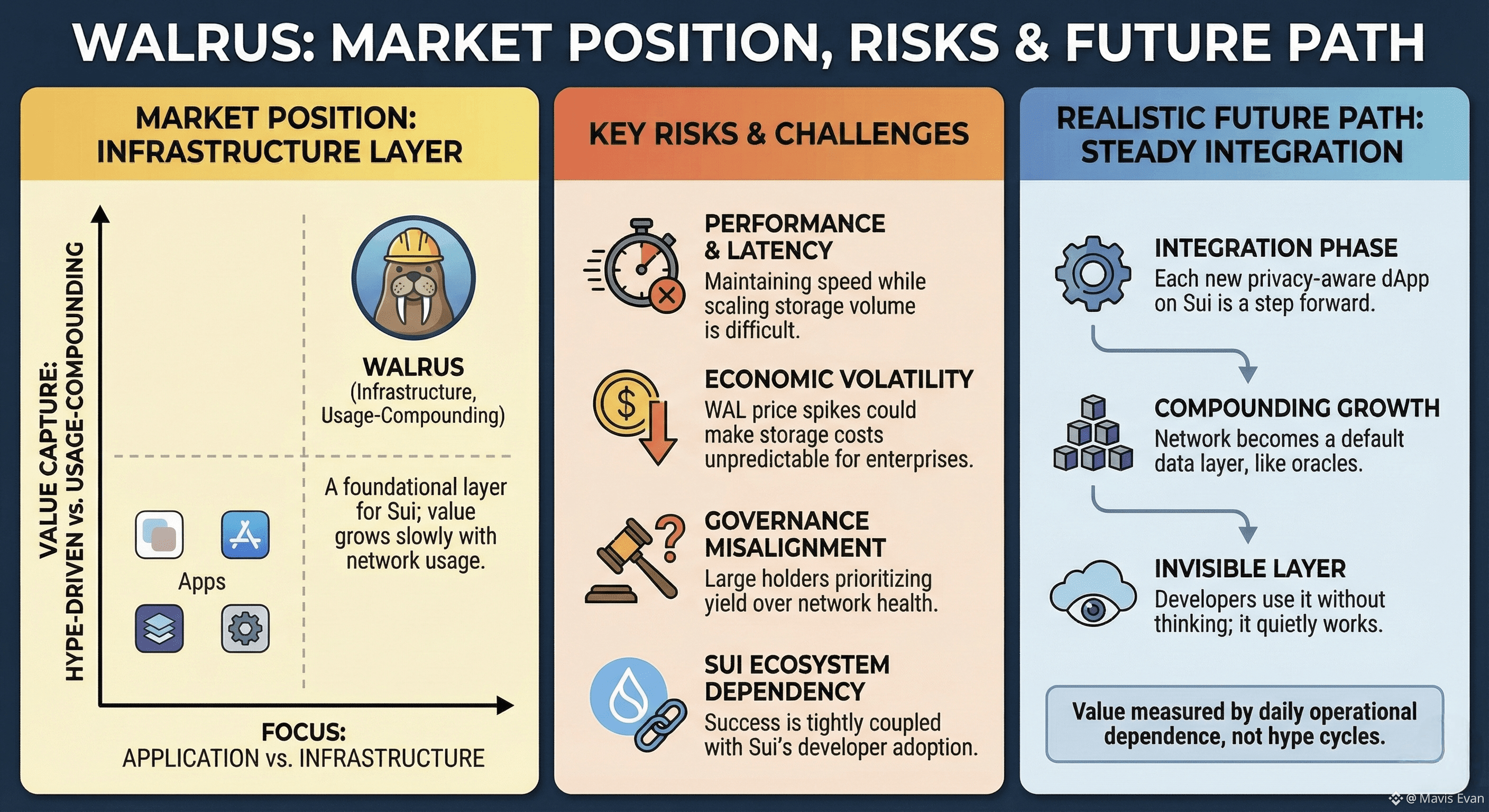
There is also the broader ecosystem risk tied to Sui itself. Walrus inherits both the strengths and the weaknesses of its base chain. High throughput and object-based execution are advantages, but any slowdown in Sui developer adoption directly limits Walrus growth. This tight coupling means that the protocol is betting on Sui becoming a long-term settlement layer for complex applications, not just another high-speed chain.
Looking ahead, the most likely path for Walrus is steady integration rather than viral adoption. Each new dApp that needs private storage is a small step forward, and these steps compound. Over time the network could become a default data layer for Sui, similar to how certain oracles became indispensable to smart contract platforms.
The forward outlook depends less on market sentiment and more on execution quality. If the team can maintain performance, keep fees predictable, and avoid governance missteps, Walrus may define what decentralized storage looks like inside a modern execution environment. Not as a bolt-on service, but as an invisible layer that developers stop thinking about because it simply works.
In a market crowded with protocols promising privacy, Walrus stands out by anchoring its value in a concrete operational role. It is not selling secrecy as an abstract concept. It is offering a way to move real data into the trust boundary of decentralized systems. If that promise holds, WAL will not be measured by hype cycles but by how many applications quietly depend on it every day.

