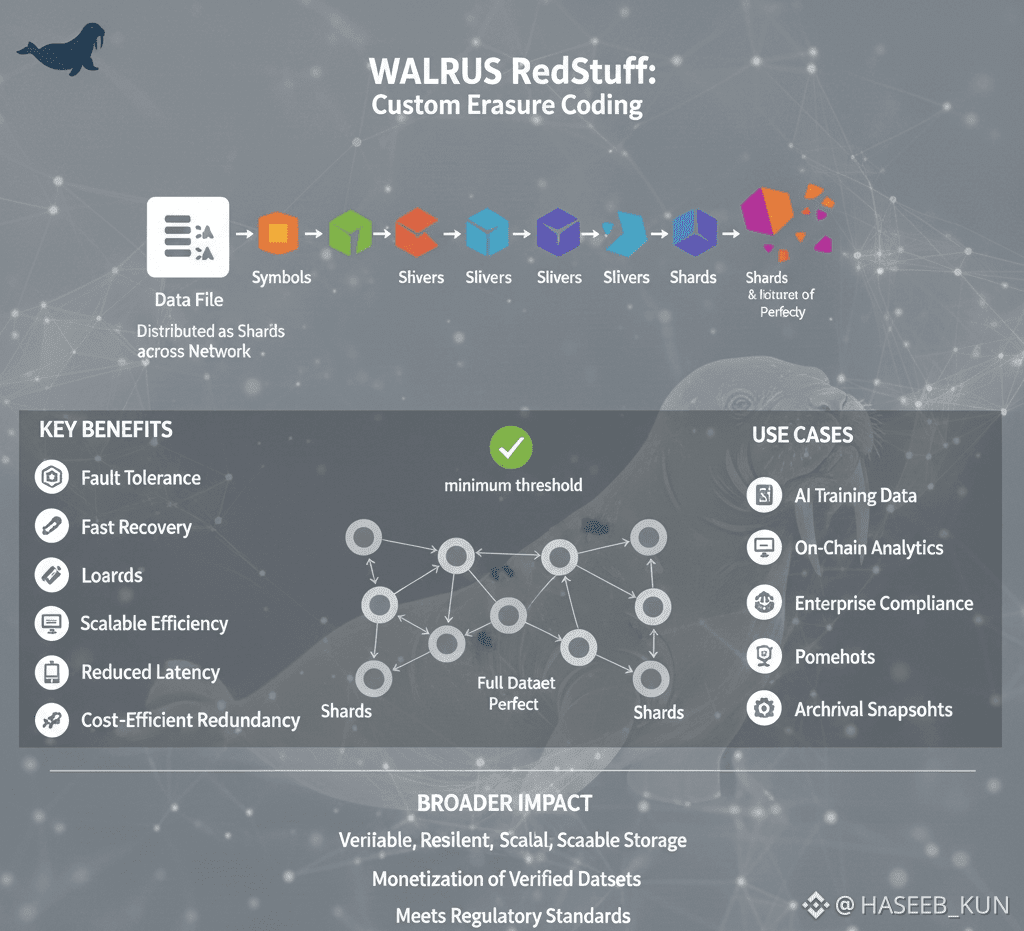
In the fast-evolving world of decentralized infrastructure, storage reliability is no longer optional—it is mission-critical. Nodes go offline, network conditions fluctuate, and failures are an inherent part of the system. Traditional replication strategies, which store multiple copies of the same dataset, can only go so far: they quickly become costly, inefficient, and vulnerable to correlated failures. Walrus addresses this challenge with RedStuff, a proprietary erasure coding solution designed to ensure that data remains fault-tolerant, fast to recover, and scalable, even in the face of network uncertainty. RedStuff does this by breaking data into smaller units called symbols, encoding them into slivers, and distributing these slivers as shards across the network. Individually, shards hold only partial information, but together they can reconstruct the full dataset with precision. This approach transforms reliability from a hopeful assumption into a verifiable guarantee: as long as a minimum threshold of shards is accessible, data can always be recovered.
What makes RedStuff particularly relevant today is its combination of fault tolerance, speed, and efficiency. Recovery can begin immediately once enough shards are available, without waiting for the entire network to be online, which reduces latency and ensures performance under real-world conditions. Unlike traditional replication, which increases storage overhead with every additional copy, RedStuff achieves redundancy through coding efficiency, allowing Walrus to scale horizontally without sacrificing reliability or inflating costs. This makes it an ideal solution for high-demand use cases such as on-chain analytics, AI training datasets, enterprise compliance storage, and archival blockchain snapshots—datasets that cannot afford downtime or corruption.
Beyond technical robustness, RedStuff also positions Walrus at the forefront of emerging trends in decentralized infrastructure. As Web3 ecosystems expand, institutions and developers increasingly demand verifiable, resilient, and scalable storage solutions that meet both commercial and regulatory standards. RedStuff enables this by embedding reliability into the very architecture of Walrus. Governance records, financial datasets, and mission-critical historical data can all be stored and reconstructed with cryptographic certainty, eliminating the need for trusted intermediaries. This approach aligns with broader market trends emphasizing decentralized, proof-based systems over centralized promises, creating opportunities for monetization of verified datasets and adoption in regulated environments.
Ultimately, RedStuff is more than a coding innovation—it is the backbone of Walrus’ promise: data that can withstand real-world failure while remaining accessible, auditable, and efficient. By combining mathematical guarantees, fast reconstruction, and scalable architecture, RedStuff transforms decentralized storage from a fragile experiment into production-ready infrastructure. In a Web3 landscape where reliability, transparency, and performance increasingly define value, Walrus demonstrates that decentralized storage can meet institutional-grade expectations while remaining fully trustless and verifiable. Symbol by symbol, shard by shard, RedStuff ensures that the data powering tomorrow’s applications is always safe, available, and ready to drive innovation.