

@Walrus 🦭/acc As blockchain systems mature, one constraint keeps resurfacing: data. Decentralized applications are increasingly required to store and serve large volumes of unstructured information images, video, AI model weights, application assets yet most blockchains were never designed for this role. Native on-chain storage is prohibitively expensive, while centralized cloud solutions sacrifice decentralization and control. Early decentralized storage networks attempted to bridge the gap but often introduced inefficiencies, heavy redundancy, or weak integration with smart contracts. Walrus positions itself as a structural answer to this problem by offering a decentralized blob storage layer that is tightly coupled with the Sui blockchain and optimized for Web3-native workloads.
Rather than treating storage as an external service, Walrus embeds data availability directly into the blockchain environment. Built on Sui’s high-throughput architecture, the protocol is designed to handle large-scale data with reliability closer to centralized infrastructure, while maintaining cryptographic verifiability and decentralization. Its defining architectural choice is the use of advanced erasure coding specifically linear coding schemes like RedStuff instead of full data replication. Each data blob is encoded into multiple fragments distributed across independent storage nodes, allowing reconstruction even when a meaningful portion of the network is unavailable. This approach delivers strong fault tolerance with far lower redundancy overhead than traditional decentralized storage models.
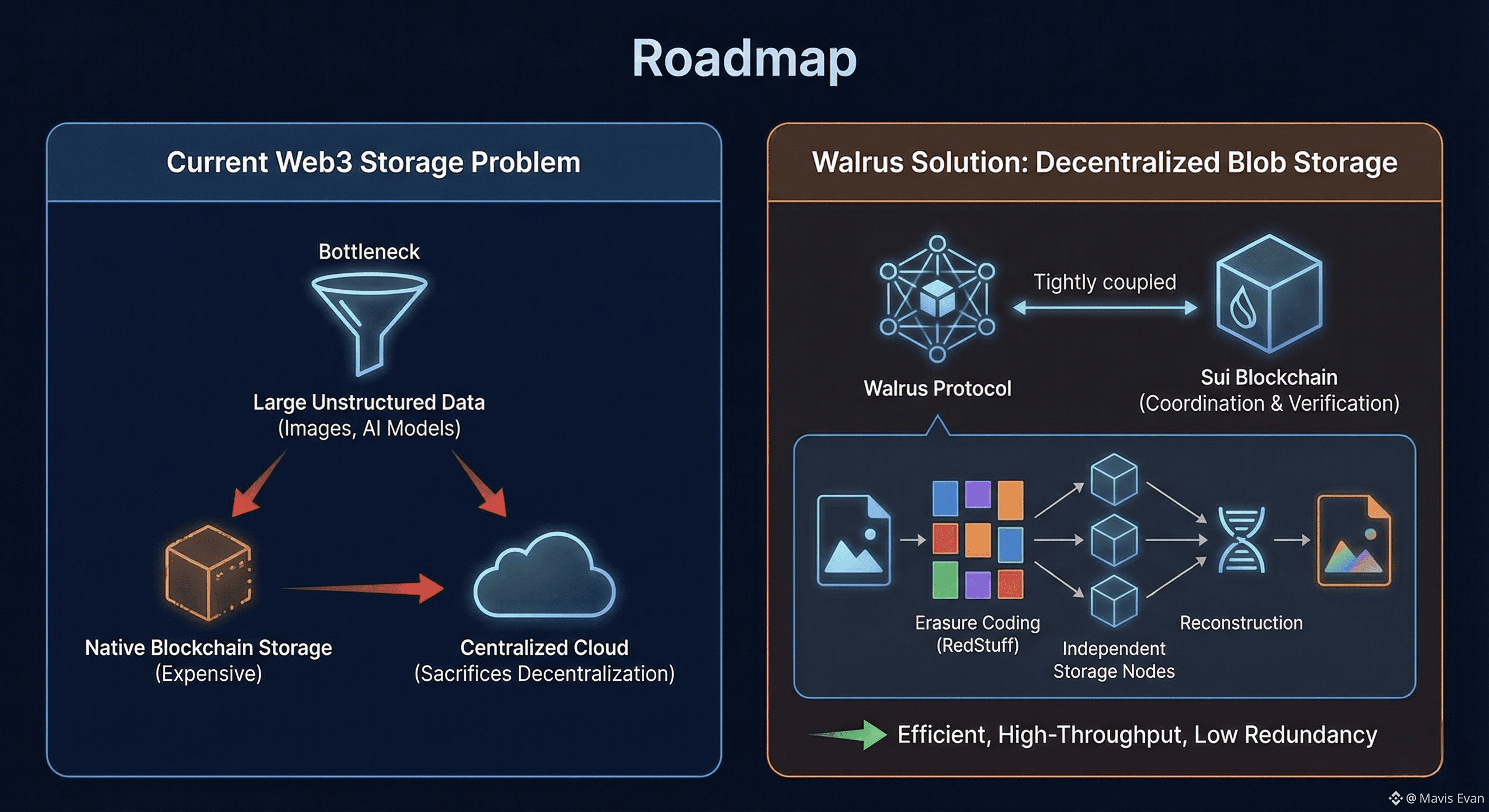
Walrus relies on Sui not just for settlement, but for coordination and verification. Metadata and availability attestations for stored blobs are recorded on-chain, allowing applications and smart contracts to confirm data availability without retrieving the data itself. This turns stored data into a programmable component of application logic rather than a passive resource. Because Walrus aligns with Sui’s object-based model, developers can natively reference stored data within decentralized applications, enabling use cases that require deterministic access to large datasets.
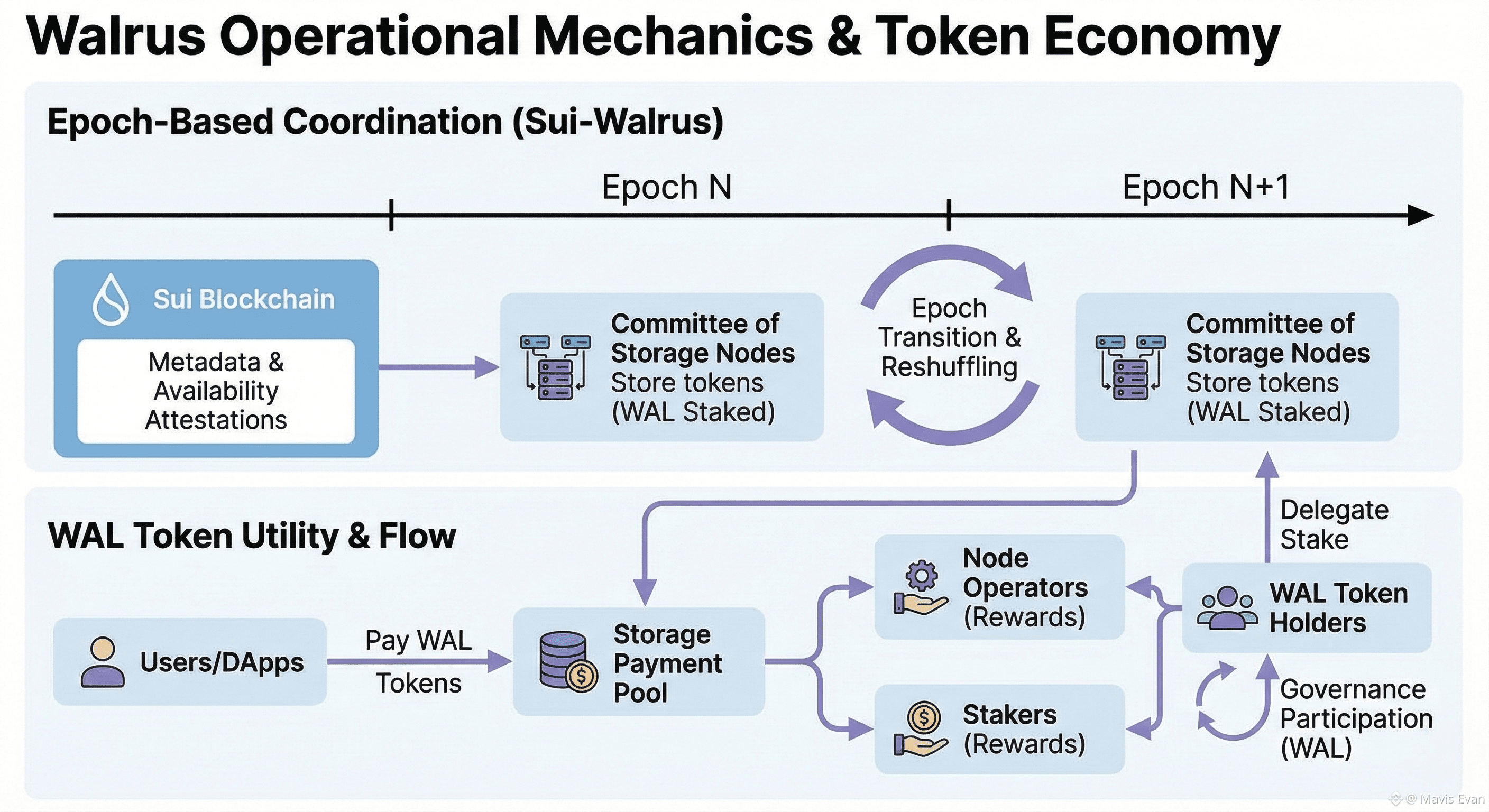
Operationally, the network is organized around epochs. At each epoch, a committee of storage nodes is selected based on delegated WAL stake. These nodes are responsible for storing encoded fragments and responding to availability checks. Epoch transitions reshuffle responsibilities and committee membership, reinforcing performance incentives while preventing static control over data availability. This design encourages long-term reliability rather than short-lived opportunism.
The WAL token sits at the center of the system’s economic design. It is used to pay for storage services, secure the network through staking, and participate in governance. Storage payments are structured as time-based commitments, with rewards distributed gradually to nodes and stakers over the lifespan of the stored data. Pricing mechanisms are designed to reduce exposure to token volatility by anchoring storage costs to more stable external references. Delegated staking allows token holders to contribute to security without operating infrastructure, while nodes compete for stake by demonstrating uptime, throughput, and reliability.
Governance is also mediated through WAL. Token holders influence parameters such as storage pricing, reward allocation, and penalty mechanisms. Planned slashing and burn mechanics aim to discourage unreliable behavior and introduce deflationary pressure over time, aligning long-term token value with network performance rather than short-term speculation.
From an on-chain perspective, Walrus presents a different set of signals than typical blockchain networks. Traditional metrics like transaction counts are less informative than indicators such as blob upload volume, storage duration, and availability attestations. Early network activity has shown meaningful data throughput across distributed nodes, suggesting that demand is rooted in actual storage use rather than synthetic activity. Node operators face a dual challenge: maintaining storage capacity while consistently proving availability, which creates a layered incentive structure favoring operational competence.
These mechanics have important market implications. WAL functions less like a narrative-driven asset and more like a utility instrument tied to real consumption of storage services. As data-intensive decentralized applications scale particularly in NFTs, AI-related workloads, and archival use cases demand for verifiable storage could translate into sustained token utility through fees and staking. Developers benefit from programmable data availability, while institutions evaluating decentralized infrastructure may be drawn to Walrus’s auditability, cost structure, and censorship resistance.
Still, meaningful risks remain. Storage economics must be calibrated carefully to avoid underpaying node operators or pricing out users. Epoch-based coordination introduces complexity and the possibility of stake concentration over time. From a technical standpoint, erasure coding and data reconstruction impose bandwidth and latency requirements that must hold up under adverse network conditions. Regulatory uncertainty around decentralized storage particularly concerning data governance and compliance adds another layer of complexity, especially for enterprise adoption.
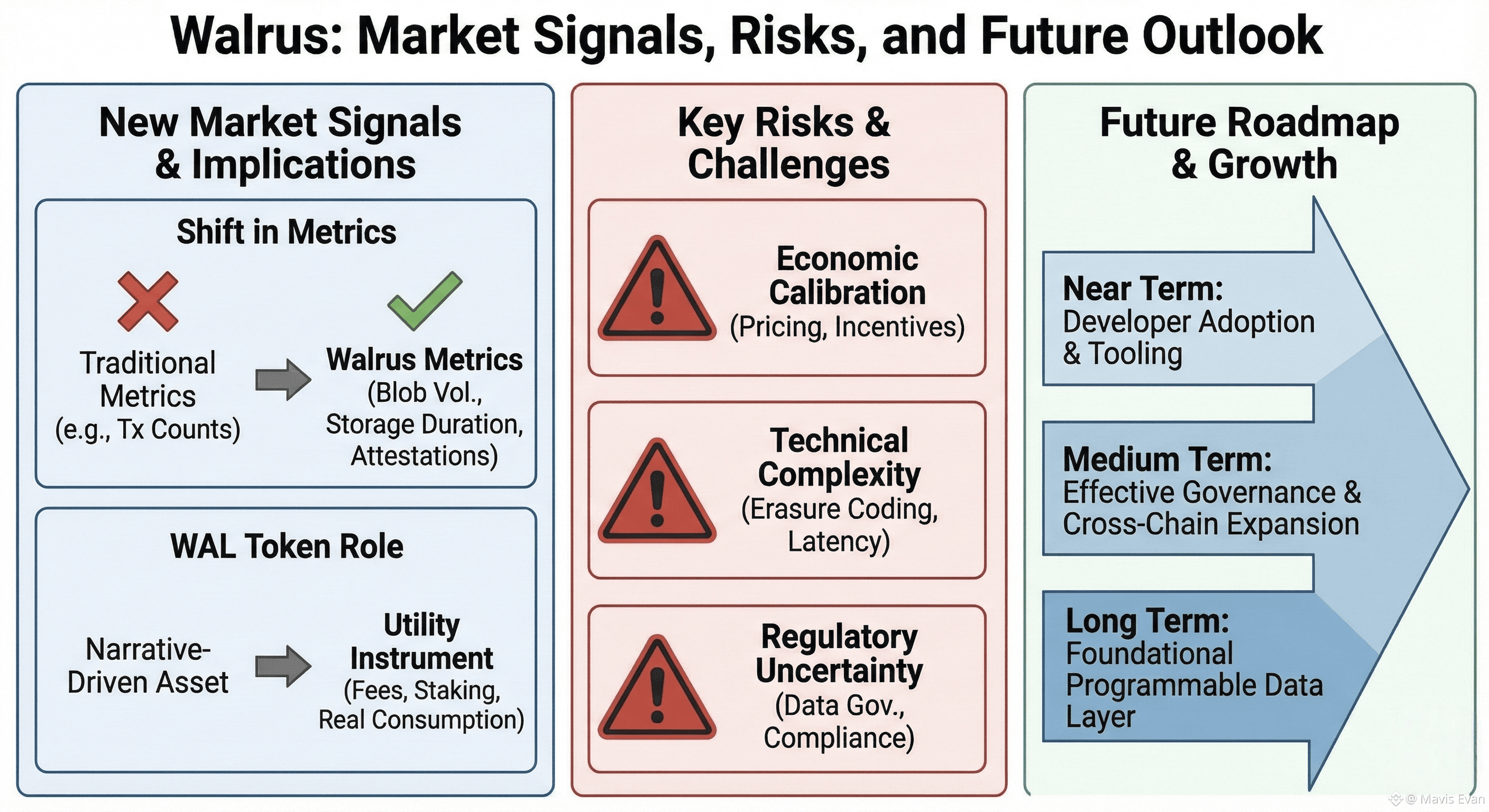
Looking forward, Walrus’s progress will depend on sustained developer adoption, expanding tooling, and demonstrable performance at scale. In the near term, growth in stored data volume and broader application integration will serve as key indicators. Over the medium term, effective governance, refined incentive mechanisms, and potential cross-chain expansion could solidify Walrus’s role as a foundational data layer. If it succeeds, Walrus may reshape how decentralized systems think about storage not as a bottleneck, but as a programmable, verifiable primitive embedded directly into Web3 infrastructure.

