



Completeness, Validity, and Read Consistency: The Foundations of Dependable Decentralized Storage — Walrus Explained
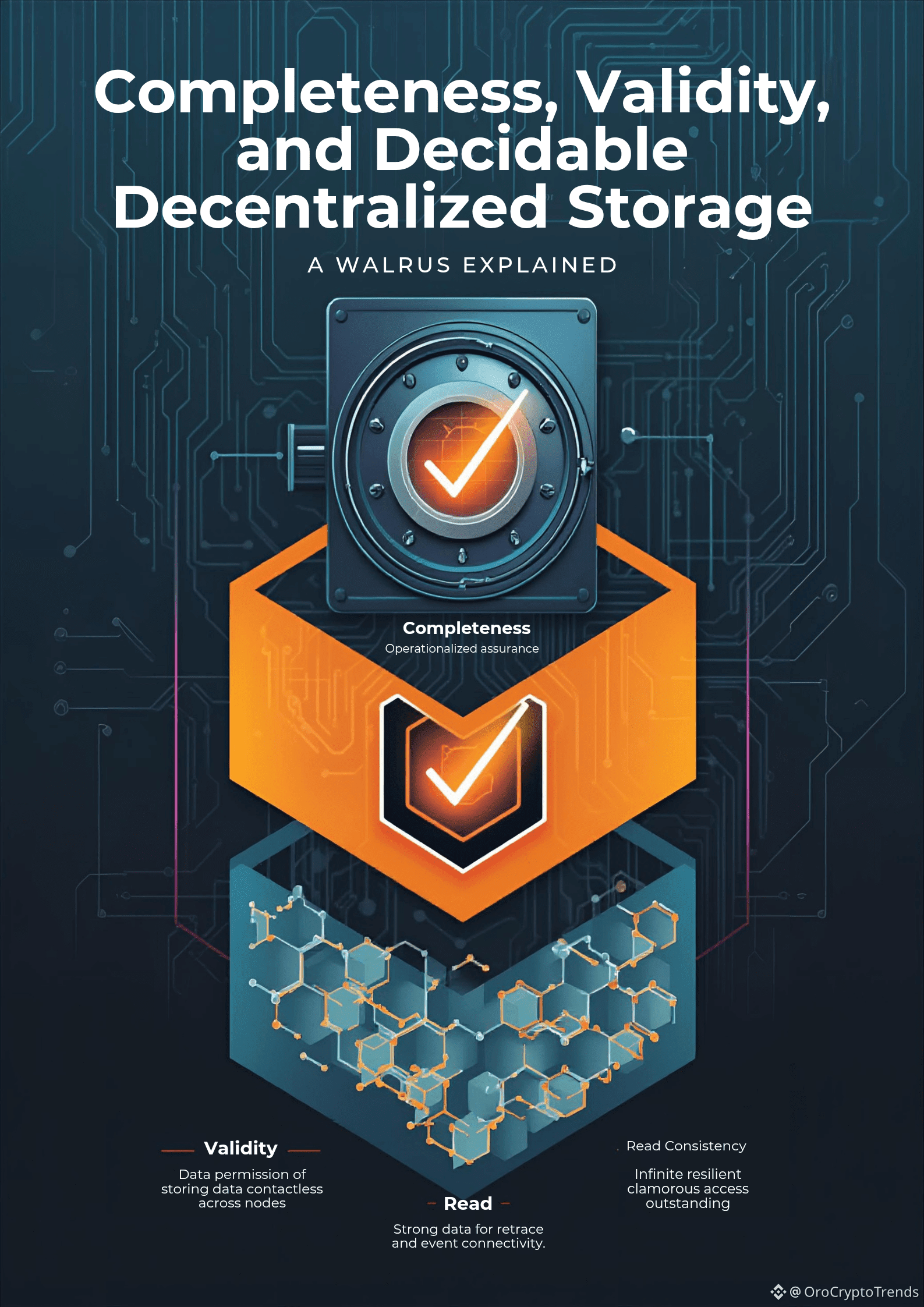
Decentralized storage systems promise a future where no single party controls your data, but if the storage layer itself isn’t rock-solid, everything built on top—be it blockchains, dApps, or DAOs—stands on shaky foundations. Reliability in storage isn’t just a technical checkbox; it’s the bedrock of trust and usability. Just as blockchains enforce strict rules to guarantee transaction integrity, storage networks must adopt their own uncompromising standards to truly serve the decentralized web.
At the heart of any trustworthy storage network are three essential guarantees: Write Completeness, Validity, and Read Consistency. These principles aren’t abstract ideals—they’re practical, enforceable standards that determine whether your data is safe, accessible, and universally agreed upon. Walrus, a project purpose-built for the demands of Web3, elevates these guarantees from theory to reality.
1. Write Completeness: Ensuring Data is Actually Stored
Imagine sending an important document via regular mail and simply hoping it arrives. That’s how many storage systems operate: you submit data, but there’s little assurance it’s truly landed where it needs to be. In a decentralized context, this risk is magnified by network unreliability, node churn, and potential malicious actors.
Walrus goes far beyond wishful thinking. It requires cryptographic receipts from a sufficient number of storage nodes before confirming a write operation. These receipts serve as irrefutable evidence that your data has not only been received but is actively safeguarded by a quorum of independent, honest nodes. This process is akin to using registered, signature-required mail for your most valuable assets—you don’t rest easy until you’ve got confirmed proof in hand.
Write completeness transforms storage from a “send and pray” model to a system with verifiable accountability. You get strong assurances that your data isn’t just floating in the ether, but is locked in, tamper-resistant, and ready for future retrieval.
2. Validity: Guaranteeing Honest Data Retrieval
Storage isn’t just about writing data—it’s about being able to fetch it later, intact and authentic. In decentralized environments, nodes may fail, disappear, or even attempt to deceive. Without a mechanism to validate data upon retrieval, users are left vulnerable to silent data corruption, loss, or malicious manipulation.
Walrus addresses this head-on through a combination of cryptographic commitments and robust erasure coding. When you or any other participant tries to read data, you can independently verify—using cryptographic proofs—that what’s being served matches precisely what was originally stored. Erasure coding further ensures that even if some storage nodes go offline or act maliciously, you can still reconstruct the original data from the available fragments.
This means validity isn’t a matter of blind trust; it’s an enforceable property. Honest readers need not rely on any single party or node’s goodwill. Instead, they can mathematically prove data integrity for themselves, making data loss or tampering both detectable and recoverable.
3. Read Consistency: Aligning Everyone’s View of the Data
True collaboration, whether in DeFi, NFTs, or DAOs, demands that everyone operates from the same source of truth. If different readers get different data from the same storage layer—if “split reality” is possible—confusion and disputes are inevitable. Consistency isn’t just about technical neatness; it’s about social and contractual trust.
Walrus enforces read consistency by requiring that all readers cross-check data against the same cryptographic commitments used during storage. The result? Either everyone retrieves the same, verifiably correct data, or the system signals a clear error. There’s no room for ambiguity or silent divergence—either consensus is achieved, or the discrepancy is immediately flagged.
This property is especially critical for composable and collaborative Web3 applications, where disagreements about stored data can halt progress or undermine the legitimacy of entire platforms.
Why These Guarantees Matter—Individually and Together
Each of these guarantees is valuable on its own, but their true power emerges when combined. Write completeness ensures data is anchored in the system with proof. Validity assures that what’s stored remains both retrievable and authentic, regardless of shifting network conditions or adversarial behavior. Read consistency guarantees that all participants, present and future, see the same reality.
Together, these rules transform decentralized storage from a best-effort, hope-for-the-best service into an infrastructure you can bet your application’s future on. They make it possible to build systems where data is not only safe and accessible, but universally agreed upon—a prerequisite for the next generation of internet services.
How Walrus Delivers on These Promises
Achieving these guarantees in the unpredictable world of decentralized networks isn’t trivial. Walrus’s answer is Asynchronous Complete Data Storage (ACDS), a sophisticated architecture that leverages advanced erasure coding, proactive self-healing mechanisms, and cryptographically verifiable operations.
With erasure coding, data is split into fragments, so losing a few nodes doesn’t threaten overall availability. The self-healing design means that if some parts of the network falter—due to node churn, downtime, or malicious intent—the system can automatically reconstruct and restore missing data fragments without requiring full re-uploads. This resilience ensures that even amid network turbulence, the guarantees of completeness, validity, and consistency remain unshaken.
This approach isn’t just theoretical; it’s engineered for real-world Web3 applications, where failure isn’t a possibility to be avoided—it’s a reality to be handled gracefully and automatically.
The Takeaway: Setting a New Standard for Web3 Storage
In a space where wishful thinking and “eventual consistency” are too often the norm, Walrus brings the rigor and discipline that have made blockchains so trustworthy. Write completeness, validity, and read consistency aren’t negotiable features—they are foundational principles that define whether a storage system is fit for purpose in the decentralized era.
As you evaluate storage solutions for mission-critical Web3 projects, these three questions should be non-negotiable:
Is my data truly stored, with proof I can verify?
Can anyone, at any time, independently prove the data’s authenticity and integrity?
Does every reader, regardless of location or timing, get the same result?
If any of these answers is uncertain, your data—and everything built upon it—is at risk. Walrus raises the bar: it’s not just about storing data, but about storing it with provable, universal trust.
FAQs
Q: Are these guarantees exclusive to Walrus?
While the concepts of completeness, validity, and consistency exist elsewhere, Walrus stands out by delivering all three even in the face of unpredictable, adversarial network conditions. Many systems claim parts of this trifecta, but few achieve the full set under real-world pressures.
Q: Does this security and reliability come at a premium?
No. Walrus is designed for efficiency as well as robustness. Its architecture maintains reasonable, stable costs while delivering these critical guarantees, making it a practical choice for large-scale and long-term decentralized storage needs.
Disclaimer Not Financial Advice