
@Walrus 🦭/acc , $WAL , #walrus
Web3 is often framed as a financial revolution, but in practice, its biggest challenge lies elsewhere. Modern digital use cases rely heavily on large-scale data: high-definition video, complex images, AI models, and massive archives. These elements are still poorly handled by most decentralized infrastructures. Walrus positions itself precisely at this weak point, and in my view, that is no coincidence. The protocol does not try to reinvent blockchain, but to fix one of its most obvious structural gaps.
For users, these issues are usually invisible, yet their consequences are immediate. A slow application, unavailable content, or a service that suddenly disappears is enough to break the experience. Walrus was designed to prevent this kind of failure. By intelligently distributing data across a network of independent nodes, the protocol maintains high availability even when parts of the network fail. What I find particularly valuable is that the complexity stays at the infrastructure level. The user simply benefits from smooth and reliable access.
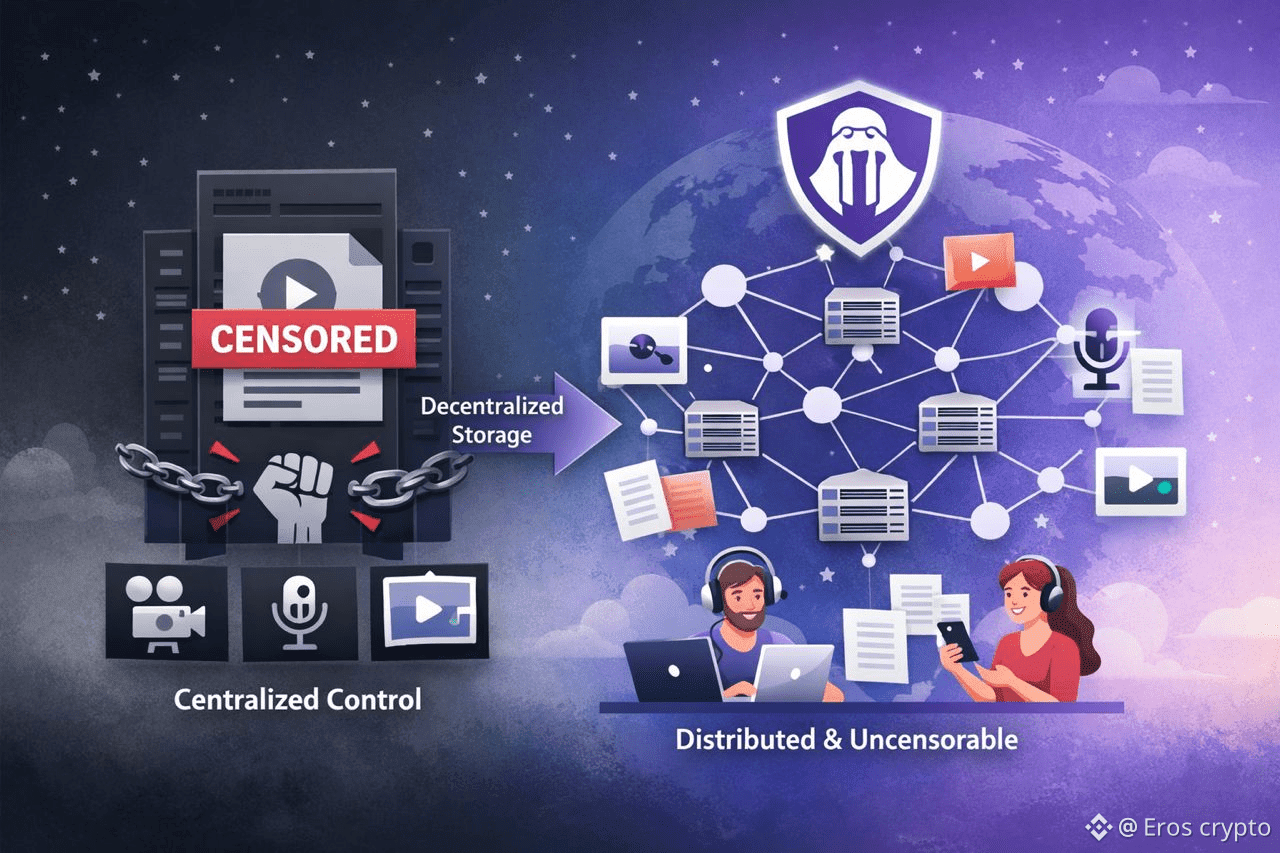
In media, the problem is even more evident. Heavy content is expensive to store and easy to censor when it depends on a single centralized provider. With distributed and verifiable storage, Walrus reduces this dependency. No single actor can unilaterally decide to remove or block access to content. For creators and users alike, this provides continuity and a form of digital sovereignty that Web3 has long been missing.
Artificial intelligence further amplifies these challenges. Modern AI models are large, frequently updated, and costly to maintain on traditional infrastructure. Walrus offers a pragmatic solution: distributed storage, version control, and lifecycle management of data. It may not sound spectacular, but this is exactly what enables AI services to scale without relying entirely on centralized giants. Over time, these practical details are what truly matter.
Large datasets are not limited to media or AI. Many Web3 applications depend on complex data structures such as financial histories, digital archives, or community databases. Walrus addresses these needs without forcing developers to constantly trade off between performance and decentralization. For end users, this results in richer, more stable applications.
One often overlooked aspect is time-based storage management. Not all data needs to live forever. Walrus allows storage duration to be adapted to real needs, avoiding unnecessary resource waste. This approach leads to more controlled costs and more responsible applications. It may not be the most marketable feature, but it is one of the most important for long-term sustainability.
What stands out to me is that Walrus is no longer just a promise. Projects are already using it to store heavy content, complex metadata, and AI models. This is not theoretical. There is real demand, and more importantly, real use cases that were waiting for an infrastructure capable of supporting them.
In my view, Walrus tackles a problem many Web3 projects have avoided for too long. By focusing on heavy data, it helps move Web3 into a more mature phase, where applications can genuinely compete with Web2 without abandoning decentralization. It may not be the loudest protocol in the market, but that is often how the most critical infrastructure is built.