

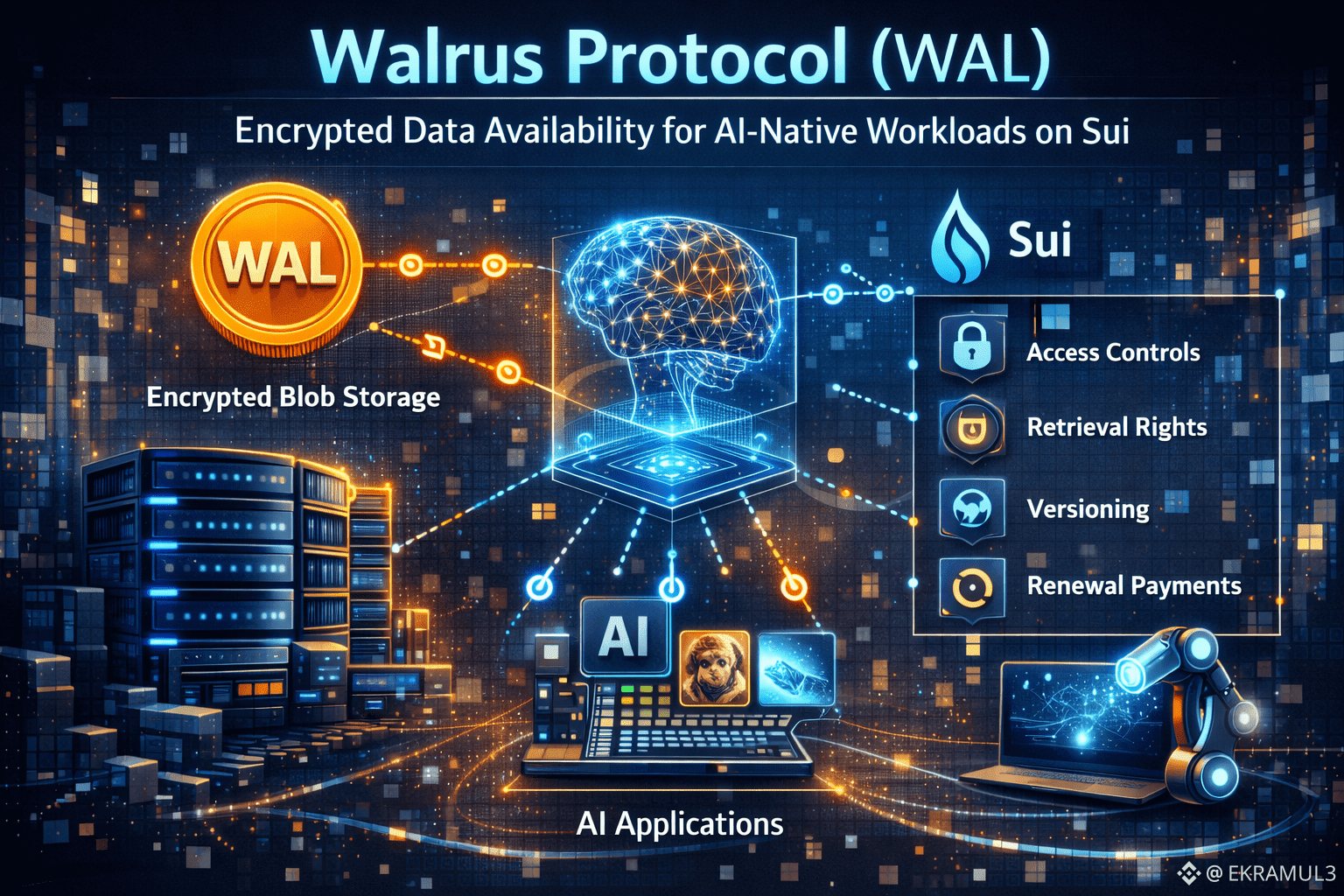
 For the last decade, AI systems have been constrained not by compute, but by the scarcity of trusted data. Models that operate in dynamic environments cannot rely on static datasets. They require streams of updated information, historical context, and controlled access to proprietary data often with privacy guarantees attached. Web2 solved this through centralized cloud pipelines. Web3 never had an equivalent layer. Until Walrus.
Walrus positions encrypted blob storage as a first-class network resource rather than an off-chain workaround. The protocol is engineered for workloads that need to query, retrieve, and validate large datasets without forcing that data onto Sui’s execution stack. Where most blockchains treat data as either “state” or “payload,” Walrus introduces a third category: AI-usable data with provable availability.
Encrypted Availability as a Requirement, Not a Feature
AI workloads break if data is either missing or observable. The two constraints availability and privacy conflict in traditional environments. Walrus resolves this tension by encoding blobs through erasure coding, encrypting fragments client-side, and distributing them across independent storage operators. No operator can reconstruct the dataset. No single failure compromises availability.
AI models can now request encrypted datasets, verify proofs, and retrieve fragments without exposing content to the network. This makes Walrus not just a storage solution, but a compliance-aligned substrate for enterprise and research-grade workloads.
The Sui Advantage: Object-Centric Execution for Data-Aware Applications
Most decentralized storage protocols stop at hosting files. Walrus integrates with Sui to make data programmable. References to stored blobs become Sui objects. Smart contracts can define:
✓ access permissions
✓ time-bound leasing
✓ retrieval rights
✓ revocation policies
✓ pay-per-read metering
✓ dataset versioning
This turns data availability into a settlement surface for AI applications. Instead of forcing AI agents to operate off-chain and reconcile asynchronously, Walrus + Sui enables them to interact with data in a deterministic, verifiable manner while keeping execution overhead lightweight.
Why This Matters for AI-Native Workloads
AI systems ingest more data than traditional dApps will ever produce. Three workload classes stand out:
1. Inference Pipelines
Models that require cached inference data benefit from low-latency blob reads without revealing proprietary assets.
2. Training & Fine-Tuning
Training sets can be updated incrementally, with version control enforced at the protocol layer rather than via centralized tooling.
3. Autonomous Agents
Agents require read-write persistence, private retrieval, and verified metadata properties blockchains never provided before.
Walrus allows these workloads to operate adjacent to compute rather than inside it, preserving Sui’s throughput advantages.
Economic Alignment Instead of Blind Trust
AI data must persist long after application hype cycles fade. Walrus introduces long-lived economic commitments that make data persistence rational rather than charitable. WAL tokens back:
— storage staking
— availability proofs
— retrieval fees
— renewal pricing
— governance over redundancy policies
What emerges is a sustainable system where operators are paid to keep data alive and users retain control over how data is accessed or monetized.
A Catalyst Beyond DeFi
The crypto ecosystem has spent years optimizing for financial primitives. Walrus expands the surface area to include data primitives, unlocking categories such as:
— encrypted research archives
— AI-based identity systems
— private social graphs
— enterprise document layers
— scientific data repositories
— autonomous agent memory
These workloads were previously impossible on public chains without compromising privacy or depending on centralized cloud vendors.
The Bottom Line
AI will not adopt blockchains because they are decentralized. It will adopt them because they can guarantee:
— verifiable persistence
— controlled privacy
— deterministic access
— programmable economics
Walrus gives Sui exactly that: a storage substrate that treats data as a resource, not as a burden. In that model, WAL is not a trading instrument it is the coordination mechanism for the first credible encrypted data availability layer in Web3.
If AI is the next wave of computation, Walrus is quietly assembling the memory architecture that makes it operational.