

Most people open blockchain documentation looking for surface things. How fast is it. How cheap are fees. Which language it supports. That’s normal. But when you spend time reading Dusk Network’s documentation properly, it becomes clear that the project is not built around feature comparisons at all.
Dusk is trying to solve a problem that most blockchains quietly ignore.
Real finance does not work in a world where everything is public.
Public blockchains usually start from the same assumption: transparency is always good. Every balance visible. Every transaction traceable forever. That works when you are dealing with experiments, open DeFi, or retail activity. But the moment regulated assets enter the picture, things start breaking.
Companies cannot expose shareholder data. Funds cannot reveal positions. Institutions cannot operate if every move is visible to everyone.
Dusk’s documentation does not dance around this. It accepts it directly.
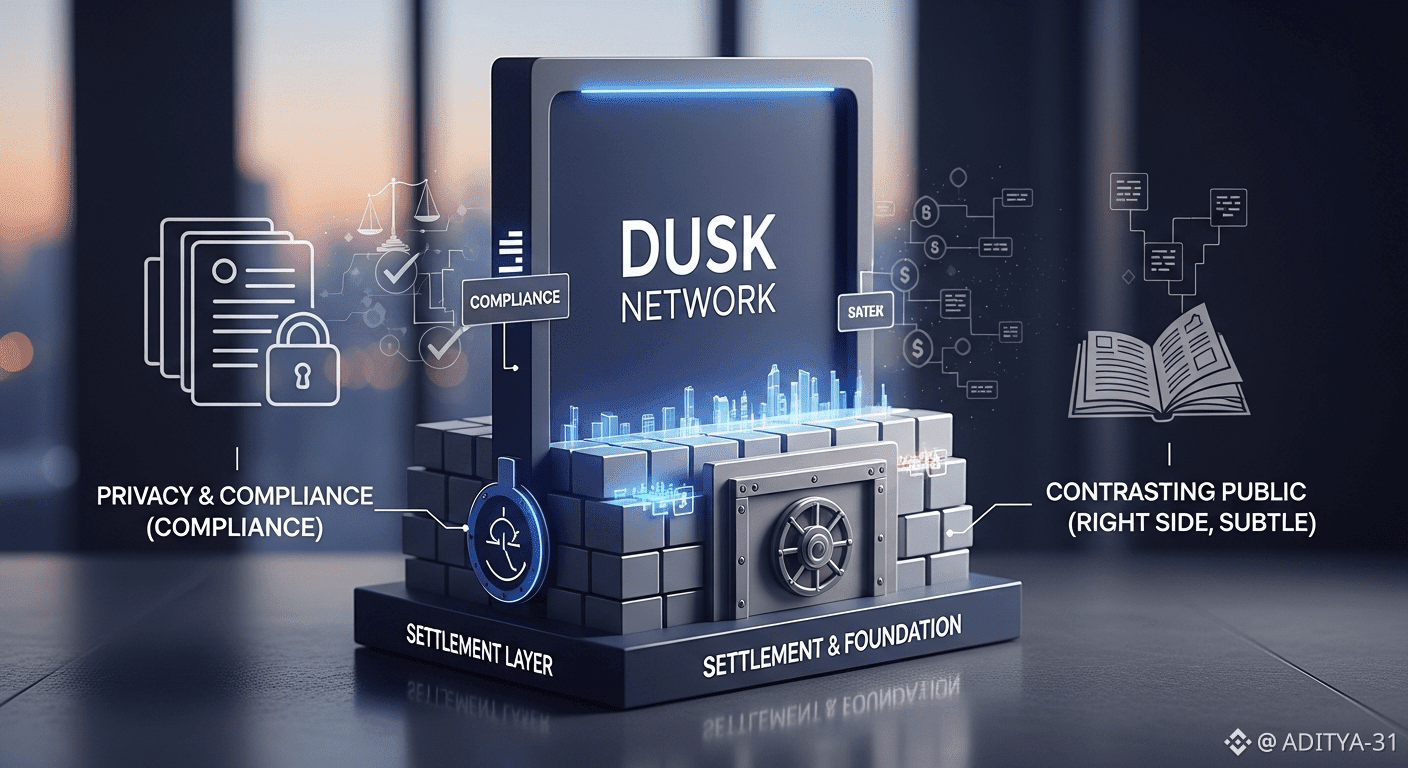
One of the core ideas running through the docs is that privacy and compliance are not enemies. In real financial systems, privacy is often required in order to comply with the law. Shareholder registers are private. Settlement information is restricted. Trading data is controlled. Dusk treats this as normal behavior, not a special case.
The docs explain how Dusk allows transactions and balances to remain confidential while still being verifiable. This is not about hiding activity or avoiding oversight. It is about separating visibility from proof. Sensitive information does not need to be public for rules to be enforced. Auditors and regulators only need the ability to verify correctness when required.
That difference matters more than it sounds.
Most blockchains assume compliance means exposing data. Dusk assumes compliance means being able to prove things without leaking information. That assumption shapes the entire architecture.
Another thing that stands out in the documentation is how Dusk treats settlement. Many chains focus on execution speed first and treat settlement as a side effect. Financial systems do the opposite. Settlement is the foundation. Finality, correctness, and auditability matter more than raw throughput.
Dusk is built with that mindset. Its settlement layer is designed for environments where mistakes are not acceptable and reversibility is not an option. This is why the network feels less like a trading playground and more like infrastructure.
From a developer perspective, the docs also make something clear: Dusk is not trying to lock builders into obscure tools. Privacy and compliance are enforced at the protocol level, but developers can still work with familiar execution environments. That lowers friction without weakening the model underneath.
This is an important design choice. When compliance is pushed entirely onto applications, systems become fragmented and fragile. Dusk centralizes enforcement at the infrastructure layer, which is how real financial systems actually operate.
When you read the documentation with this lens, the role of the $DUSK token also makes more sense. It is not framed as a narrative asset. It secures the network, pays for transactions, and anchors governance. Its relevance grows when regulated activity grows. Not when hype grows.
What really stands out is what Dusk is not trying to do.
It is not chasing every use case. It is not positioning itself as a general-purpose chain. It is not competing for memecoins or viral activity.
Its scope is narrow on purpose: make regulated finance work onchain without pretending the rules do not exist.
That is why Dusk’s documentation reads differently from most Layer-1 projects. There are fewer promises and more constraints. Less excitement about speed, more concern for correctness. Less obsession with openness, more focus on controlled visibility.
As tokenization and regulated onchain settlement move from theory into practice, many public blockchains will struggle to adapt. Dusk does not need to adapt. This is the environment it was designed for.
Open blockchains unlocked early crypto. Privacy-aware, compliant infrastructure is what unlocks real financial markets.
Dusk is not trying to reinvent finance.
It is trying to make finance function onchain — without ignoring reality.