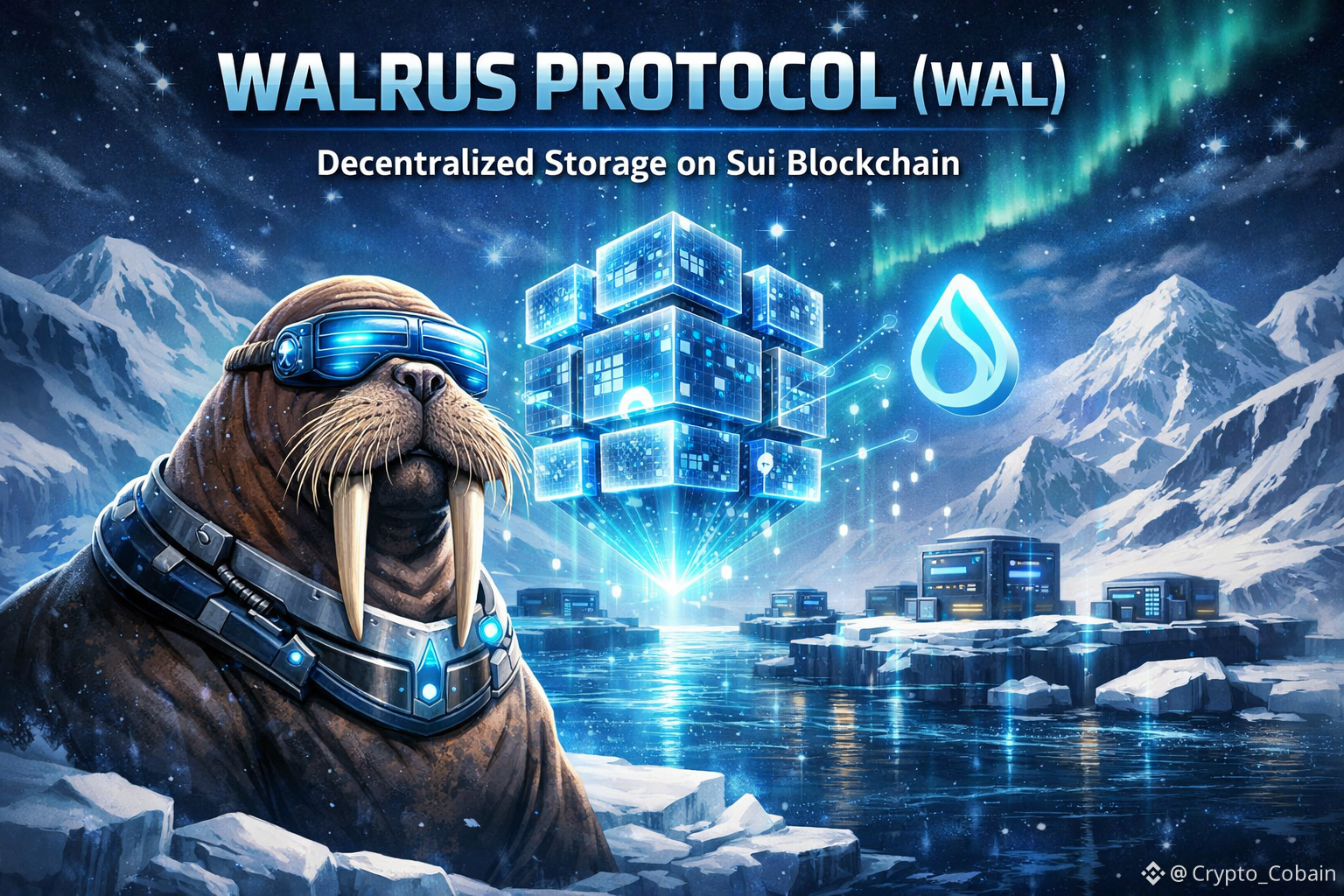
Walrus is a decentralized storage and data protocol built on the Sui blockchain. It allows users to store large files like media,NFTs, AI models, and datasets safely and efficiently without relying on centralized cloud providers. Unlike traditional storage, Walrus uses advanced erasure coding to split data into smaller pieces called slivers, which are spread across multiple nodes. Even if many nodes go offline, the data can still be reconstructed, making it resilient and reliable.
Walrus is ideal for developers, enterprises, and individuals who want a cost-efficient, censorship-resistant, and decentralized alternative to cloud storage. It also supports blockchain-based interactions, enabling integration with decentralized applications (dApps), smart contracts, and programmable storage markets.
The Sui blockchain serves as the foundation for Walrus, managing metadata, payments, and coordination between storage nodes. All data storage activities are recorded on-chain, giving users transparency and accountability while ensuring the system runs securely and smoothly.
How Walrus Works
1. Blob Storage and Erasure Coding: Users upload data as “blobs,” which are split into encoded slivers.Only a portion of these slivers is needed to recover the full data. This method is much more efficient than full replication and reduces storage costs.
2. Storage Payments: $WAL tokens are used to pay for storing data. Users can extend or delete storage through on-chain transactions.
3. Node Incentives: Storage nodes earn WAL rewards for hosting data reliably. Misbehaving nodes may be penalized, ensuring network integrity.
WAL Token – Utility and Tokenomics
WAL is the native token of the Walrus protocol. Its main uses include:
Paying for storage fees.
Staking and delegating to storage nodes to earn rewards.
Participating in governance decisions, such as pricing, protocol upgrades, and network rules.
The total WAL supply is 5 billion tokens, with a portion reserved for community airdrops, development, and ecosystem growth. Users who hold or stake WAL can influence the network while earning rewards.
Use Cases
Walrus supports a wide range of applications:
Decentralized Storage for Apps: Developers can integrate storage directly into dApps using APIs or smart contracts.
Decentralized Websites: Full websites, including images and scripts, can be hosted on Walrus in a censorship-resistant way.
NFTs and Media Files: High-resolution art, video, and AI datasets can be stored securely and efficiently.
Programmable Storage Markets: Storage capacity can be leased, tokenized, or used in custom blockchain applications.
Privacy and Security
Walrus ensures data availability and resilience, but stored data is public by default. Users must encrypt sensitive information themselves. Security relies on Sui’s blockchain, economic incentives for storage nodes, and erasure coding that protects against data loss.
Benefits and Challenges
Benefits:
Cost-efficient compared to traditional and fully replicated decentralized storage.
Highly available and resilient data recovery.
Fully integrated with blockchain and programmable through smart contracts.
Token incentives align interests of users and nodes.
Challenges:
Sensitive data must be encrypted by users.
The ecosystem is still new and growing.
WAL token price may fluctuate with market conditions.
Conclusion:
Walrus is a next-generation decentralized storage protocol that offers secure, efficient, and resilient data storage. Powered by the Sui blockchain, it combines innovative erasure coding with token incentives, allowing developers, businesses, and individuals to store data safely while participating in a decentralized ecosystem. $WAL tokens make the system work, enabling payments, staking, and governance, making Walrus a promising solution for the future of Web3 storage.