


If you’ve spent enough time in crypto, you’ll notice a clear problem: most blockchains are too public for serious financial use. Every transaction, balance, and trade is visible to everyone. That’s fine for experimentation, but it breaks down quickly when you think about stocks, bonds, or institutional trading. No company wants its trades broadcast to the world.
This is the gap Dusk is trying to fill.
The Core Problem Dusk Is Solving
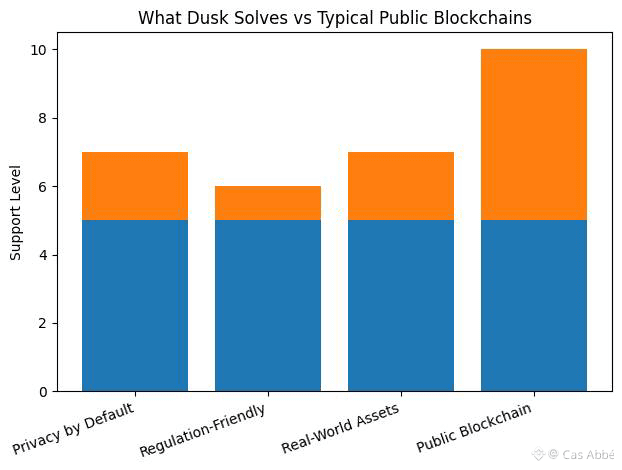
Dusk is a public, decentralized Layer-1 blockchain built specifically for private yet compliant financial applications. Instead of choosing between transparency and regulation, it tries to support both at the same time.
How Dusk Handles Privacy Without Breaking Decentralization
Dusk uses zero-knowledge cryptography to hide sensitive data while still proving that transactions are valid. You can think of it as “verify without revealing.” Balances, transaction amounts, and addresses are not publicly visible, even to block explorers.
At the same time, the network is fully public and permissionless. Anyone can run a node, verify the chain, or build applications. Privacy is not handled by a centralized service; it is enforced at the protocol level.
This is different from blockchains that rely on external privacy tools or Layer-2 solutions. On Dusk, privacy is part of the base layer.
Why This Matters for Applications
Because privacy is built in, developers can create applications that would be impossible on fully transparent chains. This includes tokenized securities, private trading platforms, regulated DeFi products, and institutional financial tools.
Dusk was also built from scratch, not on top of Ethereum or another chain. Its smart contracts run on a custom virtual machine designed to work with private data. Its consensus mechanism separates block creation from validation, reducing network load and improving reliability as the system scales.
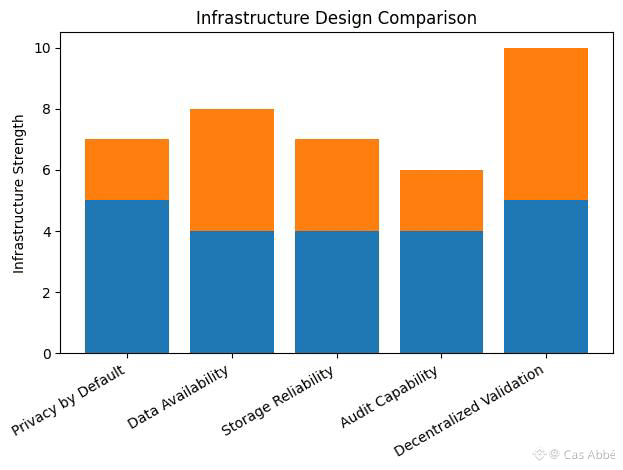
These design choices make the network more predictable and easier to operate for long-term financial use.
How Dusk Is Different From Other Blockchains
Most blockchains focus on general-purpose activity or speculative DeFi. Dusk is optimized for regulated financial infrastructure. It does not try to make everything public, and it does not ignore compliance either.
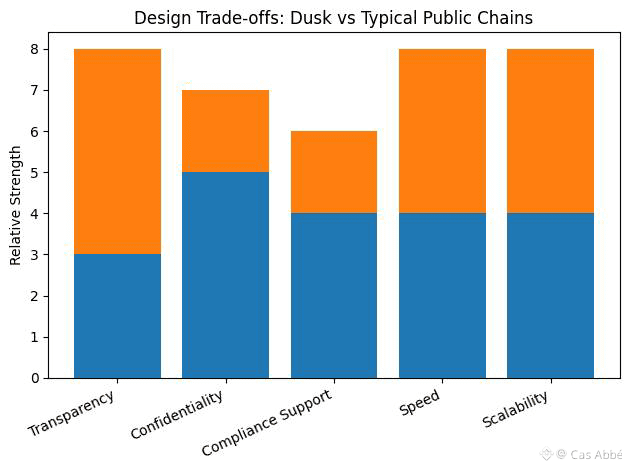
The chart above shows the difference clearly. Typical public blockchains force trade-offs between privacy, regulation, and decentralization. Dusk is designed to support all three at once.
Dusk is not trying to reinvent crypto culture. It is trying to fix a structural limitation in blockchain design. If crypto wants to move beyond speculation and support real financial markets, privacy and compliance must be native, not optional.
That’s what makes Dusk interesting. It’s less about hype and more about whether blockchain can realistically support real-world finance without losing its core principles.