


For a long time, Web3 storage followed two bad choices.
Either storage was very safe but extremely expensive, or cheap but limited and hard to use. Projects like Filecoin and Arweave each solved part of the problem, but not the whole thing. Security, cost, and flexibility rarely worked together.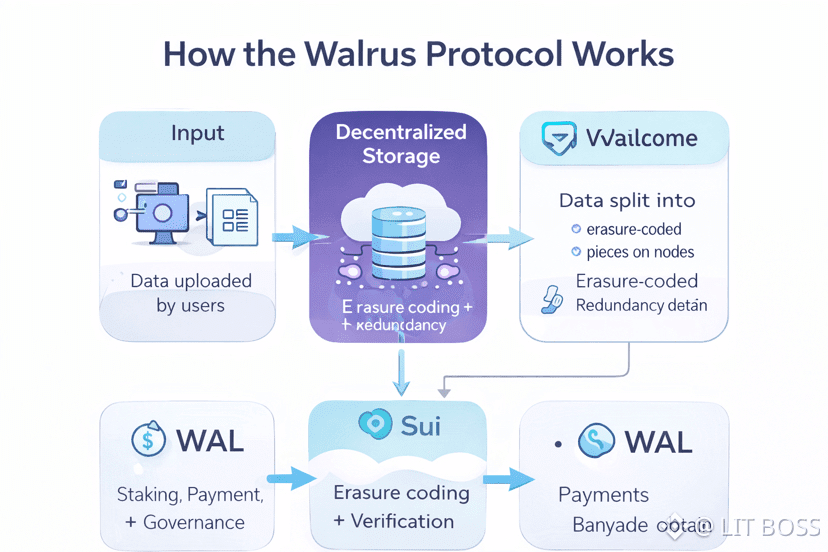
Walrus is trying to change that by rebuilding how storage works from the ground up.
Instead of treating storage as a simple place to park files, Walrus treats it as real infrastructure. Something apps can depend on long term, not just during a test phase. The project is backed by Mysten Labs and is closely connected to the Sui ecosystem.
A different way to think about storage
Most storage networks compete on one thing at a time. Walrus tries to balance three things at once:
• Strong data safety
• Much lower costs
• The ability for developers to actually interact with stored data
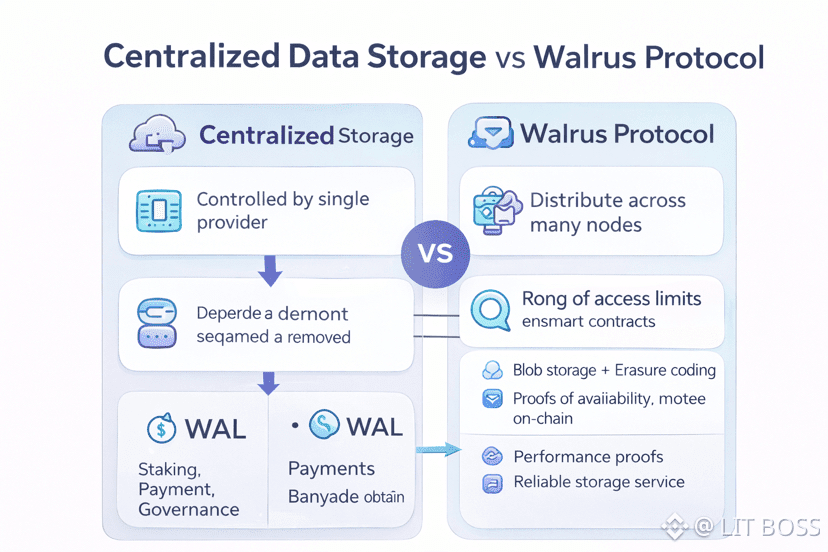
Walrus does this by breaking files into smart pieces and spreading them across the network. Even if many nodes go offline, the data can still be rebuilt. This keeps data available without needing huge numbers of full copies, which is what usually makes storage expensive.
The result is storage that stays reliable but costs much less.
 Storage that developers can program
One of the biggest differences is that data stored on Walrus is not just “sitting there.”
Because it’s integrated with Sui, stored data can be controlled by smart contracts.
That means:
• NFT data can be updated over time
• AI datasets can have access rules
• RWA documents can stay traceable and verifiable
Storage becomes part of how apps work, not something glued on later.
Built with an ecosystem, not against it
Many storage projects attach themselves to a blockchain and hope for traffic. Walrus does more than that. Sui handles execution and coordination, while Walrus focuses on storage. Each makes the other stronger.
This setup helped Walrus grow quickly during testing, with real data being stored and real apps being built. At the same time, the team is working on expanding beyond one ecosystem so Walrus doesn’t depend on a single chain forever.
A business model tied to real usage
Walrus also moves away from the old “pay for space only” model.
Different use cases pay differently. AI storage, real-world assets, and long-term archives all have different needs, and Walrus prices them accordingly. Extra services like access control and verification add more value on top.
The WAL token supports this system by rewarding storage providers, securing the network, and keeping incentives aligned with real demand instead of hype.
Why this matters for Web3
Web3 is moving out of its experiment phase.
Users want apps that don’t break.
Developers want systems they don’t have to rebuild every year.
Companies want guarantees that data will still exist in five or ten years.
Storage is the quiet layer that decides whether any of that is possible.
Walrus isn’t trying to win attention. It’s trying to become invisible infrastructure. The kind that works so well no one thinks about it.
If Web3 is going to grow up, this kind of storage is not optional. It’s required.