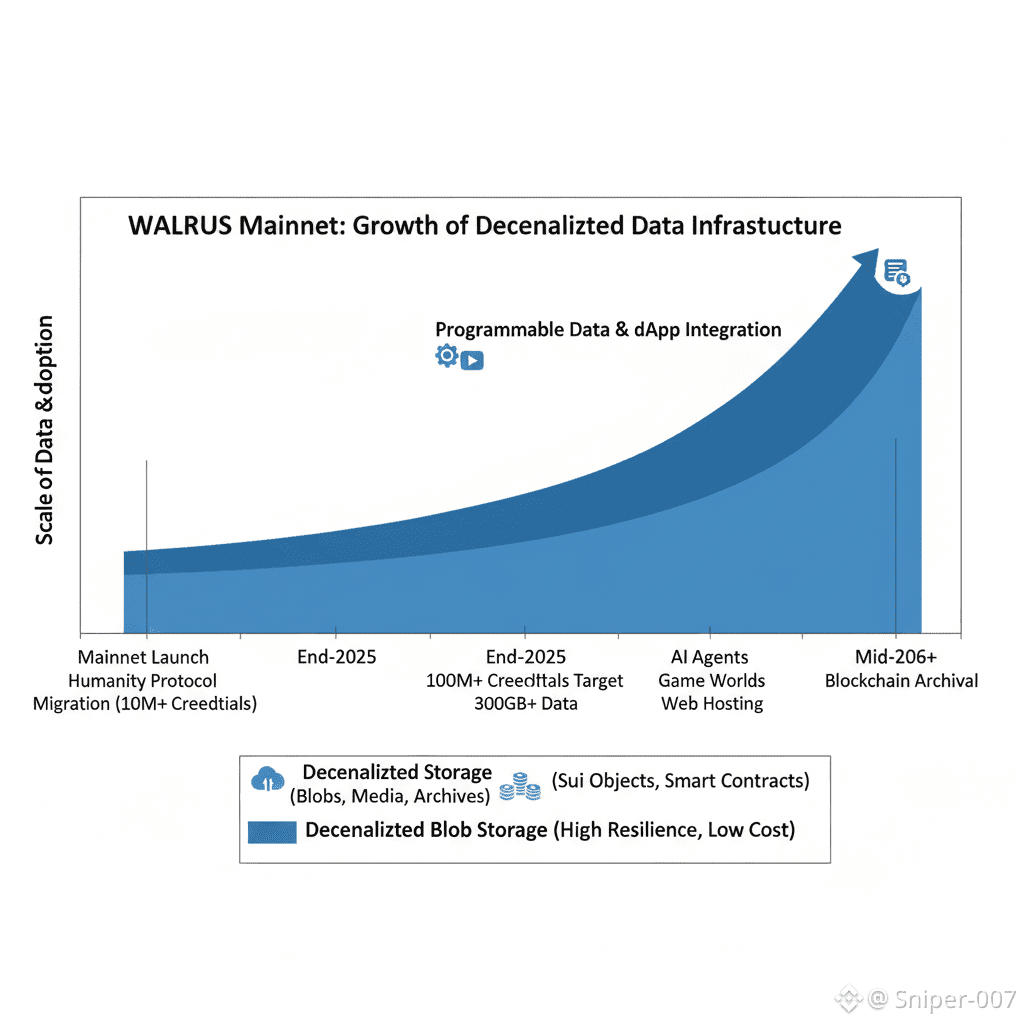
Here we are in early 2026, and decentralized storage has gone from “maybe someday” to stuff that’s actually running in production. Walrus is right in the middle of that shift. Its mainnet launched earlier this year, and now it’s not just a testnet toy anymore—it’s the go-to spot for devs who need to store big files reliably, cheaply, and without giving up the whole decentralized vibe.
Why This Actually Matters in Real Life
Sui (and most other fast chains) are amazing at handling transactions and smart contract logic. But throw in a 4K video, a huge AI dataset, or a full NFT collection’s media? Forget it. Fees go through the roof, the chain chokes, and everyone suffers. Walrus solves this the smart way: keep the heavy blobs completely off the execution layer. The files live on a bunch of decentralized storage nodes spread around the world. Then Sui just holds the important stuff—proofs that the data is still there, untampered, and retrievable whenever you need it. Execution stays fast and cheap. Data stays alive. Win-win.
The Tech That Makes It Actually Work
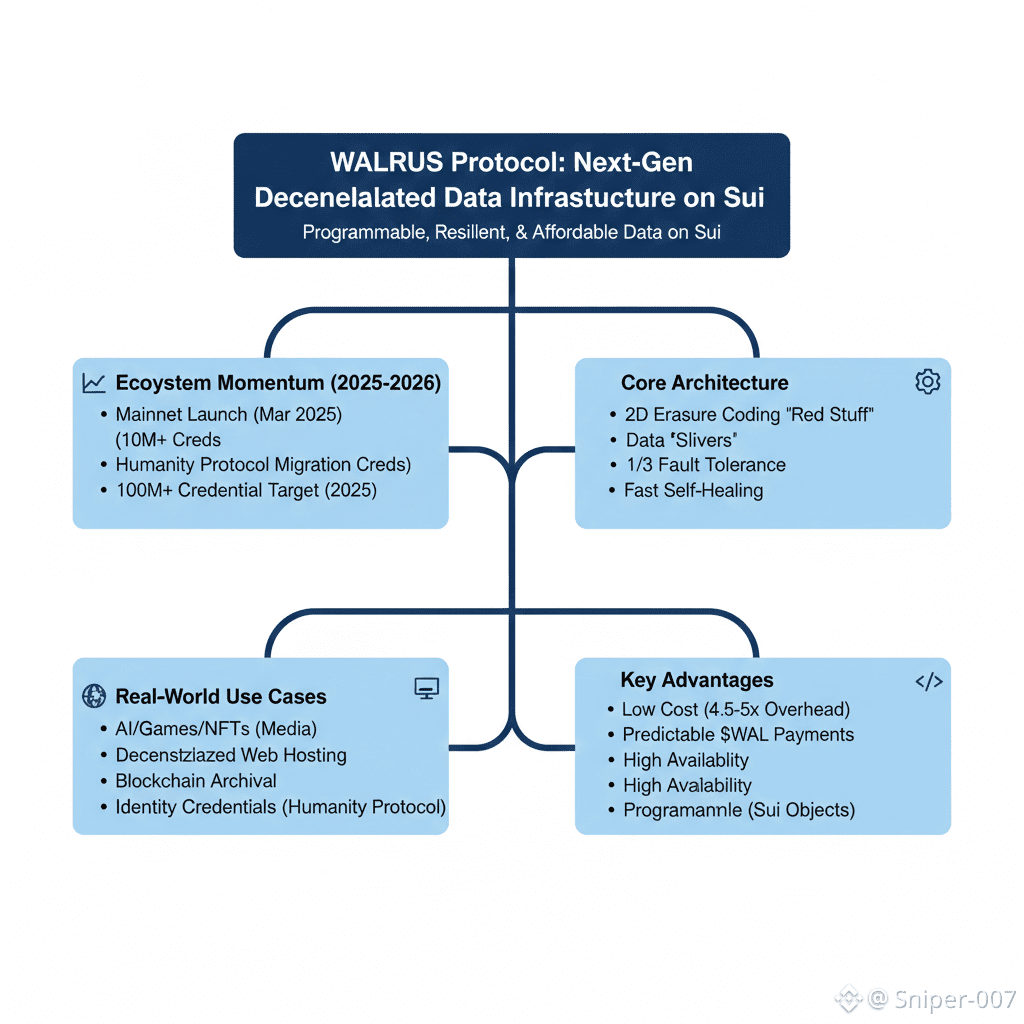
Walrus uses something called Red Stuff (their custom 2D erasure coding). Basically, your file gets sliced, diced, and encoded into these little pieces called “slivers.” Those slivers get handed out to different nodes. Here’s the impressive part: even if a huge chunk of nodes disappear (up to about two-thirds), you can still rebuild the original file from whatever’s left. It only needs roughly 4–5x the original file size in redundancy—basically the same efficiency you get from cloud storage, but decentralized and way more fault-tolerant than the old-school 10x+ replication systems.
The Part That Feels Like the Future
What really sets Walrus apart is that it makes storage programmable. Every blob you upload becomes a Sui object. That means you can write Move smart contracts that actually interact with your stored data. Need to auto-extend storage when it’s about to expire? Easy. Want to check availability before unlocking an NFT or running a trade? Done. Want to build a marketplace where people rent out storage space? Totally possible. It turns boring file hosting into something devs can build real logic around.
Stuff People Are Actually Building With It
- Full decentralized websites and dApp front-ends—no more praying AWS doesn’t go down or IPFS pins disappear.
- AI training data, model weights, and even proofs that models were trained fairly—perfect for verifiable, transparent AI.
- Long-term blockchain archives: storing historical states, checkpoints, or old transaction batches without bloating the chain.
- Data availability for rollups and L2s—certifying off-chain batches, ZK proofs, everything stays verifiable forever.
How the Money Keeps It Honest
You pay upfront in $WAL tokens for “epochs” (fixed time slots, like two weeks on mainnet). Storage nodes stake $WAL, get randomly challenged to prove they’re still holding your slivers, earn rewards when they behave, and get slashed if they don’t. Token holders can vote on things like pricing and upgrades, so the whole system stays decentralized and responsive.
It’s Gaining Real Traction
Walrus works nicely with standard dev tools and even HTTP interfaces, so it’s not just for crypto natives—normal apps can use it too. Adoption is picking up: projects like Humanity Protocol already moved millions of identity credentials over, and more teams are jumping in for anything that needs data to last without drama.
Bottom line: Walrus isn’t trying to be flashy or solve everything. It’s laser-focused on fixing one of the biggest real pain points in Web3—data that actually sticks around, costs what it should, and can be used in smart ways. With mainnet live and real apps depending on it, this feels like the moment decentralized storage stops being a nice experiment and starts being essential infrastructure.
(Just sharing thoughts here—not financial advice. Always DYOR!)