

The Forty-Percent Quiet: When Walrus Made Storage Feel Less Like a Gamble
@Walrus 🦭/acc Walrus has always felt like a system built around a simple dare: if you’re going to promise people their data will still exist tomorrow, you don’t get to be vague about what “exist” means. Not “probably there.” Not “there unless a provider changes its mind.” Not “there until the bill goes unpaid.” You either keep the promise or you admit you can’t. That’s why the recent Walrus 2.0-era shift toward a more efficient way of breaking and distributing large data isn’t just an optimization story. It’s a trust story, told in the language of cost, recovery, and what happens when nodes disappear at the worst possible moment.
People first notice Walrus through WAL, because markets make everything feel immediate. Today WAL trades around fifteen cents, with a circulating supply measured in the billions and a market cap that moves like a living thing—sensitive to attention, risk appetite, and the mood of the week. But Walrus itself is judged on a different clock. The network launched mainnet in late March 2025, and it wasn’t shy about the ambition: a real storage economy, powered by a token that has to do more than represent belief—it has to pay for time, bandwidth, and honesty.
The heart of the recent update is easy to misunderstand if you only look at the headline. “Cheaper storage” sounds like a pricing tactic. In practice it’s something closer to emotional safety for builders: the feeling that you can store big, messy, human data without constantly doing mental math about failure. When Walrus encodes a blob, it doesn’t treat the file as a single fragile object that must be protected by duplicating it over and over. It treats it like something that can be spread out, verified, and recovered without needing anyone to be a hero under pressure.
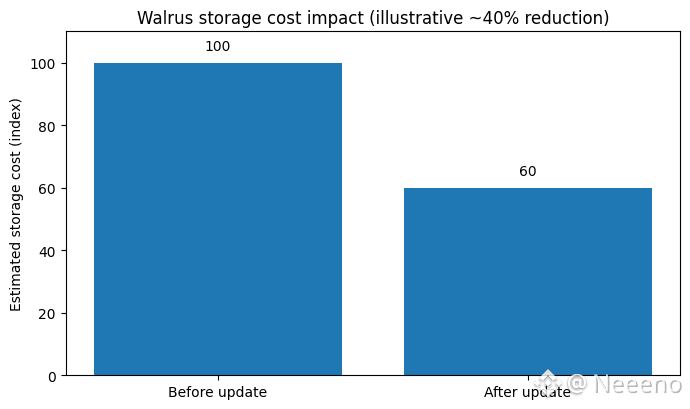
That’s where the “forty percent” claim lands. Some ecosystem summaries describe the upgrade as cutting storage costs by roughly that amount for large files. Even if you set the exact percentage aside, the direction is grounded in the core technical reality Walrus keeps repeating in its own materials: the overhead is designed to be far lower than naïve duplication, while still keeping recovery practical in a world where nodes churn and networks misbehave. The whitepaper version of that statement is blunt: Walrus targets high security with a replication factor on the order of 4.5x, and it pairs that with recovery bandwidth that scales with what was lost, not with the entire original file
If you’ve ever shipped an app that stores user-generated content, you know where the fear lives. It isn’t in the happy path. It’s in the edge cases: a corrupted chunk, an operator who goes offline mid-epoch, a region that suddenly becomes unreachable, a wave of demand that turns “fast enough” into “why is this timing out.” Under those conditions, storage isn’t a feature. It’s a liability—because the moment the data can’t be retrieved, your product becomes a collection of broken references and unfulfilled promises. Walrus’s recent work is basically an attempt to make those failures boring again, to make recovery feel like routine maintenance instead of a crisis call at 3 a.m.
What changes for a real user is subtle. They don’t see “encoding.” They see a photo that still loads. A document that still opens. A media file that doesn’t become a ghost when a few nodes vanish. Underneath, the system is doing something psychologically important: it reduces the number of times a user is forced to wonder whether the platform is lying. That’s what reliability is, in human terms—fewer moments of doubt. Walrus’s design leans on the idea that reads should remain possible even when the network is having a bad day, and that writes should require stronger agreement so the network doesn’t casually accept data it can’t stand behind.
Cost matters here not because cheaper is fashionable, but because cost is what decides who gets to be serious. If storing large blobs is expensive, only well-funded teams can afford to be reliable; everyone else is pushed toward shortcuts, external dependencies, and “we’ll fix it later.” When Walrus talks about pushing costs toward stability and predictability, it’s acknowledging an ugly truth: builders don’t abandon decentralization because they hate ideals, they abandon it because unpredictability makes them feel irresponsible. Walrus documentation is explicit that storage on mainnet involves WAL for the storage operation and SUI for the underlying transactions, and it also talks about plans to stabilize storage fees against currency swings so users aren’t forced to gamble on token volatility just to store data.
That’s also why WAL isn’t just “the token,” in the abstract way people say it. Walrus frames WAL as the unit that pays for storage over time, compensates operators and stakers, and anchors the incentive design meant to reduce adversarial behavior. In other words, WAL is the part of the system that has to remain emotionally credible during conflict. When demand spikes, when prices swing, when someone tries to game the network, the token’s job is to keep the economics from turning the protocol into a mood ring.
The recent “decentralized at scale” messaging fits into that same responsibility thread. The danger isn’t that a network starts centralized. The danger is that it centralizes quietly, by accident, because growth rewards whoever can accumulate more stake, run bigger machines, or dominate distribution. Walrus’s January 2026 update frames decentralization as something that has to be actively defended through incentives and penalties, not just hoped for. It keeps returning to the same premise: if performance is verifiable and accountability is financial, smaller operators can still compete, and power has less room to congeal into something fragile.
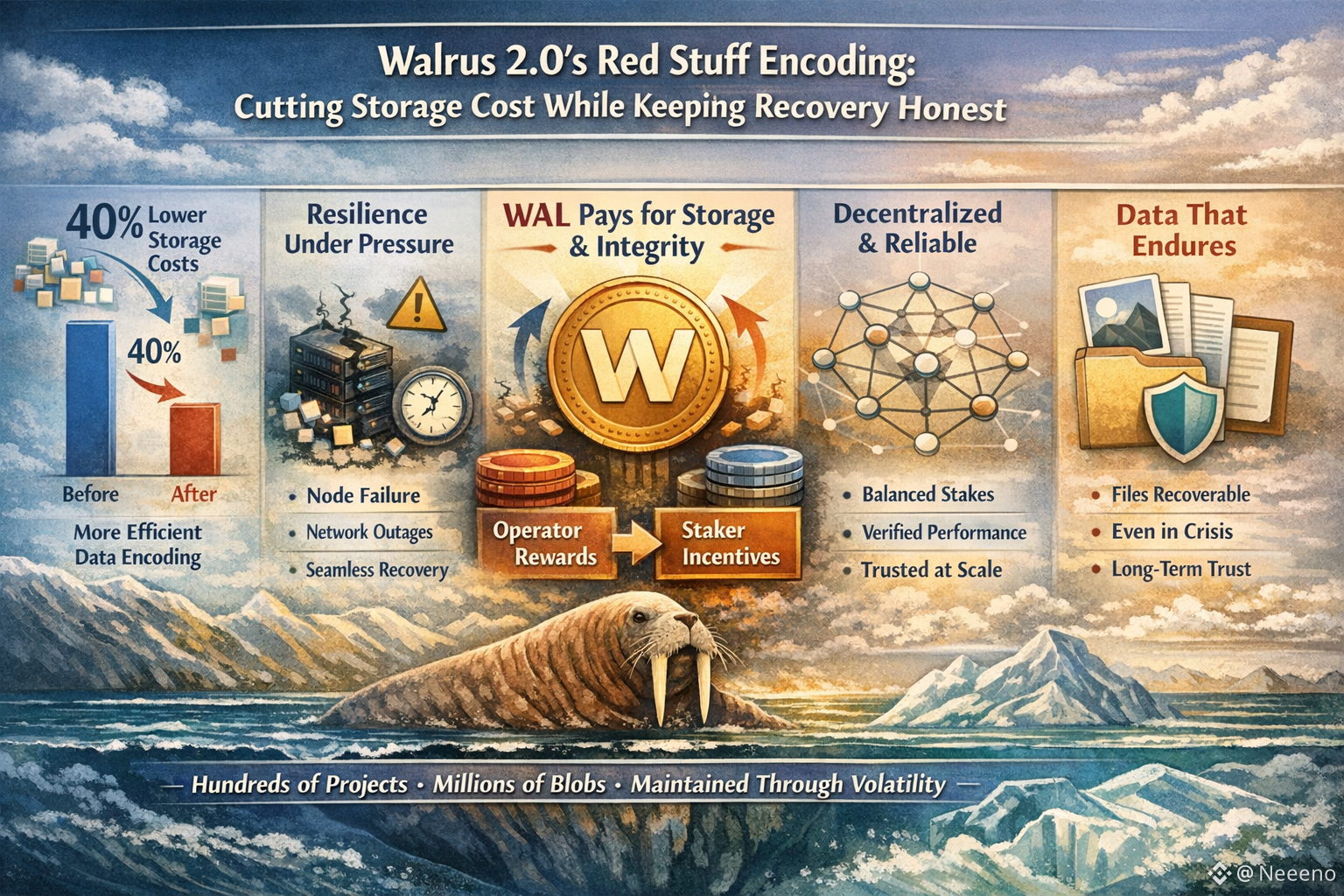
This is where “data” stops being an engineering object and starts being a social object. Real-world information is messy. Two sources disagree. A file is updated, but someone claims the old version is the “real” one. A dataset is copied and re-labeled. A piece of evidence is presented out of context. Walrus doesn’t solve human disagreement. What it tries to do is narrow the space where disagreement can be amplified by infrastructure failure. If the network can prove what was stored, and if retrieval doesn’t depend on one party’s continued goodwill, then at least you’re arguing about reality—not about missing files.
The scale signals from 2025 make that feel less theoretical. A few months after mainnet, Walrus was already talking publicly about hundreds of projects building on it and hundreds of terabytes of encoded data across millions of blobs. Numbers like that matter because they change the failure mode. At small scale, you can manually patch over weaknesses. At scale, you either have self-healing behavior or you have outages that keep repeating in new costumes. Walrus’s approach tries to make recovery a first-class behavior instead of an emergency procedure.
And then there’s the uncomfortable part people avoid: incentives don’t just reward honesty, they also create new ways to cheat. A system that moves stake too easily invites coordinated power grabs. A system with no penalties invites low-effort participation that collapses under load. Walrus’s token design explicitly anticipates this with mechanisms meant to discourage short-term stake shifts and, once fully enabled, punish low performance through slashing and partial burning.This is what it looks like when a protocol admits that “being good” isn’t a personality trait for operators—it’s a behavior that must remain profitable even when nobody is watching.
It’s also why the early funding story matters, even if you don’t care about venture headlines. When Walrus Foundation announced a $140M private token sale ahead of mainnet, it was effectively saying: this thing will be maintained, not just launched. For infrastructure, maintenance is morality. It’s the difference between a network that shows up during calm markets and a network that stays present when the world is distracted, when fees fluctuate, when builders are exhausted, when users are angry because something didn’t load.
So when you hear “Walrus 2.0 reduced storage costs,” it helps to translate it into what people actually feel. It means a builder can store larger files with less fear that the bill will become unbearable. It means operators can recover from churn without dragging the whole network through expensive, bandwidth-heavy repairs. It means WAL’s role becomes clearer: not as a narrative token, but as the accounting system behind a promise that has to keep being honored day after day.
The most honest thing about Walrus is that it doesn’t ask to be admired. It asks to be depended on. The best outcome is that nobody talks about it when it works, because the photos load and the archives remain intact and the apps don’t flinch during volatility. That’s not glamour. That’s quiet responsibility. Invisible infrastructure is where trust goes to live when it’s tired of speeches, and Walrus—through its recent encoding shift, its scaling posture, and the economics of WAL—keeps betting that reliability will matter more than attention in the end.

