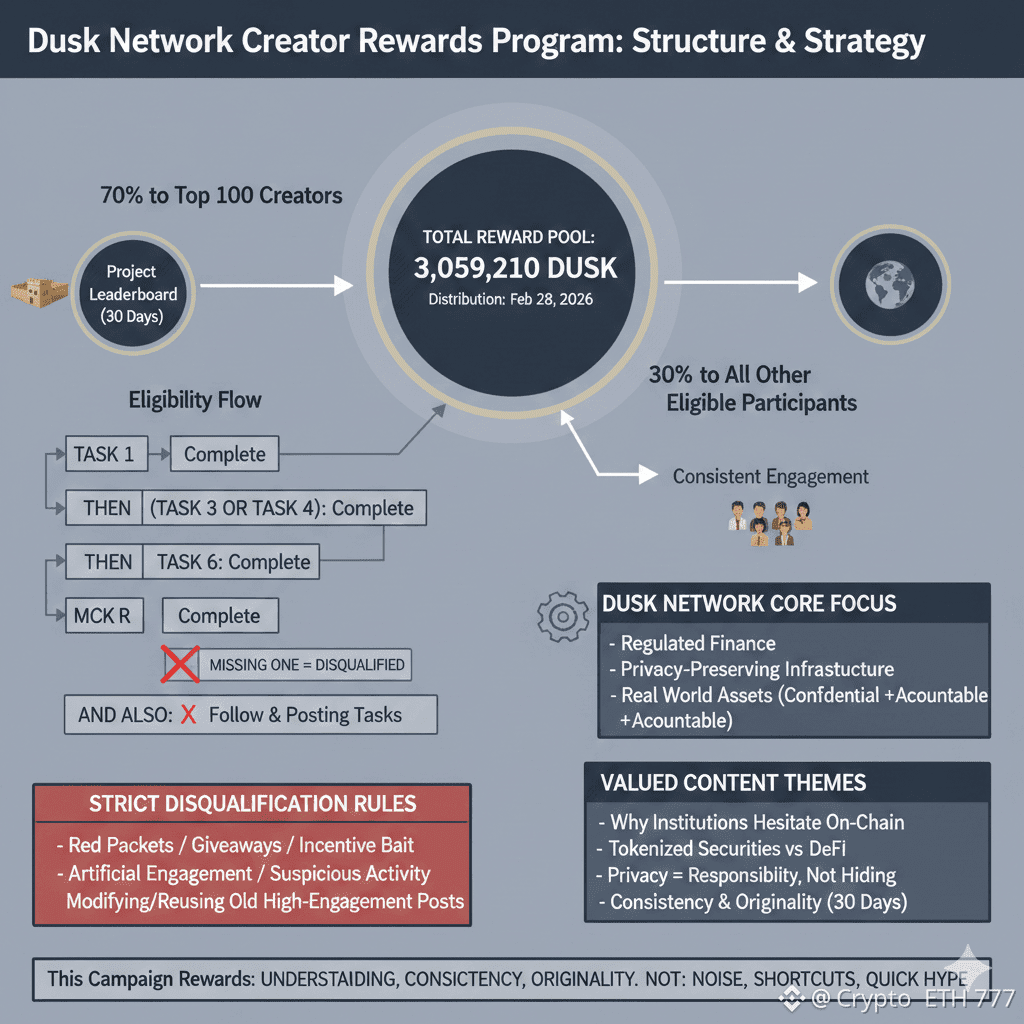
When I first came across a reward pool crossing three million tokens, my reaction was not excitement but curiosity. Campaigns like this often look loud from the outside, but once you slow down and read carefully, you realize this one is structured very differently. It is not designed for noise, shortcuts, or quick hype.
It feels more like a long test of patience, understanding, and the ability to explain something complex in a calm, honest way. The total pool stands at 3,059,210 DUSK, yet the number itself is not the most important part. What matters is how it is distributed and what kind of behavior it quietly encourages.
Seventy percent of the rewards are reserved for the top one hundred creators on the thirty day Project Leaderboard, while the remaining thirty percent is shared among all other eligible participants. This immediately changes the mindset because a single viral post means very little here. Consistency over an entire month matters more than short bursts of attention.
On top of that, the rewards are split evenly between Chinese creators and creators in all other languages, with 1,529,605 DUSK allocated to each side, meaning you are really competing within your own language group rather than against everyone globally. Where many creators lose without realizing it is in the task structure. This campaign is very specific about combinations.
To qualify for the Project Leaderboard, Task 1 must be completed, then either Task 3 or Task 4, and finally Task 6. Missing even one of these breaks eligibility entirely, no matter how strong the content is. Separately, to qualify for the reward pool itself, the additional X follow and posting tasks must also be completed.
Many people post confidently and only later discover that skipping one small requirement made all their effort invalid. The disqualification rules are equally strict and very deliberate. Any content involving red packets, giveaways, or incentive bait is immediately disqualified.
Artificial engagement, suspicious activity, or automated interactions can remove a participant from the campaign altogether. One rule that catches many off guard is the ban on modifying previously published high engagement posts and submitting them as campaign entries.
Even if the content is relevant, reusing or editing older posts is treated as manipulation. Fresh thinking is clearly valued more than recycled performance.
To understand why the rules are this tight, you have to understand what Dusk Network is actually trying to build. This is not a project chasing trends or short term attention. Its focus is regulated finance, privacy preserving infrastructure, and real world assets that require both confidentiality and accountability.
Traditional finance cannot operate on fully transparent ledgers, yet it also cannot function without audits and rules. Dusk positions itself exactly in that space where privacy does not remove responsibility but supports it. That context shapes what kind of content naturally works best.
Writing about Dusk is less about excitement and more about explanation. Why institutions hesitate to move on chain, why tokenized securities are different from ordinary DeFi assets, and why privacy sometimes protects participants rather than hiding them are all angles that resonate because they feel thoughtful.
Content written from this perspective invites discussion instead of clicks, and that kind of engagement usually carries more weight over a long leaderboard cycle. The DUSK token fits quietly into this narrative as well. It supports network participation, staking, and operational activity rather than existing only as a speculative instrument.
That gives creators something solid to discuss without drifting into price predictions. Explaining how incentives work and why the token exists builds trust with readers who are tired of exaggerated promises. One thing that truly makes content feel human is acknowledging uncertainty.
Regulated finance moves slowly, adoption depends on laws and institutions, and competition is real. Not every experiment succeeds. Saying this openly does not weaken the message, it strengthens it, because readers can feel the difference between someone thinking and someone selling.
Over thirty days, the creators who perform best are usually those who vary their perspective without repeating themselves. One day they reflect on why transparency is not always ideal in finance, another day they explore how privacy can coexist with audits, another day they break down what real world assets actually mean beyond buzzwords.
None of this requires loud language. Calm explanations often travel further because they feel honest. In the end, rewards are scheduled to be distributed by February 28, 2026 through the Rewards Hub, but the real outcome appears earlier.
Creators who approach this campaign with patience and curiosity often walk away with something more durable than tokens, a reputation for clarity and credibility. This campaign does not reward noise or shortcuts. It rewards understanding, consistency, and originality, and for creators who care about long term value, that may be the most meaningful reward of all.