Walrus exists because most decentralized applications quietly rely on centralized storage even when everything else claims to be trustless.
Smart contracts may run onchain, but images, videos, datasets, AI models, archives, and application history usually live on servers owned by someone else.
This contradiction is easy to ignore until something breaks, data disappears, or access is restricted.
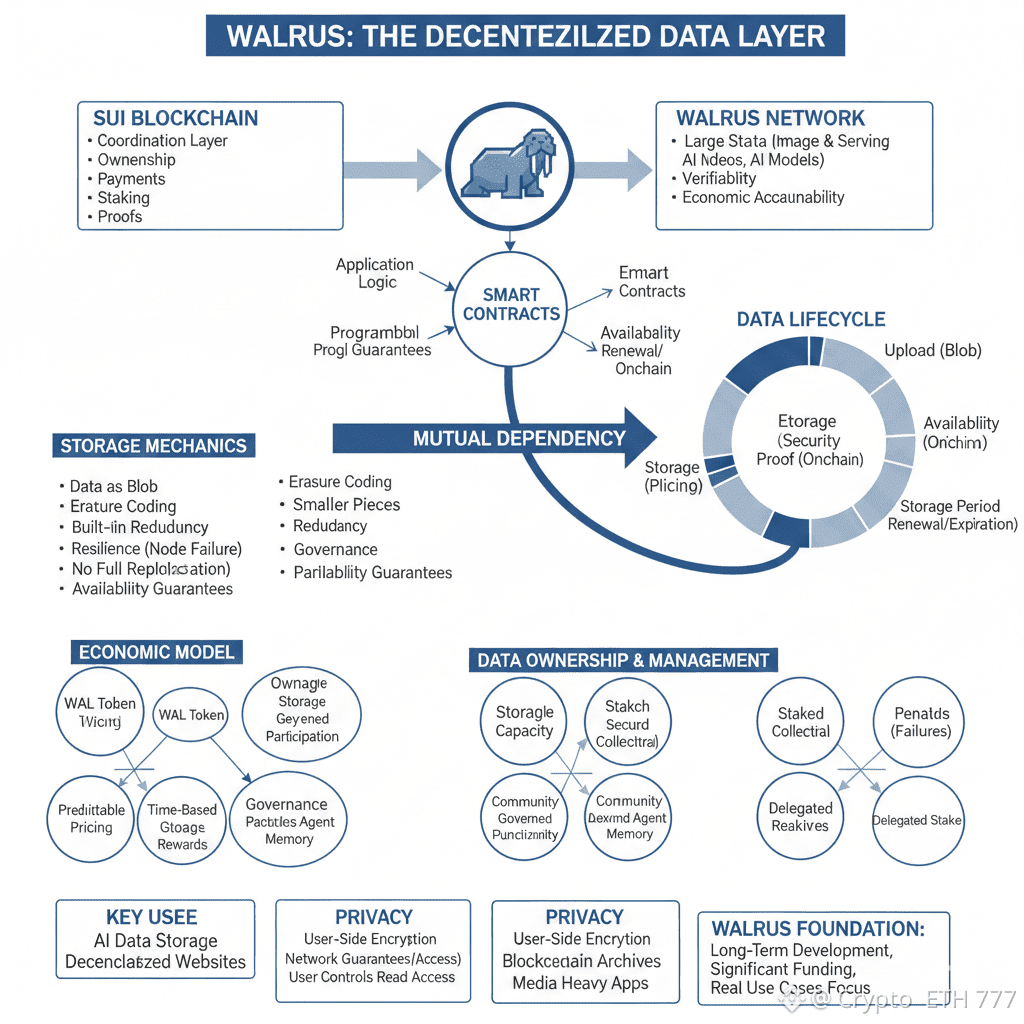
Walrus was designed to remove that weak link by giving decentralized systems a way to store large data without sacrificing verifiability, control, or economic accountability. Instead of forcing blockchains to do what they were never built for, Walrus separates concerns in a practical way.
The Sui blockchain acts as the coordination layer that handles ownership, payments, rules, staking, and proofs, while Walrus focuses purely on storing and serving data at scale. This division allows each layer to do what it does best without compromise.
When data is uploaded to Walrus, it is treated as a blob and transformed through erasure coding into many smaller pieces with built in redundancy.
The idea is simple even if the math is not. The network does not need every piece to survive in order to recover the original file. Enough pieces are sufficient, which means the system remains resilient even when nodes fail or go offline.
This approach avoids the heavy cost of full replication while still providing strong availability guarantees. Storage in Walrus is not passive. It has a defined lifecycle enforced by economic rules.
Users pay for storage for a specific period, and the network commits to keeping that data available for that duration. An onchain proof confirms that commitment, allowing applications to verify availability directly through smart contracts.
This changes how developers think about storage. Instead of trusting an external service, they can program against guarantees.
Contracts can automatically renew storage, restrict access when availability expires, or tie data usage to governance and payments. Storage becomes part of application logic rather than an invisible backend. Walrus also treats storage capacity as something that can be owned and managed.
Space can be allocated, transferred, split, or merged, making it possible to build applications where data ownership, access, and hosting are inseparable.
This opens the door to community governed datasets, decentralized media platforms, and autonomous agents that maintain long term memory without relying on centralized infrastructure.
The network is secured by storage nodes selected in epochs and backed by stake. These nodes are rewarded for reliable performance and penalized for failures, creating real economic pressure to provide consistent service.
Users who do not want to operate nodes themselves can delegate stake, aligning their incentives with operators they trust. The WAL token sits at the center of this system. It is used to pay for storage, to secure the network through staking, and to participate in governance.
A key design choice is the focus on predictable storage pricing so applications can plan costs without being exposed to extreme volatility. Payments are structured so users buy storage for time while rewards are distributed gradually, supporting both usability and network sustainability. Staking WAL is not just about yield but about responsibility.
Poorly performing operators risk penalties, while reliable ones earn trust and rewards over time. This pushes the network toward quality rather than superficial growth. Walrus is supported by a dedicated foundation and significant funding aimed at long term development rather than short term hype.
The emphasis is on real use cases such as AI data storage, decentralized websites, blockchain archives, and media heavy applications where availability and integrity matter.
Privacy is handled through user side encryption, meaning the network guarantees storage and access while users control who can read the data. Walrus does not promise instant success. Like any infrastructure, it must earn adoption through usefulness.
Competition is real and decentralization must remain meaningful as the network grows. What makes Walrus compelling is that it accepts a simple truth many systems avoided. Data is the missing layer of decentralized applications.
If blockchains are meant to support complex, data rich systems, storage must be as programmable and trustless as the contracts that depend on it. Walrus is built on the belief that once developers experience that alignment, going back to centralized storage will feel like a step backward.